

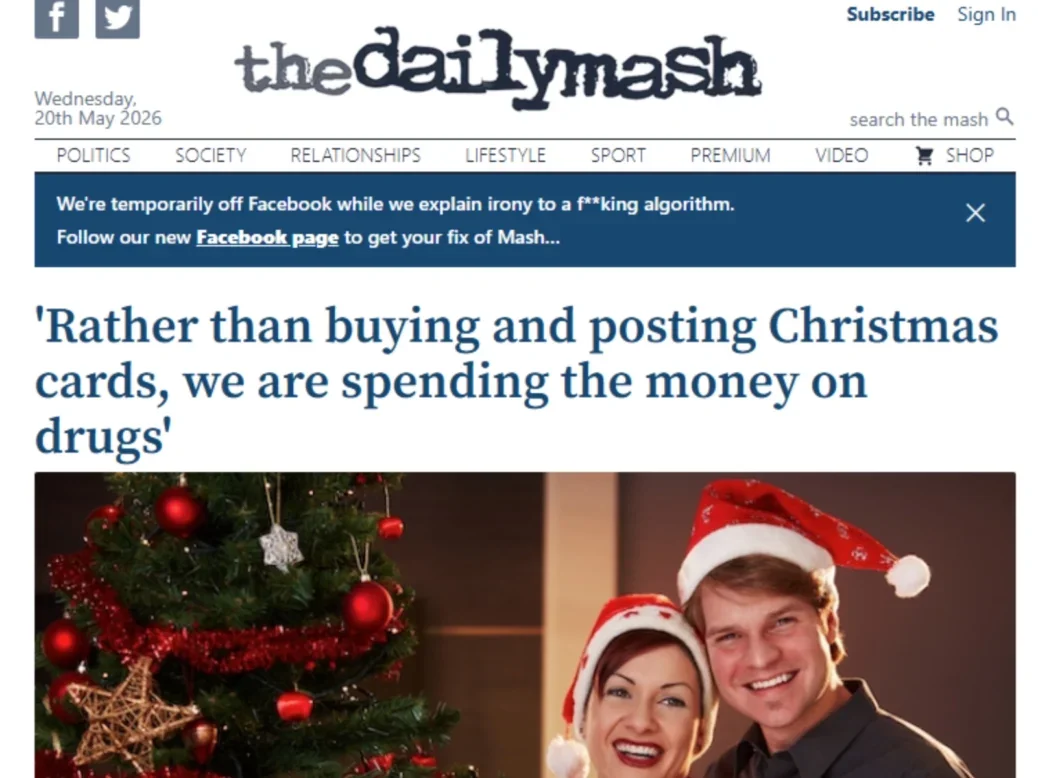
Satirical newsbrand The Daily Mash has been banned from Facebook for almost four months after the platform “struggled to understand humour”.
The Daily Mash, owned by publisher Digitalbox, had its page with one million followers completely removed from Facebook on 1 February after three posts were flagged for a supposed breach of community standards.
The stories were:
– Six ways to get through three weeks of Jubilee wank (which mentions drugs in two paragraphs)
– Women allowed to take cocaine if it ruins their life and they beg for forgiveness, says Daily Mail
– ‘Rather than buying and posting Christmas cards, we are spending the money on drugs’
Each of the stories were years old and had previously been posted without issue to the Facebook page, but when they were each posted again starting in December they were flagged as a breach of Facebook’s community standards on drugs.
The Daily Mash was told the posts were:
– Selling or promoting any highly addictive, non-medical or psychedelic drug
– Giving instructions on how to take drugs
– Selling or promoting equipment used to take drugs
Press Gazette reported earlier this week that Iliffe Media title Newbury Today had the reach of its Facebook page restricted, and monetisation cut off, due to a post linking to a court story about a drug-driver being sentenced. Since then, fellow Iliffe title Stratford Herald had a post about an RSPCA appeal for a dog looking for a home taken down for a supposed breach of community standards as it “may buy, sell, promote or exchange live animals or animal parts”.
If a user attempts to visit facebook.com/thedailymash, they see a page that states: “This content isn’t available right now. When this happens, it’s usually because the owner only shared it with a small group of people, changed who can see it or it’s been deleted.”
This is despite the fact the page had been verified and registered as a satirical news source. The Daily Mash has attempted to explain this to Facebook via appeals since February but has made no progress. Facebook did not respond to a Press Gazette query about this case.
Editor-in-chief Tom Whiteley said “an algorithm deep within Meta confirmed these posts were not feeble attempts at humour but sophisticated and oblique attempts to sell drugs”.
He added: “If we can’t mention illegal drugs in any capacity, discussing the policies of the Green Party on Facebook is going to be impossible at the next election.”
Digitalbox chief executive James Carter told Press Gazette: “What I’m absolutely sure about is the one million people that chose to follow The Daily Mash would like to see The Daily Mash content, and I don’t think they would approve of Facebook saying you cannot receive this content any longer… Mash content makes people laugh. It’s highly engaging. It effectively makes the platform money by keeping people stickier on its platform.”
He added that the lack of response from Facebook appeared to show “they’re not really that bothered”.
Carter also said: “Whilst AI tools clearly have a place in society, it would appear that Meta’s algorithms have plenty to do in order to become sentient. Whilst – in our case – they have clearly struggled to understand humour, it does pose a much bigger question about how the ‘gatekeepers to the internet’ deploy totally unqualified moderation services to control the information we all see. ”
The Daily Mash has had previous issues with Facebook, reporting in 2021 that its “increasingly sensitive” algorithms were flagging content around the Covid-19 pandemic and the 2020 US presidential election.
Carter told Press Gazette the Facebook ban is not a direct hit to revenue via referral traffic and advertising because The Daily Mash pivoted towards subscriptions and now has almost 5,000 people paying £30 a year for full access to its site.
But, he said, “turning off the oxygen to reach potential subscribers does cause a problem”.
The Daily Mash website is currently advising users to visit a different Facebook humour page with 119,000 followers to get its content on the platform. A banner on the site explains: “We’re temporarily off Facebook while we explain irony to a f**king algorithm.”
Another publisher separately having issues on Facebook is DC Thomson, which has had engagement monetisation blocked for its three biggest pages (The Courier, The Press & Journal and The Evening Express).
In that case it was not due to any content that had been posted but happened after Facebook asked for business documents to verify the identity of the page for monetisation purposes. The publisher was first told it had issues with “account integrity” and now “unusual activity”.
Email pged@pressgazette.co.uk to point out mistakes, provide story tips or send in a letter for publication on our "Letters Page" blog
