

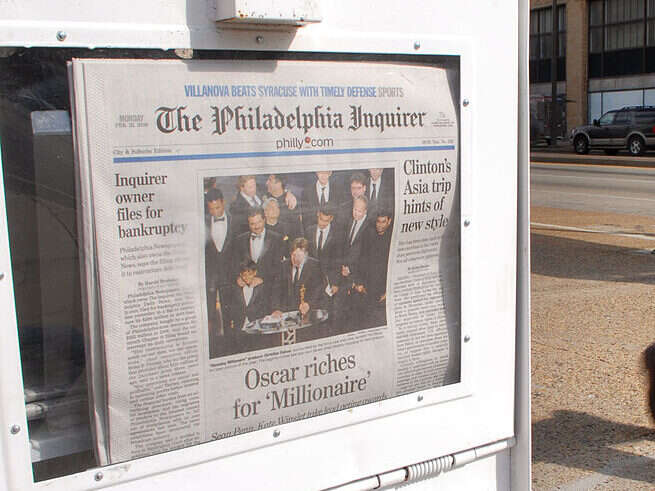
The CEO of the Philadelphia Inquirer has revealed how one of the oldest daily newspapers in the US came back from bankruptcy to turn its first profit last year in more than a decade.
The title was bought by its creditors in 2010 after it filed for bankruptcy and was then acquired by businessman Harold Fitzgerald “Gerry” Lenfest in 2015 who placed it into the hands of the non-profit Lenfest Institute for Journalism.
Earlier this year The Inquirer revealed that 2025 saw it achieve revenue growth for the first time since 2004 and an operating profit of “several millions”.
CEO Lisa Hughes told Press Gazette: “This is not just a charitable entity. This is a business that has to succeed as a long-term sustainable business.”
Lenfest “figured out a novel tax structure” to establish the Lenfest Institute as a nonprofit owner of a for-profit newsroom – a set-up Hughes believes was the first of its kind in the country.
“I don’t have to return a profit to a hedge fund or to a board of shareholders. I just have to be in the black, and then we can invest anything we make back into the business. That’s a great gift.”
In the time before Lenfest’s takeover, the Inquirer was mostly dependent on advertising for revenue, but by 2016 51% of its revenue was from subscribers and around 41% from ads.
In 2024 the Lenfest Intitute gave the Inquirer a cash grant of $7.8m, according to the former’s tax filings, to “transition from a traditional printed newspaper to an economically sustainable, primarily digital, equitable news enterprise”.
Today the 197-year-old paper, which publishes seven days a week and now sees 70% of revenue from subscribers, 20% from advertising, around 4% from oher sources (including syndication) and 6% from philanthropy.
Some 120,000 of its 170,000 paying subscribers – more than 70% – are digital-only (up from 118,000 in 2024, and 70,000 in 2022).
“You have to skate where the puck is going,” Hughes said. “It’s a nice ten years into it to say, ‘is the Gerry Lenfest model working?’ And we would say, yes.”
Digital subscriptions currently cost $21.96 (£16.12) per month for full access. The subscription offering his boosted by a deal which sees some New York Times cooking app offered free for one year.
The return to profitability has allowed the Inquirer to reinvest in expansion to South Jersey, which Hughes calls “a little bit of a news desert”.
The South Jersey Regional will be a digital daily newspaper covering breaking and trending news in the area, with six additional staff hired for the initiative. Current education and politics staff will also contribute, and the paper will be promoted through email and text alerts – similar to its hyperlocal newsletters.
[Read more: The US regional dailies proving news can pay despite Washington Post challenges]
Smaller newsroom since Lenfest invested
While a financial success, Lenfest involvement has driven a reduction in newsroom and operational headcount since 2015, with staff being “trimmed”, said Hughes.
“Since I’ve been here, we still have a nice-sized newsroom, relative to our city, a little over 200 reporters,” she added.
In 2020, the Inquirer sold its printing plant and started outsourcing its printing to Gannett. This led to more than 500 union workers – nearly half of the paper’s workforce – being laid off. Today, the company has around 403 full-time employees.
Hughes said it was “an important move” to make and that print is still a profitable section of the business – “we still think it’s an important part of our mix”.
She added the paper has a “very avid print readership”, though according to data from Alliance for Audited Media it saw its average daily print circulation decline by 15.3% year-on-year in the six months to the end of September 2025 to just over 32,000 copies per day.
[Read more: Why Philadelphia Inquirer spent a year redesigning its print offering]
16 newsletters and live events
Aside from print and website, the Inquirer has an app, a weekly sports podcast and 16 newsletters covering topics from food to business, four of which are hyperlocal.
These newsletters have 2.3 million free subscribers (50,000 across the four hyperlocal editions). The company plans to expand its newsletter offering by ten this year, followed by another ten next year.
Live events are also an important part of the strategy: “Our food festival being one of our biggest ones that we do annually with Philly’s amazing food town,” said Hughes of the paper’s event that launched in November 2025.
The event attracted 2,000 attendees at $150 a ticket. Some 40% of attendees were subscribers, with the remainder able to “experience our brand [in a way] that ushers them into a path to be a subscriber”.
Live events – which also include panel talks – and newsletters are both important for the Inquirer to convert people to becoming paying subscribers.
The Inquirer mostly runs direct-sold ads across its site and newsletters, but also operates a separate content hub called Philly First, which publishes “branded content articles written by a real journalist” and helps companies “tell their story about what they’re doing and why”, said Hughes, adding its been “enormously successful for us”.
Investment in own AI tools
Investing in the building of its own AI tools has also created more efficiency in the Inquirer’s newsroom.
One of these, Scribe, has freed up journalists to focus on hyperlocal newsletters called Inquirer Local by listening to municipal or school board meetings and flagging headlines for reporters.
“You can do this [in] 30 municipalities now, 30 school board meetings… I don’t have 60 reporters to go do that. So AI tools allow us to do that efficiently,” said Hughes.
The paper may open-source Scribe for use by other publishers, following its success in open-sourcing its back-end archive AI tool Dewey (a sort of AI librarian now used by around four other newspapers in the US).
The Inquirer covers a metropolitan area of six million people and has no competition in terms of daily newspapers.
Hughes sees its main competitors as being the likes of Netflix and other media subscription products.
“I have to be good enough for you to want to pay for our content,” she said.
“This is a tough year. We all know that there are serious audience declines across the board because of the shifts in Google‘s algorithm…But I think Gerry was a visionary, and we’re really grateful for his vision and investment, because it’s why we’re successful today.”
Email pged@pressgazette.co.uk to point out mistakes, provide story tips or send in a letter for publication on our "Letters Page" blog
