

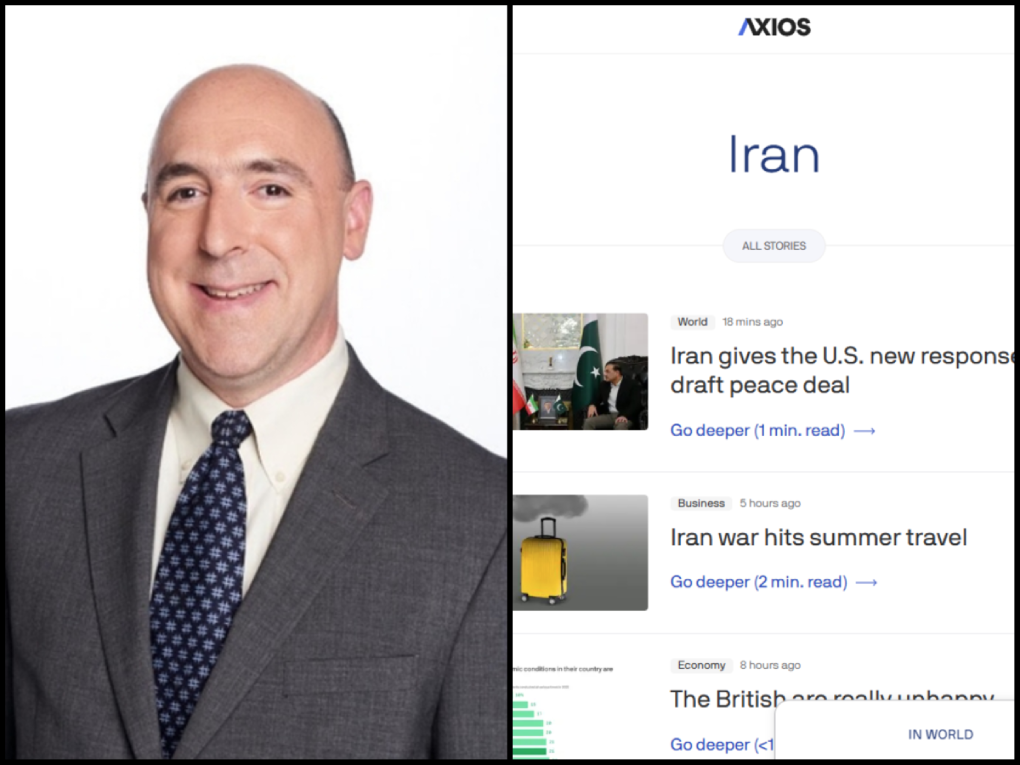
US newsbrand Axios has cut its output by almost a quarter to concentrate on adding “real value” for its high-level readers and stop chasing traffic – but page views have grown anyway.
Axios head of news Ben Berkowitz told Press Gazette’s Future of Media Explained podcast that the “less is more” strategy started at the end of last year.
“Write fewer stories… Write the things that actually matter. Don’t chase clicks. Don’t chase audience. Curate audience. Don’t just chase traffic,” he said.
He said that before this strategy change, the focus was often on traffic and writing stories based around SEO keywords.
But he said this was not what Axios was “built for, not really our core mission, and also not really the thing that served the audience best.
“Ultimately, we targeted a discerning reader, we targeted an executive reader, we targeted a reader in the corridors of power in Washington. And just writing headlines for sake of writing headlines wasn’t serving those audiences.”
Axios, which has a newsroom of more than 200 people, covers key pillars like politics, health, media, tech, business and climate using its “smart brevity” format.
It also has an expanding US local news network in almost 50 cities and a subscription-based Pro product based around exclusive M&A coverage.
Axios ‘held the line’ on output decrease despite start of Iran war
Total Axios output in Q1 compared to the first quarter of 2026 was down 22% as a result of the changes.
Page views were up 30% and page views per visitor were up 22%, according to internal data shared by the publisher. Q1 2025 contained its own major stories including mass US government layoffs driven by Elon Musk’s DOGE.
The quarter was the best Q1 for traffic since Axios launched in 2017 and its second-best quarter overall after Q3 2024.
Global affairs correspondent Barak Ravid’s page views in March were the most by a single reporter over one month in Axios history.
Berkowitz said the start of the Iran war had helped the numbers but that traffic was going in a “positive direction” even if those stories were stripped out.
Berkowitz said Ravid and colleagues like White House correspondent Marc Caputo are “breaking news every day. Let them break news. Support them breaking news. Do what we can to amplify and magnify the news that they’re breaking. That’s the real value.”
He added that because of the war, “the decrease in volume is at a time when a newsroom’s natural instincts would be to increase output dramatically. We we have held the line quite firmly.
“Output is down quite substantially and the audience is growing tremendously because we’re focusing on the stuff that matters and the stuff that our readers really want to read and the things that we do best and that we know best.”
The US and Israel launched missile strikes on Iran on 28 February but January and February were still the biggest months since the 2024 US presidential election thanks to reporting on Anthropic’s dispute with the Pentagon and reporting from the White House.
The decrease in output came despite continued expansion in Axios Local, meaning a likely higher percentage decline in the national output.
According to Similarweb, there were 32.9 million visits to axios.com in March 2026 – the highest in the past year.
Berkowitz said: “Traffic remains important. Traffic still has value. It has value in a bunch of different dimensions. But also, we are very, very mindful internally of the fact that the world is changing. The traditional fire hoses are gone or going away.”
Although breaking news may be a resilient content type amid the growth of Google’s AI Overviews, as AI summaries are unlikely to be updated as quickly as a news website, Berkowitz said it is commoditised as many journalists write the same story.
“President Trump says a thing. The stock market does a thing. Thing happens in a place. We’re built for those. We have those fast twitch muscles. We are very, very fast.
“We have a bunch of very, very good breaking news writers who can do those quick turns. Do we need to? What can we say that adds value…?”
Berkowitz said they are concentrating instead on stories where they “either have something unique, it’s exclusive, it’s a scoop, we have some unique information, or we can, from the first word, add some kind of value that will inform our audience in a way that maybe the commoditised headlines will not.”
He added that “clinical analysis” has also been a “key to Axios’s success…
“That clinical analysis that tells people not just here’s what happened, but here’s what’s going to happen next.”
Axios has made cuts to its newsroom, with Berkowitz saying they have “tightened up the news operation”.
In March, 11 staff were laid off on the news desk and visual and social teams.
Publisher Nicholas Johnston told staff in a memo that they “continue to build a newsroom of the future, tightly focused on subject matter experts and local expansion”.
He said they will “keep hiring new experts, moving people to play to their strengths, and cutting back in areas where we no longer have an edge”.
Berkowitz told Press Gazette: “What I would say is it has not been a case of fewer people made to do more work. It’s fewer people doing better work, doing smarter work. We got out of the mentality of: you’re here and you have a keyboard so you should be typing something.”
Change isn’t failure: ‘It just means the world has changed’
Berkowitz acknowledged that making changes like this is “tough” but said they have been helped because Axios still runs “like a start-up. We keep that start-up mentality of every day, something different. Just because you do something a certain way today doesn’t mean it can’t change, doesn’t mean it won’t change.
“We’re a newsroom where structures change, org charts change, reporting lines change, style changes, newsletter names change, formats change.”
He added that this means the key question is: Are we covering the right stories the right way and serving the readers the right way? And then you back the organisation into that.
“And if that means changing things every six months, you do that. But we have a culture of folks who understand that sometimes we’re going to do one thing, sometimes we’re going to do another thing, and sometimes things will change. And if you’ve been around long enough, which many of our folks have, they’ve seen evolutions and revolutions. It’s just the way we do business.”
His advice to other publishers was to “give people permission to change” and say to them that if something isn’t working anymore it’s “not my failure, your failure, our failure. It just means the world has changed and we have to adapt.”
Axios head of news says ‘business is good’
Axios, which is owned by privately held Cox Enterprises since its 2022 sale, does not share financial figures but Berkowitz said “business is good… We’re happy with the direction of the business.”
He pointed to its diversity of revenue, which includes: advertising partnerships on newsletters, the website, podcast and app, sponsored events, subscription-based newsletters, Axios Local memberships, job and event boards, and the Smart Brevity studio creating content for brands.
The “less is more” strategy is having a positive impact, he added, because it “drives quality and quality drives attention and attention drives sponsorship and sponsorship drives attendance at events. It is all a virtuous circle.
“We absolutely think about the funnel. Everything starts with getting audience attention by any means, whether it’s stories, newsletters, events, whatever, bringing them in, growing the pie, attracting more revenue, attracting sponsors, attracting advertisers. ‘Less is more’ absolutely contributes.
“Going into it, it was certainly a bit nerve-racking. How much traffic are we going to lose?… What’s that going to do? Is that going to damage the funnel? Is it going to damage revenue?
“It paid off. It always pays off. I’ve done this exercise five times now in various newsrooms over the years. Local news, national news, in English, in Spanish, with articles, with push alerting. It works every time. Once you focus on what the audience actually cares about, as opposed to chasing whatever algorithmic hit you can get, you grow the pie. And that broadens the funnel and that grows revenue. It always works.”
Berkowitz said Axios is now at the “end of the beginning” of this strategy.
“The first 20 % is relatively easy. Then you start to get into the more serious conversations about: now we’ve done less, are we doing the right things in the rest of it? Do we have the right people? Do we have the right writers? Do we have the right editors? Do we have the right structure? Are we communicating internally in the right way for maximum efficiency? Are we producing the right kinds of products – text, multimedia, et cetera?
“Those are the harder conversations and the more nuanced conversations, and that’s kind of the next phase that we’re moving into now.”
Email pged@pressgazette.co.uk to point out mistakes, provide story tips or send in a letter for publication on our "Letters Page" blog
