

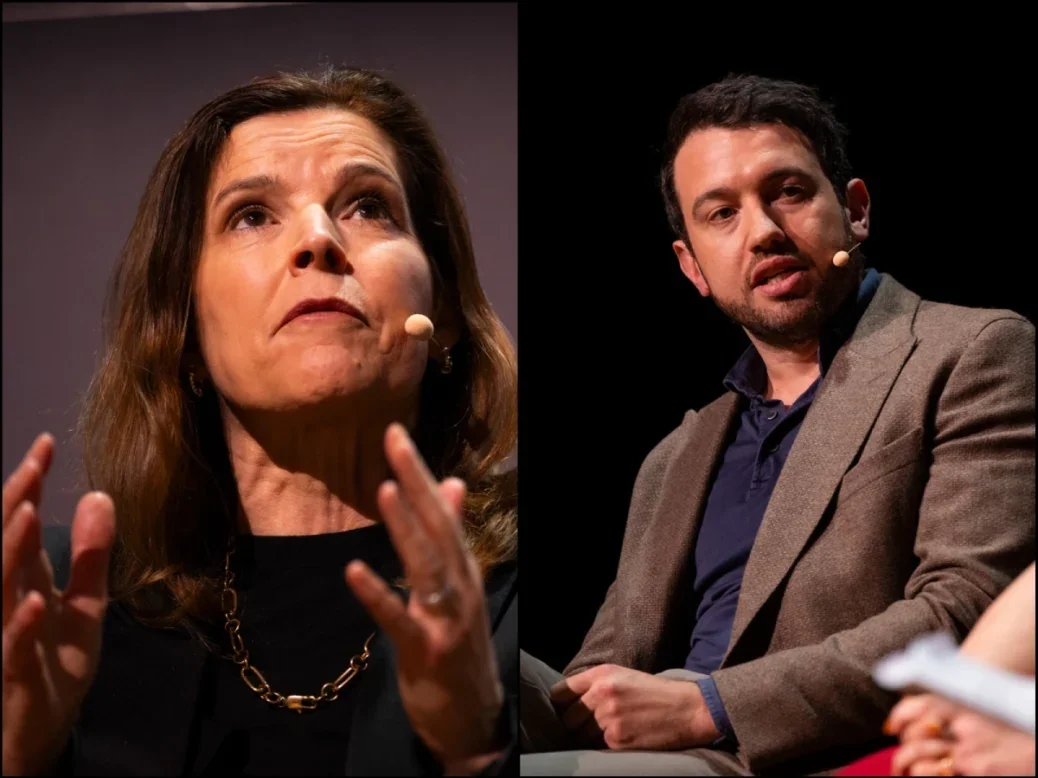
Wall Street Journal editor-in-chief Emma Tucker has said her team “ran towards the fire” with their reporting linking Donald Trump to Epstein’s birthday book – but that “at least” his legal threat came after publication and not before.
Trump attempted to claim $10bn in damages over reporting that said he had sent a bawdy birthday card to disgraced financier Jeffrey Epstein.
The lawsuit was dismissed in April as a judge found he had not proved the WSJ had acted with actual malice as required under US defamation law.
Speaking at Truth Tellers, The Sir Harry Evans Investigative Journalism Summit in London on Wednesday, Tucker joked that the story had caused “a whole world of pain”.
She said: “It’s a really good example of why the kind of journalism that we’re all endeavouring to keep alive and focus on is challenged, because it took an awfully long time. It took a huge amount of resources.”
[Read more: WSJ editor Emma Tucker on how title grew digital subs by a third to 4.3m]
She said at least 20 people were involved in the story including reporters, editors, the legal team and the standards editor, and that the story took “well over six months”.
Tucker continued: “And my point is, in a world of AI, these are the stories we have to be focusing on, the ones that tell people something they didn’t know, the ones that truly move the dial on a conversation…
“We didn’t just do the first story. We did the second story. We ran towards the fire after we published the first one. These stories require a huge amount of effort, resources and legal expertise. They are very, very expensive. You have to have deep pockets and a stiff backbone to do stories like this.”
‘What happens before you publish’ is now one of biggest challenges
Tucker said the “strong response” from Trump was “inevitable”.
But she added that “one of the biggest challenges to us now isn’t so much what happens afterwards, it’s what happens before you even publish”.
Tucker said “British journalists are probably used to this with injunctions and SLAPPs [strategic lawsuits against public participation] and all the rest of it – but increasingly it is the case that before you even get to publication, the lawsuits come raining down, a whole torrent of legal letters come your way…”
She described this as a “PR strategy” because when word of a lawsuit gets out, it places a question over the reporting in the minds of other journalists.
She continued: “Everybody gets tied up. The lawyers are busy. The reporters working on the story, instead of working on the story, they’re having to deal with the lawyers. It’s also the case that the stories that used to get dismissed by courts no longer get dismissed…
“So basically, the point is the Trump stories have epitomised how difficult and expensive these stories are, but at least the defamation came after we’d published. These days, increasingly, we’re getting legally challenged before we even get to publication.”
Tucker was asked about the extent of Wall Street Journal owner Rupert Murdoch’s involvement in the work coming out of the newsroom.
She responded: “Conversations happen, that’s normal in any organisation, especially if you’re doing something risky that might end up in a massive great lawsuit. You’re going to have conversations. But the decisions to publish are mine.”
Joshi Herrmann: Legal threats ‘big drain on our time and resources’
Mill Media founder Joshi Herrmann, who launched a newsletter-led outlet covering Manchester in 2020 before expanding into several other cities, warned later in the day that legal threats are a “big reason” stories are not reported.
Mill Media is currently fighting two libel claims, one by a businessman whose alleged dishonest conduct was reported on by The Londoner and one relating to Liverpool Post reporting that questioned why former TV historian Laurence Westgaph was hired by a major cultural institution.
“Currently, the way the laws are written in the UK allows people to bring bad faith lawsuits against stories that are true and that have been really well reported,” Herrmann said.
“I think until the Government acts and changes the law, there has been some protection put into the law about anti-SLAPP when it comes to financial [reporting], but what you really need is for that to be extended to lots of other forms of journalism, because at the moment, it is a big drain on our time and on our resources.”
‘Incredibly aggressive’ legal threat from Government special adviser
He described an “incredibly aggressive” pre-publication threat received at 7pm last Friday from the special adviser to Home Secretary Shabana Mahmood relating to a planned Birmingham Dispatch story about discrepancies between two of her postal ballots in 2004.
Herrmann said: “He threatened us with defamation, privacy and potentially an imminent injunction at the High Court to stop us publishing. I think he did that because he thought this is a small local publication in Birmingham, and I can bully them.
“And then as soon as we got back in touch and said hang on, we don’t appreciate those kind of threats, and we’re going to make your threats part of the story… suddenly he says, well, actually, it wasn’t sent from the Government, well it came from a government email. You signed it off ‘special advisor to the home secretary’. So it sure felt like it came from the Government.
“And the Government threatening to sue a small independent media company, I don’t think that’s quite right. So that is the kind of threat I know is stopping publication of important stories, particularly in local journalism across the country.”
The third paragraph of the story reads: “Mahmood’s special adviser at the Home Office last night threatened to sue The Dispatch for defamation and breach of privacy, as well as to invoke ‘injunctive relief to restrain publication’ when we sought comment from the Home SSecretary.”
Patrick Radden Keefe: Legal letters ‘designed to intimidate’
Appearing alongside Tucker was Patrick Radden Keefe, an investigative journalist for The New Yorker who said pre-publication legal threats had been a common theme in his reporting.
But he noted that although he has often written about gangsters, he only tends to get threatened by billionaires.
He said: “These letters are designed to intimidate. There are these firms that are now making a big business out of sending these letters before a piece has even been published.”
He said that when he was working on a book about the Sacklers and their links to the American opioid crisis, he received a “litigation hold” that meant he had to keep documents indefinitely, joking that it became “a small housekeeping hazard”.
“I’ve been with the same publisher for 20 years. I’ve been with the same magazine for 20 years. What happens to the person who’s earlier in their career? What happens to the person who this is their first freelance piece? What happens to the independent journalist or kind of the equivalent of an alt-weekly or a brand new magazine, when they get a letter from one of these firms. I think very often, they are intimidated. They have to be, right? It would be irresponsible for them not to think about what the consequences of such a lawsuit would be.
“The frustration is, I know the ratio of letters written to actual lawsuits brought – this is a letter writing business. These people are getting paid by the word.”

The same panel also heard from CNN chief international anchor Christiane Amanpour who said she was “concerned” by the potential takeover of her network by billionaire David Ellison, who took over rival TV newsroom CBS News last year.
She suggested CBS News is “haemorrhaging viewers, probably haemorrhaging money” with its “ideological realignment”.
Amanpour said: “I would like to think that we would have the very basics, which is editorial independence. I’m hoping for that. I know many of us at CNN, including leadership, are very, very committed to that, clearly.”
Email pged@pressgazette.co.uk to point out mistakes, provide story tips or send in a letter for publication on our "Letters Page" blog
