

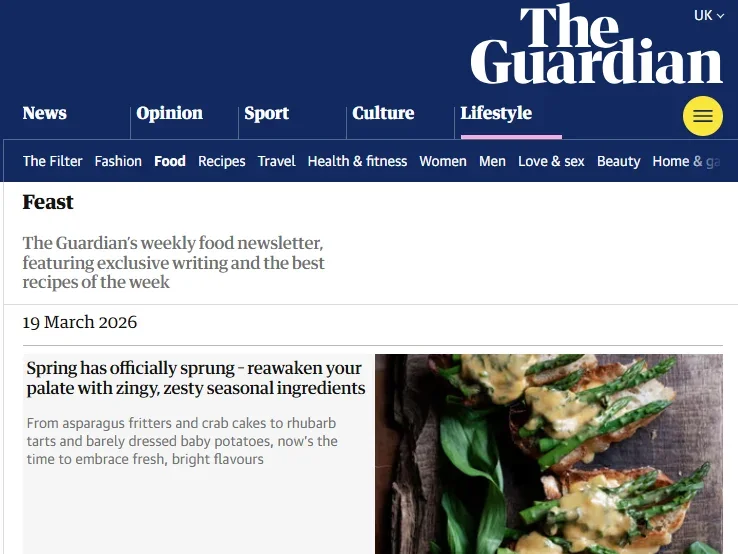
The Guardian has decided to experiment with Substack by recreating its weekly food newsletter Feast on the platform.
The Substack play is part of Project Berger, the multi-year transformation plan designed to make The Guardian “more visual, digital and experimental” as first outlined by editor-in-chief Katharine Viner to Press Gazette in October.
Feast has more than 100,000 subscribers and open rates of almost 70%, according to The Guardian.
It is one of almost 60 newsletters at The Guardian following a pivot over the past four years away from link-led automated dispatches towards authored emails with more original reporting and analysis.
In total The Guardian reports having more than five million unique newsletters subscribers.
By cross-publishing Feast on Substack, Feast can make use of social media style features on Substack like the Notes feed. Readers can now sign up for the Substack version here.
Substack also has recommendation features that mean, for example, food publishers can recommend each other to their subscribers. Some Guardian food writers, such as Yotam Ottolenghi, also have their own Substack newsletters and may be able to help promote Feast.
Toby Moses, who became The Guardian’s first head of newsletters in 2021, told Press Gazette there is a “really thriving” food scene on Substack, for example Vittles, and that it seemed like a good place to start because of The Guardian’s strength in that area. The Guardian Food Quarterly print supplement also launched in mid-March.
Moses said: “What we don’t know about Substack is, is this a new audience? Are these people that aren’t familiar with The Guardian, aren’t already engaging with our journalism? And the only way we can find that out is by trying it out.”
He added: “What I try to do with all our newsletters as much as possible is to have that back and forth with our readers, and this is potentially a different group of readers to do that with, and to do it in a slightly different way.”
A potential second stage to the experiment would be to try doing unique content for Substack. If cross-publishing works, more of The Guardian’s existing newsletters could join the platform to find new audiences.
The Financial Times also recently launched its first Substack newsletter, with a free weekly offering from its FT Alphaville finance blog designed to reach a younger audience outside the main FT website.
Sarah Ebner, then-director of editorial growth and engagement said of the launch in November: “This is a new venture for us and is particularly aimed at reaching and engaging younger readers. We know from our research that Alphaville strongly resonates with this group, and we hope to reach more of them by launching on a platform where we know they already are.”
Ebner continued: “We are also sure there are many existing Substack readers who will enjoy this new newsletter and look forward to them discovering and engaging with it. Alphaville is already free on FT.com so it should work well to also share the team’s brilliant journalism on Substack. It’s really a way of joining a successful existing product to an ecosystem that a lot of readers use to discover new content.”
The Economist launched its first newsletter on Substack in September but made this a paid subscription separate to the publisher’s main paywall with the aim of attracting people unlikely to pay for the full product.
Data journalism newsletter Off the Charts is available on Substack as well as to subscribers of The Economist through the brand’s own website.
The Economist‘s president Luke Bradley-Jones said they saw it as an “opportunity to sort of nurture more of a niche audience around a particular area of interest, which isn’t in any way going to cannibalise our core subscription base”.
He added: “We think there’s a really large potential audience on Substack who are engaged in that form of journalism, really interested in data journalism, which is a real sort of flourishing space on Substack.
“But also, when we looked at the consumption patterns of that journalism within The Economist’s base, there’s nobody just consuming that content. So they’re not going to spin down from The Economist to take out their Substack subscription. They’re consuming geopolitics, international economics, business and finance and so on.
“So it was a sweet spot where we think there’s an audience to go after, but it’s not going to cannibalise what we offer through our core subscription.”
Email pged@pressgazette.co.uk to point out mistakes, provide story tips or send in a letter for publication on our "Letters Page" blog
