

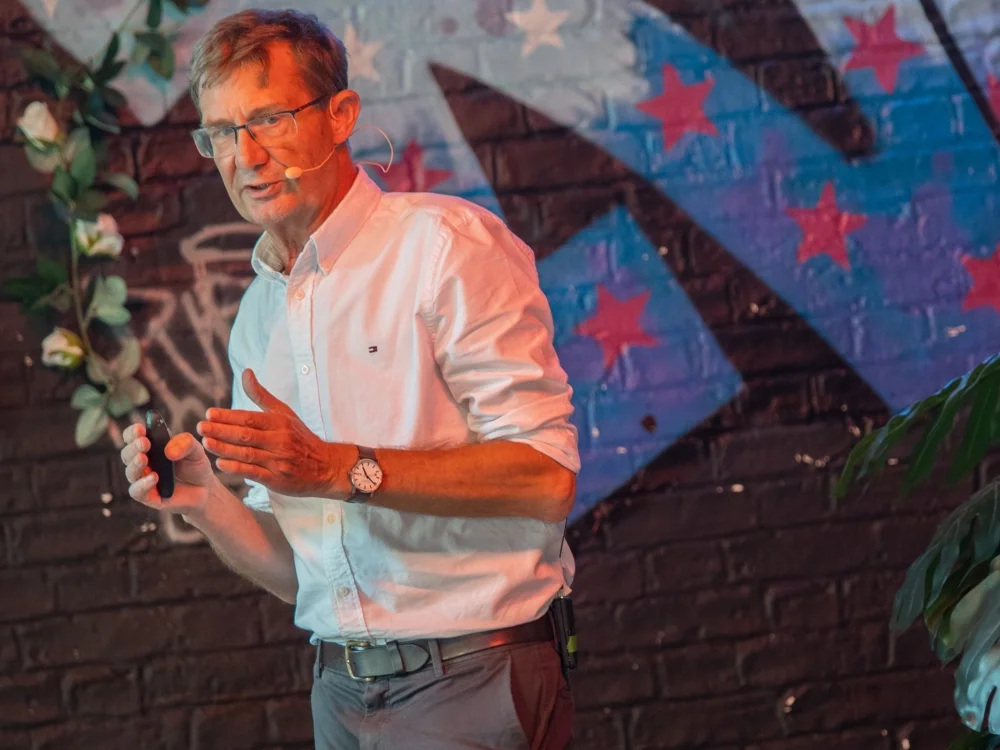
Media research expert Nic Newman has warned the ability of AI models to provide “liquid content” in different formats is a “really serious challenge” to news media.
Speaking at the Media Voices Publisher Summit in London on Thursday, Newman had a slide that said “AI can do what journalists do quicker and better”.
But the Reuters Institute senior research associate (and former lead author of the annual Digital News Report) explained publishers see their future in content that is original and distinctive.
Newman noted that chatbots like Anthropic’s Claude have “got so much more capable” at providing information and content however people want it – not just in text but also by producing graphs, for example.
He gave the example of asking Claude questions relating to the UK heatwaves, including where the UK stands in terms of air conditioning compared to other countries and previous temperature records.
Claude was able to produce information in a Q&A format, generate graphs which were filterable by different parts of the world, and show Met Office warnings.
Newman described this as “liquid content”, with AI able to recreate information in “different formats that are much more relevant personally to different audience members”. He said people like this convenience.
Newman said: “Claude delivers this stuff really quickly, really effectively, and this is becoming, obviously, a really serious challenge for news media. It makes us think about what it is that we do differently.”
Newman also said: “Content is becoming much more fluid, whether we like it or not. It’s going to be remixed in many different ways, and audiences will expect and like that level of personalisation, that they can get the content in the format that they want.”
He warned that this is going to become an even bigger risk to media as AI is increasingly asked to go away and complete tasks for users.
“This is a huge challenge already in terms of providing many of the services that traditional media provide already, let alone what’s coming next in terms of people not having to put words into a search box, but the AI agents knowing what you’re interested in and bringing it to you automatically.”
He gave the example of ChatGPT Pulse, which can digest a user’s chat history and connected apps like Google Calendar to proactively provide a morning digest without being asked to do so.
He also suggested AI will increasingly summarise publisher newsletters into a “really convenient” audio digest.
“So we’re going to see more of that. Publishers are really worried about what the impact of agentic AI might be in the future.”
The majority of 264 news leaders told Newman’s 2026 predictions and trends report that they believed “distinctiveness” will be key in this AI world.
Original investigations/on the ground were perceived as being most important, followed by contextual analysis and community building via events. Newman said “human connection” will be “really important”.
He added that there should be “less of some of the things that we’ve been doing over the last five years, so just producing general news for anybody is something that probably is going to be much more commoditised by the AI itself”.
He also cited investment in audio and video, saying text is “very easy for AI to package”.
Newman added: “I also think that it’s really important that we incorporate a lot of the capabilities of AI to make our own platforms more relevant to people”, citing on-site AI chatbots being developed by publishers including The Washington Post.
He said publishers can use prompts, such as “tell me more about air conditioning”, to “combine some of the human judgement and curation with some of that ability of AI to answer specific questions.
“So I think that combination is something we’re going to see a lot more of. Companies like Schibsted are planning to implement this pretty quickly.”
‘Authenticity and relatability’ to creator-style content
Newman described “the other big disruption” facing publishers as “the rise of personality-led journalism” and “creator-like journalism videos”.
“Some of that’s being done by publishers, some of it’s being done by individuals acting on their own, and a lot of that change is driven by what we’ve seen in social media.”
Newman cited analysis from Financial Times data journalist John Burn-Murdoch that showed social media is now much less social as people are more likely to use the platforms to follow celebrities and fill their spare time, and less likely to use it to keep up with friends or meet new people.
Newman noted that US podcaster Joe Rogan now reaches around a fifth of American adults on a weekly basis.
“Even in particular niches like technology, people like Kara Swisher have built huge influence and significant amounts of money, particularly in those bigger countries. It’s not exactly the same here in the UK, but we’re seeing a lot of the same trends.”
Explaining why people like this kind of personality-led media, Newman said “they say it’s easier to understand and more entertaining” but noted that overall people see it as “less trustworthy and less impartial”.
But, he continued, “if you talk to people who use these platforms, they think that creator-type media, creator-led media is better on all of these characteristics, including trust, including functionality. That sense that you’re seeing what you’re getting. There’s nobody hiding behind the content. There’s an authenticity and relatability about the content.”
Newman noted that many publishers are now building specific products for Youtube, citing The Guardian‘s Today in Focus: The Latest, which is a new video evening edition of its flagship podcast, and “very successful” video podcasts from Der Spiegel in Germany.
He said Wired is “creating these so-called platform personalities, so helping to train individuals to take their text content and to transfer it into content that works across platforms in a much more visual and relatable way”.
Newman told publishers they will “need to put more effort into building those opportunities… not just on our own websites and apps, but also within these other experiences on other people’s platforms, with all the risks that contains”.
He noted that younger groups are migrating towards social media, video networks and AI platforms, according to the latest Digital News Report. About half (52%) of 18 to 24-year-olds said these platforms were their main source of news, up from 40% five years ago. News websites and apps were down as the main source of news for every age group except the 55s and overs – who have stayed level compared to 2021.
Newman added: “I think what this all adds up to, and a lot of this we’ve been talking about for a long time, is everyone says we’ve got to build relationships, we’ve got to build people coming to our website and app, but… that is broadly a declining business for all sort of generational reasons… and so the model where you use newsletters, podcasts and video, and social media as a funnel to that core proposition, it’s important, and you should keep doing it, but it’s not going to be enough, and we also need to think about how we structure things like audio and video internally, because they are converging on the output side, so it doesn’t make so much sense to keep them separate.”
He continued: “The growth is really in show-based models, talent-based models, so built around a niche or an individual, and that what you’re building is fandom and habit and likability around the content, but also around the personalities, and then around that you have all these different outputs.
“You’ve seen Goalhanger adding text and newsletters and social clips and events, and then around that you’ve got all of the different ways in which you can diversify your revenue streams, and we see a lot of other publishers leaning into this sort of studio-based model, show-based model, The Guardian started Guardian Studios, for example, and you’ll see a lot more of that.
“It’s really about combining the traditional web and app model with these sort of drivers of growth, and using the trust and the leverage you have in the brand and the individuals into something that really works for growth.”
Email pged@pressgazette.co.uk to point out mistakes, provide story tips or send in a letter for publication on our "Letters Page" blog
