

The Telegraph was the UK newsbrand with the most breaches of the Editors’ Code upheld by regulator IPSO in 2025, according to its annual report for the year.
The Telegraph was found to have breached the code 12 times last year across website and print, with eleven complaints partially upheld and one fully upheld (seven on the Daily Telegraph, four on Telegraph.co.uk and one for the Sunday Telegraph).
The Express was found to have breached the Editors’ Code six times last year, but had the most complaints fully upheld by IPSO at three. Last year Press Gazette found the title had 12 breaches of the Editors’ Code upheld by IPSO in 2025 (going by date of published adjudications, as opposed to IPSO’s annual report which is based on when complaints are entered into its computer system).
IPSO’s data reported dailymail.co.uk (previously Mail Online), Daily Mail, The National and mirror.co.uk with two breaches each.
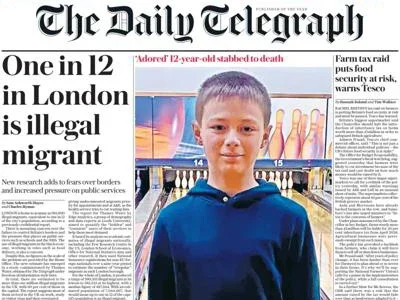
Two fully upheld complaints against The Telegraph were related to its inaccurate sums used to calculate that “one in 12 in London” is an illegal migrant. The front page article in January 2025 relied upon a study commissioned by Thames Water and obtained under freedom of information laws, and the claim was repeated in a comment piece which led to the second breach.
Reuse of the claim by the Daily Mail also led to an upheld IPSO complaint for its online piece.
IPSO regulates most of the UK’s largest non-broadcast newsbrands. Some prominent publishers have opted to self-regulate, however, including Guardian News and Media, the Financial Times, the Evening Standard and The Independent.
The most complained about title in 2025 was express.co.uk with 1,417 complaints across 234 articles.
Dailymail.co.uk trailed behind with 633 complaints across 491 articles, followed by The Spectator (469 complaints across seven articles) and The Telegraph (419 across 150).
In 2025, IPSO received 6,534 complaints, after recording 6,655 in 2024, 8,045 in 2023 and 38,658 in 2022. It took an average of 81 days to process complaints which relateed to a possible breach of the Editors’ Code, and 12 days to process complaints with no possible breach.
More than three quarters of complaints cited accuracy, one third mentioned discrimination and one in five mentioned intrusion into grief or shock.
Some 555 complaints were investigated (8.5%) with 53 of these upheld (9.5% of total investigated), while 62 (11.2%) were not. A total 193 complaints (34.8%) were resolved with the complainant. Some 191 did not receive an adjudication because they were not considered to be the lead complainant. A further 56 were not pursued by the complainant.
IPSO reported that in 68% of cases complainants were satisfied with the outcome.
Notable IPSO rulings for 2025:
- The family of British aid worker, John Chapman, complained that The Sun breached clauses of accuracy, harassment and intrusion into grief or shock. The complaint was upheld under Clause 4 (intrusion into grief or shock) after a reporter informed Chapman’s parents about a fatal airstrike in Gaza while seeking comment at their home and remaining at the property when it was likely the family would receive distressing news about their son.
- The Daily Mail was found in breach of two clauses (grief or shock, privacy) when a reporter opened a porch door without consent in search of a comment from a family following the death of the complainant’s son’s ex-partner.
- Reform UK deputy leader Richard Tice won complaints against Reach titles Sunday People and Daily Record for breaching Clause 1 (accuracy). The complaints were in relation to statements that British Steel closed its plant in Darlington “after rent hike threat” from site owner Quidnet Reit, for which Tice is a director.
- The Mail on Sunday received 123 complaints about a front-page headline saying punk rap duo Bob Vylan had “led ‘death to Israelis’ chants” at Glastonbury, but was not found to be misleading or inaccurate.
- Birmingham Live was found in breach of Clause 1 over two “actively misleading” headlines on state pensioners. One article claimed Labour was scrapping free bus passes and another scrapping the triple lock pension.
- Former MP and defence and education secretary Gavin Williamson won a complaint against Birmingham Live over an article that described a village in his constituency as the “grimmest” in the UK.
The Jewish Chronicle received 37 complaints across 36 articles and had one complaint upheld on an article claiming the Abrar Islamic Foundation supports “Iran-backed terror groups”.
In its annual report, IPSO said it worked closely with the Jewish Chronicle in the first half of 2025 following concerns about a series of articles on its website about the war in Gaza which had been submitted by a freelance journalist in 2024.
IPSO investigated the circumstance around the complaints and was satisfied the Chronicle had responded decisively when concerns were raised, acting swiftly to remove the disputed articles and publishing an apology.
The Board published a statement in April setting out IPSO’s approach to standards at the publisher.
IPSO has the power to independently conduct a standards investigation where there has been a serious and/or systematic breach of the Editors’ Code. It has to get to conduct a Standards Investigation.
Email pged@pressgazette.co.uk to point out mistakes, provide story tips or send in a letter for publication on our "Letters Page" blog
