

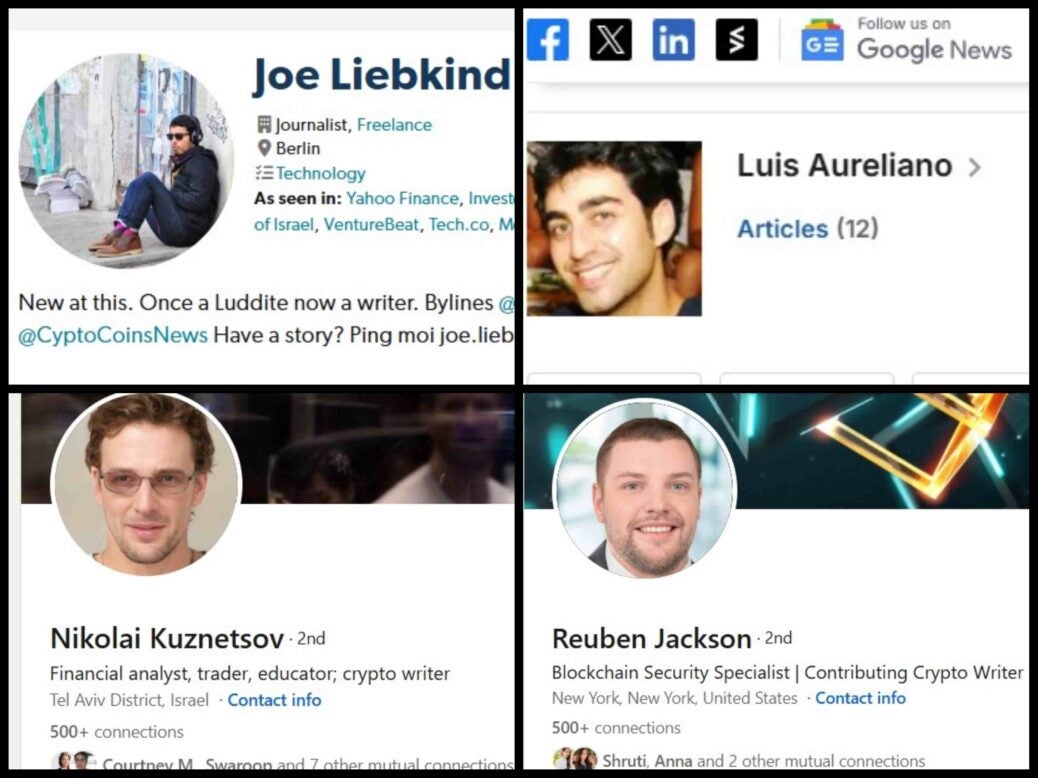
Four prolific financial journalists who cover the world of cryptocurrency have ignored repeated requests by Press Gazette to verify their identities.
Together, they have written over 1,000 articles for more than 30 different news outlets.
None of the many publications who have published their work has yet been able to verify them either despite being asked to do so by Press Gazette.
And despite purporting to be freelance journalists the four don’t advertise any way to get in touch and book their editorial services.
Press Gazette was alerted by a tipster to investigate the four and found they had sparse Linkedin profiles with AI-generated or otherwise questionable profile pictures.
The danger to publishers of employing freelance journalists without properly verifying their credentials was previously highlighted by the case of Margaux Blanchard, a freelance journalist published in Wired, Index on Censorship and Business Insider – who we revealed to be an AI-powered invention.
Press Gazette will be happy to update this article and set the record straight if any of the four get in touch.
Nikolai Kuznetsov
The most prolific of the four is Nikolai Kuznetsov who has written top-tier financial publications including Forbes, Investing.com, HuffingtonPost, TheNextWeb, Entrepreneur, CoinTelegraph and FinanceMagnates.
On LinkedIn he describes himself as being a Tel Aviv-based “financial analyst and professional trader” but his only listed work placements are freelance writing at Cointelegraph, Investing.com, TNW, Forbes and TheStreet.
His profile picture is 100% AI-generated according to Identifai and early byline pictures of Kuznetsov appear to show an entirely different person. It is believed this is a real person who currently lives in the Netherlands. Press Gazette has contacted this individual but has yet to receive a reply.
Kuznetsov has written prolifically around the crypto space, often offering general advice, but sometimes selecting specific tokens and coins to promote.
Kutznetsov’s articles have promoted a range of specific crypto coins including OPUS, NEO, QTUM and Ardo, all of which have been linked to Israeli PR firm Market Across.
Market Across desribes itself as “the blockchain industry’s leading PR firm” and profiles nearly 40 members of staff on its website.
A previous website for Kuznetsov, now archived but visible via Wayback Machine, gives his address as Bezalet Street, 5 Ramat Gan, Israel – the same address as InBound Junction, a company which has the same founders and staff as Market Across.
Kuznetsov also claims to be a black belt in Brazilian Jiu Jitsu – a hobby he shares with Market Across co-founder Elad Mor.
His earliest article was published 2015. The most recent, in 2025, promoted Paris Blockchain Week, of which MarketAcross was the media partner.
He has some 238 published news articles archived on the journalist directory website Muckrack, which also has a non-AI-generated profile picture.
When contacted by Press Gazette via LinkedIn and his supplied email address, Kuznetsov did not reply.
Reuben Jackson
Another crypto-obsessed journalist unable so far to verify their credentials is Reuben Jackson, whose bio on X proclaims: “I love dogs and believe in changing the way we do business worldwide through Blockchain and Cryptocurrency.”
He has 526 articles listed on the journalist database Muckrack, with the last cuttings published just over a year ago.
On LinkedIn he describes himself as a New York-based managing consultant: “I help organisations fundamentally redesign experiences to create new sources of value blockchain and Crypto-wise in a variety of sectors including financial services, tech, manufacturing, publishing, and non-profit organisations.”
But he has not been active on the platform in the last four years.
His X profile picture is fully AI-generated, according to Identifai – although previous images of Jackson do not carry the hallmarks of AI.

Like Kutznetsov, he’s prolific, working on Bitcoin News, Crunchbase, VentureBeat, BigThink, ReadWrite, ValueWalk and Hackernoon.
He has most recently written extensively for TheStreet – a finance brand which is part of Arena Group and attracts more than 22 million site visits per month, according to Similarweb. After authoring more than 50 articles for TheStreet, he stopped contributing in January 2025.
TheStreet has not responded to a request for comment.
One website editor, talking on condition of anonymity, said they regularly exchanged email messages with Jackson, but he never went on a video call.
The editor described him as “mysterious” and said that they wondered if he was working for a company which did not allow him to write freelance articles.
Jackson’s articles on the site Benzinga are actually tagged “Market Across”, suggesting they were promotional or sponsored content. Press Gazette has asked Benzinga to confirm the relationship.
Jackson has written multiple articles containing positive coverage of cryptocoins represented by Market Across such as TRON, Polkadot and Tezos.
Luis Aureliano
Another finance writer who has often written positively about Market Across clients is Luis Aureliano, who also has a sparse bare LinkedIn profile, with little information on his alleged career as an analyst.
Aureliano has written for Investing.com, Benzinga, ADVFN, Equities and Born2Invest.
He is billed as a “a business writer and financial analyst.”
He has more than 500 articles archived on Muckrack, the most recent published four years ago. A large number of these are sponsored editorial posts on Benzinga (but the name of the sponsor is not revealed).
On Investing.com, he says: “I religiously follow The Financial Times – dreaming to become a reporter there one day!”
Unlike the others, his profile image on Investing.com appears to be human, scanning as 0% artificially generated – but his image bears close resemblance to a chef who lives in Tel Aviv.
One article in particular promoted a highly controversial coin launch, Gladius – an interest he shares with another prolific journalist, Joe Liebkind.
Joe Liebkind
Liebkind wrote two separate pieces (for Investopedia and TechinAsia) promoting Gladius, a company which hired Market Across to “facilitate investor interest”.
Gladius was an enormously controversial crypto startup which collapsed in 2017. It raised $12.7 million through an initial coin offering but investors lost their money.
He has more than 100 article links posted on Muckrack, with the last one appearing six years ago.
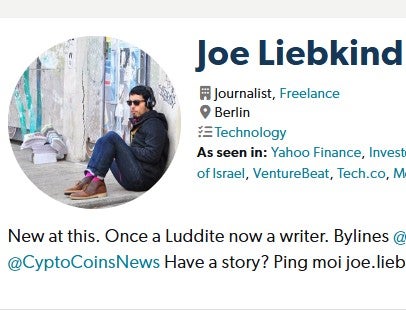
His profile image on Muckrack and X appears to have been repurposed from Flickr, and is a free-use image which has been used on Wikipedia pages for the term ‘hipster’.
In one case, Investopedia appears to have rewritten an article by Liebkind to tone down his promotion of a crypto coin, looking at archived versions of the site. Investopedia has taken down all its Liebkind-authored articles since being contacted by Press Gazette but did not respond to a request for comment. The website Tech.EU has also taken down Liebkind-authored articles after being contacted by Press Gazette.
Liebkind has also written for titles including the Jerusalem Post, Times of Israel, Tech.eu and VentureBeat.
Several dozen articles by Liebkind appeared to promote Market Across clients including QTUM, TRON, EOS, Tatau, RSK, eToro and Daostack.
Market Across
Press Gazette contacted Market Across multiple times via email and LInkedIn, and received a reply from the organisation’s managing partner, Itai Elizur.
Elizur said: “InboundJunction works with hundreds of clients and thousands of contacts across news agencies, media brokers, third‑party providers and platforms (Haro, Whitepress etc.).
“We do not employ journalists, and our employees do not operate any of the profiles you referenced. We do not hold personal contact details for the individuals you mentioned and any activity associated with them appears to be years ago.
“For context, two former InboundJunction employees are currently the subject of ongoing civil proceedings brought by the company, which include allegations of breach of contract, breach of fiduciary duty and fraud. That litigation is a matter of public record. To the extent any information reaching you has originated, directly or indirectly, from them, we would ask that you weigh that context in considering their reliability and motivations.”
Pseudonyms and anonymity are part of crypto culture
Crypto journalists have told Press Gazette that the sector is notorious for undisclosed promotional content and blurred lines between paid-for content and editorial.
One crypto journalist who did not want to be named said that the appearance of the four journalists coincided with a boom in Initial Coin Offerings in the years from 2016 to 2019, where cryptocurrency companies could raise large amounts of investment without the regulations that traditionally accompany investment rounds.
Jasper Hamill, former tech editor at The Sun and Metro and founder of the independent tech news startup Machine, said: “I would never trust a crypto influencer without strong evidence of their provenance. We’ve seen so many major scams over the years that anyone who suddenly appears online and starts aggressively promoting a coin or investment opportunity is naturally going to raise alarm bells – even if they appear convincing and authoritative on the surface.
“One of the biggest giveaways of a fake influencer is the lack of a real history. Alarm bells should ring when somebody appears out of nowhere with no credible background, real industry footprint, or evidence they existed before they started promoting crypto online. AI-generated profile pictures and a lack of genuine on-camera appearances can also be warning signs.
“It would be shocking, but not necessarily surprising, to discover networks of fake influencers operating in crypto. After all, we still do not know the true identity of [Bitcoin founder] Satoshi Nakamoto, so pseudonyms and anonymity have always been part of the culture.”
Email pged@pressgazette.co.uk to point out mistakes, provide story tips or send in a letter for publication on our "Letters Page" blog
