

An internet hoaxer calling themselves Andrew Frelon has claimed responsibility for the fake (likely AI-generated) freelance journalist Margaux Blanchard.
Andrew Frelon is itself a pseudonym and their claims have to be treated with a high degree of scepticism.
The author of a Margaux Blanchard X account, which emerged to protest the author’s innocence after Press Gazette exposed Blanchard as a fake, has said that they are Andrew Frelon.
Meanwhile, an editor for City AM has tracked down another fake freelance journalist who used AI and a pseudonym to Nairobi.
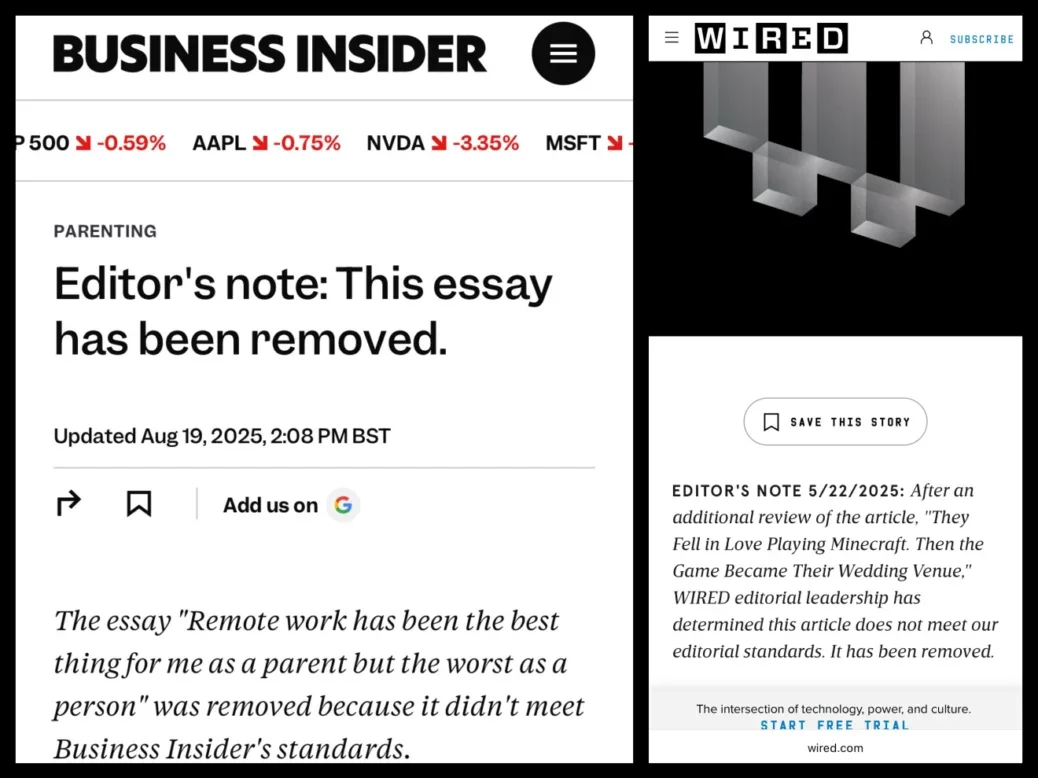
Wired removed the Blanchard article, about weddings being held in online spaces like Minecraft, within days of publication in May after the writer asked to be paid in an unusual way. The tech publication has now said it “did not go through a proper fact-check process or get a top edit from a more senior editor”.
Five other publications also removed Blanchard articles after Press Gazette concluded they were fictional.
Business Insider has now removed further first-person pieces by other authors over concerns about their veracity.
Who is Margaux Blanchard?
Days after Press Gazette published its investigation, an X account in the name of Margaux Blanchard appeared.
The profile and header images for the account appear to be AI-generated – and show a very different woman to the one connected to Blanchard’s Gmail account and seen by multiple editors who received her pitches.

A long direct message sent from the Blanchard X account to Press Gazette was identified as being AI-generated with 99% certainty by online AI detector Pangram. Other shorter messages from Blanchard were identified as being human-written.
“Blanchard” first denied the allegations that her work was written by AI, then argued that freelance journalists “often use pen names”.
They then wrote to Press Gazette: “my real name is andrew frelon,” although Frelon’s real name is Tim Boucher, a web platform safety and policy issues expert based in Quebec according to Canada’s CBC News.
On the same day (Saturday, 30 August) that this message sent, a post was published on Frelon’s Medium page with a different picture of the same woman in the main image on X.
In the post, Frelon claimed he had perpetrated the Blanchard fraud to provide a “major media client” with “actionable data” to answer the question of whether a “fully autonomous AI system [could] produce credible news stories of sufficient quality that they could be sold to top-tier outlets”.
He described setting up an agentic AI system that could find emerging trends – or invent them – and draft and send pitches “mostly without intervention”.
But the post was tagged “satire” and “fiction”.
Velvet Sundown AI band hoax
“Frelon” made headlines in July when he set up an X account purporting to represent the AI-generated band The Velvet Sundown and spoke to the media without the knowledge or permission of those actually behind the music group.
An initial mea culpa by Frelon explained that he was running the fake X account and outlined his interactions with the media, including a phone interview with Rolling Stone that made it to publication.
The music magazine brand subsequently published an update above the interview stating: “The pseudonymous Andrew Frelon, who spoke to Rolling Stone on Wednesday as a spokesperson for the viral AI band Velvet Sundown, and runs a Twitter account that purports to represent the band, now says in a Medium post that he was running an elaborate hoax aimed at the media.”
In a later Medium post, tagged “satire”, Frelon also claimed responsibility for whole Velvet Sundown AI music project. But CBC News, which said it had verified Frelon’s identity using screenshots and a Signal video chat before later revealing his true identity to be Tim Boucher, noted that the true creator of the band “remains a mystery”.
Boucher told CBC News: “I want to be able to show people a bit of what that’s like — this feeling of having to determine what’s real, and having to determine is this right or is this wrong, or having to make all these really weird decisions that for some reason are your problem, or your responsibility.”
Boucher has previously spoken about receiving backlash for “writing” 120 books using AI, proposing an AI Bill of Rights to the Canadian Government and creating fake archival references and backdated articles about a made-up art group across the internet.
City AM Magazine editor uncovers ‘AI rogue reporter’ based in Nairobi
City AM Magazine editor Steve Dinneen told Press Gazette on Friday he received a pitch from Blanchard in July about “the rise of silent dance parties doubling as fitness classes… But here’s the twist: I’d position it as the new status symbol for the wellness-obsessed and burnout-weary.”
Dinneen sometimes posts a callout asking for “weird features ideas” from new writers who don’t realise that City AM Magazine, unlike the main newspaper, is not a business publication.
But he said those callouts are increasingly receiving “waves of unusable stuff – not all of it AI, in fact the vast majority of it written by people, but just completely unusable.
“And now we’ve got AI being added into that mix as well. So it’s just another difficulty in sifting through the pitches for the odd nugget of gold… I think it does make you retrench and go again to the people that you’ve worked with before and trust and know that they’re not going to use AI to generate their pitch, not going to use AI to write the pitch, which is sad, because then you end up without new voices, and eventually that’s going to become a problem.”
Dinneen has recently uncovered a separate journalist writing using AI under a fake name, publishing his findings last week.
He discovered that a US-based writer called Joseph Wales was in fact a man based in Nairobi called Wilson Kaharua.
Kaharua, under the name of Wales, had sent Dinneen two pitches: one about the “bizarre, hyper-relatable trend of bed rotting — Gen Z’s viral obsession with spending entire days (or weekends) marinating in bed, scrolling, snacking, and fully embracing inertia”, which Dineen ignored because it was so “anodyne”, and one about “London’s fried chicken wars” to which he did respond to find out more.
But Dinneen told Press Gazette there were “lots of weird lines” in their email exchange that were “quite obviously not the kind of thing that a human would write”. For example, Dinneen flagged lines like “Think The Sopranos meets Kitchen Nightmares, with a side of peri-peri” and “Let me know if you want me to go undercover (with extra fries)”.
Dinneen told Press Gazette: “Even six months ago, I think these pitches would have been very, very easy to spot. But I got about 300 responses to the callout on social media for features, and by this time, this was one of the middle to late pitches that I was reading, and my brain was dead, so I didn’t immediately spot that it was AI. I saw a pretty good pitch, and it wasn’t until maybe the third email back and forth that I started to be like, wait, this doesn’t look legit.”
Dinneen managed to track down Kaharua to Nairobi and interviewed him over video call.
Kaharua told Dinneen he paid to subscribe to a service that would alert him to callouts for pitches and then he generated pitches using AI – Deepseek in this case – to respond.
“If you were not smart enough, it would have gone through,” he told Dinneen. “I have to try. I’m not a scammer, I’m just doing what I have to to survive.”
Kaharua told Dinneen he would have written the chicken shop story as best as he could if it had been commissioned, researching it online and using the help of relatives in London. But Dineen pointed out that places mentioned in the pitch, such as a branch of Chicken Cottage in Stratford, did not exist.
Dinneen said that a story written by Kaharua for a website called I Have That On Vinyl, which has since been taken down, used “some of the telltale signs of AI – em dashes, bullet-pointed lists, words bolded up”. These signals were also seen in Kaharua’s emails.
Kaharua had previously been paid to write for big copywriting agencies, with pay that went further in Nairobi than it would have done in the UK. After the rapid improvements made to generative AI in 2023 when ChatGPT launched, he had to change his angle.
Dinneen also asked how Kaharua had managed to get paid when his byline didn’t match his bank account and he explained that some companies paid him in crypto while for others he used a fake drivers’ licence bought on the dark web and a Paypal account registered under the name Joseph Wales. He also has a US phone number on his CV for which he pays $3.99 a month.
Email pged@pressgazette.co.uk to point out mistakes, provide story tips or send in a letter for publication on our "Letters Page" blog
