

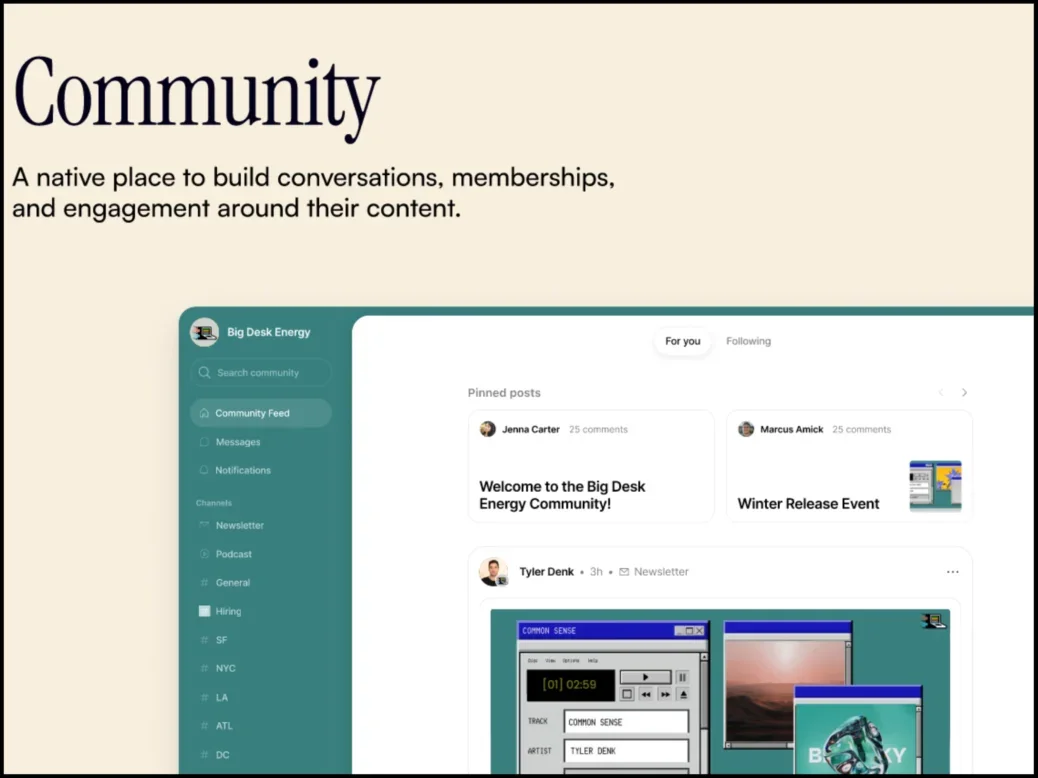
Newsletter and website hosting platform Beehiiv is adding features to help publishers and creators build communities around shared interests.
Beehiiv is also launching programmatic advertising, which has been pushed for by some of the large publishers using the platform.
The new community features mean publications will be able to create what are essentially their own discussion hubs, with the capability for users to post, reply and direct message each other on a main feed as well as specific channels. The idea is to go beyond the traditional comment sections for individual posts.
Unlike Substack, Beehiiv does not have its own app creating a wider network of readers and publications.
Beehiiv chief executive and co-founder Tyler Denk told Press Gazette: “Overwhelmingly, community has come up for the past 12 months as something that people wanted more of, everyone from content creators to even large publishers that we work with.”
[Read more: CEO sets out the case for Beehiiv versus Substack]
Publishers such as Time, Techcrunch, Newsweek, Sinclair and the Boston Globe host newsletters on Beehiiv as well as many smaller brands and individual creators. Some of the best known journalistic brands on Beehiiv include The Nerve (of which Carole Cadwalladr is one of the co-founders), Breaker (a media newsletter led by former Daily Beast editor-at-large Lachlan Cartwright) and Catherine Herridge Reports.
Denk said publishers “want to find and create a space where their audience can engage with one another and create different community experiences, both IRL and virtually… community is kind of this missing piece that people want more of.
“I think with AI, it actually becomes even more important. I think more people crave this human-to-human interaction… to have this community that you can go to with a shared experience and shared interest in something.”
Beehiiv wants to compete with major community platforms
Some creators on Beehiiv had already built a free or paid community but had to use other third-party platforms such as Facebook groups, Discord and Slack in order to do so. Denk said this could mean “technical complications” for syncing up with paid newsletters, separate costs, and a different user interface which is “inconsistent for both the user and the audience”.
Denk said Slack is more of a workspace tool and is expensive, while Discord was “was built primarily for gaming, and it’s just a whole different paradigm of how they feature content”.
Asked about the risks of hosting everything in one place, as Beehiiv also has newsletters, podcasts, websites and other products, Denk said some other platforms don’t make it easy to move paid subscribers and other data to another site.
“I think there’s a lot of value in having everything in one platform for ease of use, a single subscription, all of the integrations… but we have to earn the right to have that customer, and if we don’t do that, and they think that they could be served somewhere better elsewhere, we want to facilitate that, and so data portability is huge for us.”
[Newsletter market in 2026: $10 per month is default price but not ceiling]
Denk said Beehiiv now has a “very aggressive six to eight month roadmap to make this very, very competitive,” for example users will be able to create different segments of their audience based on who is engaging in the community and enrol them in automated campaigns, such as sending an email to upsell them to a higher subscription tier if they comment three times.
Publishers want higher programmatic ad rates and visual editing tools
Among the other features being added at the same time as community is programmatic advertising. Currently publishers can browse available inventory in Beehiiv’s ad network and choose what they want to put in their newsletter, collectively earning $1m per month.
“Now you can just put in a programmatic ad block, and we will automatically fill it with the best option for your audience at the highest payout, so kind of like putting it on autopilot and just being able to fill ad slots automatically for publishers, which is more akin to Liveintent and some of the other programmatic ad solutions in email,” Denk said.
He added that the addition of programmatic ads was “very much driven by large publishers” who want to receive “higher rates” from a “higher quality ad unit” compared to some legacy platforms.
Publishers also pushed for the launch of a visual editor, also newly announced, which means users can see what a post will look like as they are writing and editing it without needing to click into preview mode, as well as collaborative editing and more customisation options.
Beehiiv also added podcast hosting and monetisation to its platform in April. Denk said 50% of people who have adopted Beehiiv podcasting were existing users who already had podcasts on other platforms, showing that they wanted to consolidate them into one place. A quarter were existing users who launched a podcast from scratch while the final quarter were new users who brought their email, website and podcast to Beehiiv from another platform.
Denk said video capabilities and programmatic podcast advertising will both be added later this year.
Beehiiv also recently added an MCP (Model Context Protocol) which means users can connect their accounts to AI tools like Claude and ChatGPT’s Codex to generate insights and complete tasks on their behalf. Denk suggested users might ask questions like: “What are the trends in my newsletters? Who are the most engaged readers? What subject lines work best?”
Beehiiv is now upgrading this with Copilot, which puts an AI assistant directly in the platform. “The big thinking there is how do we have our publishers and users spend more time creating content and all of the other tasks around that?” Denk said, as opposed to non-content tasks.
Email pged@pressgazette.co.uk to point out mistakes, provide story tips or send in a letter for publication on our "Letters Page" blog
