

A “misleading” Home Office booklet that appears to suggest taking pictures of people in public without their consent is wrong could lead to “increased hostility” towards journalists, according to the National Union of Journalists (NUJ).
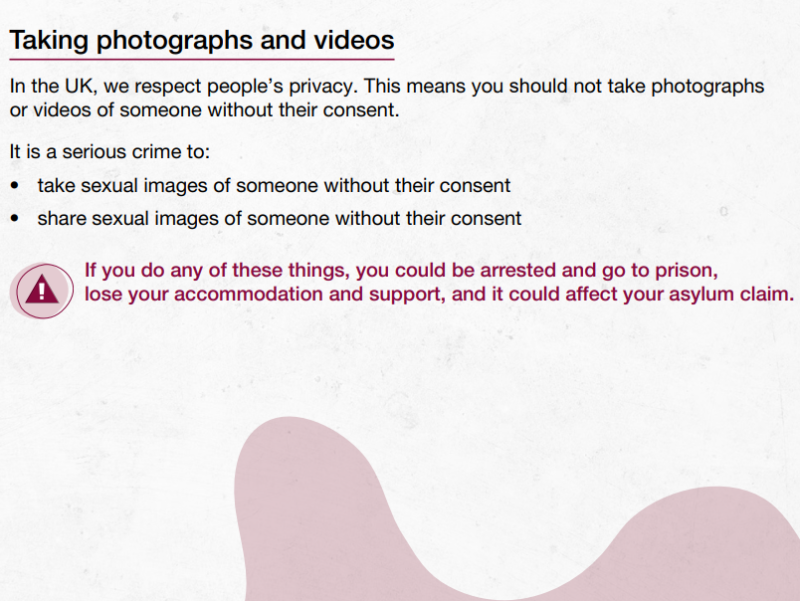
The nine-page booklet was published by the government as a guide for asylum seekers. Titled “Understanding behaviours and expectations in the UK”, it suggests taking photos in public without consent could result in a prison sentence for the photographer.
It made headlines for its content on sex and consent after being widely shared and criticised on social media.
Under a section titled “Respect in public” and “Taking photographs and videos”, the official booklet claims: “In the UK, we respect people’s privacy. This means you should not take photographs or videos of someone without their consent.”
The booklet correctly states that it is a crime to take or share sexual images of someone without their consent, but fails to make a clear distinction between this and more generally taking photos of someone without their consent in stating: “If you do any of these things, you could be arrested and go to prison…”
The NUJ has said the booklet risks spreading confusion and could result in its members facing “increased hostility and harassment as well as wrongful accusations of criminality and unjustifiable stops by the police”.
Guidance could ‘inhibit public interest journalism’
Journalism often requires photographing people in public without their consent, for example when attending court. There is no law against taking someone’s picture where they do not have a reasonable expectation of privacy, whether they consent or not.
Exceptions for harassment and images of a sexual nature, such as upskirting, apply. Police also have the power to detain someone taking photographs and view the images if they reasonably expect that person to be a terrorist.
In its advice on photography, the Met Police website states: “Members of the public and the media do not need a permit to film or photograph in public places and police have no power to stop them filming or photographing incidents or police personnel.”
The NUJ has said it will write to Home Secretary Shabana Mahmood to raise its concerns. The booklet’s advice has now gone far beyond its intended audience, with coverage on BBC News bulletins, social media, and newspaper headlines.
Séamus Dooley, NUJ assistant general secretary, said: “This communication not only runs the risk of misleading asylum seekers, it could also have serious consequences for our members – particularly photographers and videographers who regularly carry out their work in public places.
“It also spreads public confusion that could serve to inhibit public interest journalism. Press photographers and other lens-based journalists perform a legitimate and important function in reporting and recording events in public spaces.
“The union is very concerned that the spread of inaccurate information around the right to photograph and film people in public without permission could expose our members to increased hostility and harassment as well as wrongful accusations of criminality and unjustifiable stops by the police. This would undermine journalists’ right to report and the public’s right to know.
“The NUJ urges the government to amend its publication and will be writing directly to the Home Secretary to raise this issue.”
A Home Office spokesperson told Press Gazette: “We expect everyone who comes to the UK to abide by our laws. If they do not, they will face consequences, including the refusal of their asylum claim and removal from the UK. Returns of failed asylum seekers have reached their highest level since 2010 under this Government.”
The NUJ launched an online Journalist Safety Tracker in November 2024 to compile evidence of abuse aimed at journalists in the UK and Ireland. In its first year, the tracker received 32 reports of abuse from 26 journalists, including 18 physical attacks.
[Tim Dawson: Tracking abuse of journalists makes us all safer]
When asked who was responsible for the abuse, 15 reports stated an “organisation”, ten blamed members of the public, five said it was anonymous, and two pointed to the police. Most reported incidents occurred in Greater London.
The physical attacks included two reports of sexual assault, six reports of stalking/harassment, six of verbal abuse, and two cases of people being arrested.
The actual number of incidents of abuse towards journalists is far higher. When the NUJ surveyed its members in January this year about the tracker, almost half (71) of the 151 respondents said they had experienced abuse during the course of their work.
The NUJ said at the time: “It is clear that journalists in the UK are the targets of ‘shocking’ abuse and harassment both online and in-person, restricting their ability to do their work, and, consequently, freedom of the press.”
Email pged@pressgazette.co.uk to point out mistakes, provide story tips or send in a letter for publication on our "Letters Page" blog
