

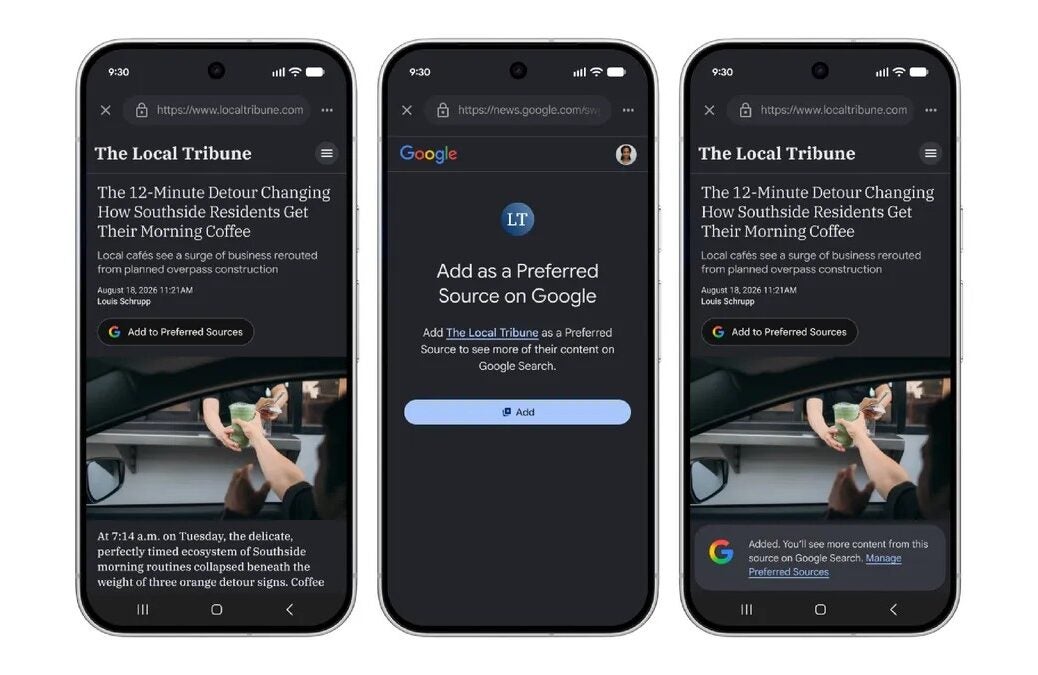
Google has added a new feature enabling users to pick a newsbrand as a “preferred source” in search results with one click while reading one of their articles.
The preferred sources feature, rolled out worldwide in English late last year, gives users more control over which news sources appear in their search results, including for AI summaries.
Users can curate the sources Google draws on for its Top Stories section, which includes snippets from news websites on articles related to key search terms, as well as for generating its AI Overviews and responses in AI Mode.
Readers can now add a preferred source by clicking a button or link while in an article.
“When readers click this button, it adds the site as a Preferred Source on Google and immediately directs them back to where they left off on the publisher’s page,” Google said in a blog announcing the feature.
More than 600,000 sources have been selected already, according to Google.
Search users can also curate their sources for Top Stories by clicking the symbol next to it on results pages, searching the website and adding it.
AI Overviews are summaries generated by Gemini, Google’s in-house AI, that appear at the top of some Google search results. AI Mode is a search mode in which Gemini relays results in a conversational written style with fewer links, rather than the traditional list of results and pages.
[Google AI changes could deal further blow to publisher Discover traffic]
Publishers can find the code for adding the ‘Preferred Source’ button in Google’s notes for developers. So far The Telegraph, The Guardian and the Daily Mail have adopted the feature, although their approaches to its appearance and wording have not been uniform.
Google said: “When a user selects your site as a preferred source, your content is more likely to appear in ‘Top Stories’, highlighted with a ‘preferred’ badge. In AI Mode and AI Overviews, your content can be highlighted with a ‘preferred’ badge for users who have selected your site as a preferred source.”
It comes after Google began replacing publisher links in its Discover aggregation feed with AI-written posts summarising related stories and downgraded publisher posts with content from social media.
Concerns remain that AI-generated search summaries will significantly impact referral traffic to publishers’ websites by discouraging them from clicking on links to the original source material on which AI relies to generate its summaries.
Last month, the Association of Online Publishers released the findings of a study including eight leading UK publishers which showed in Q2 2025, the same quarter in which Google said its Search revenue grew by 12% and AI Overviews significantly expanded, publishers saw referral traffic from the platform plummet.
[Google search traffic to leading UK publishers set to halve by Q3 2027]
Between Q1 and Q2 2025, organic Google Search referrals fell by 7.1% across all participants in the study. On this trajectory, pageviews delivered by Google will be cut in half by Q3 2027, the AOP said, not accounting for the compounding effects of AI use. “Given the company’s intention to make its zero-click AI Mode central to its future search experience, it’s not unreasonable to expect declines to accelerate,” it added.
In a world first, UK regulators told Google last month to give publishers control over how their content is surfaced in AI answers.
Email pged@pressgazette.co.uk to point out mistakes, provide story tips or send in a letter for publication on our "Letters Page" blog
