

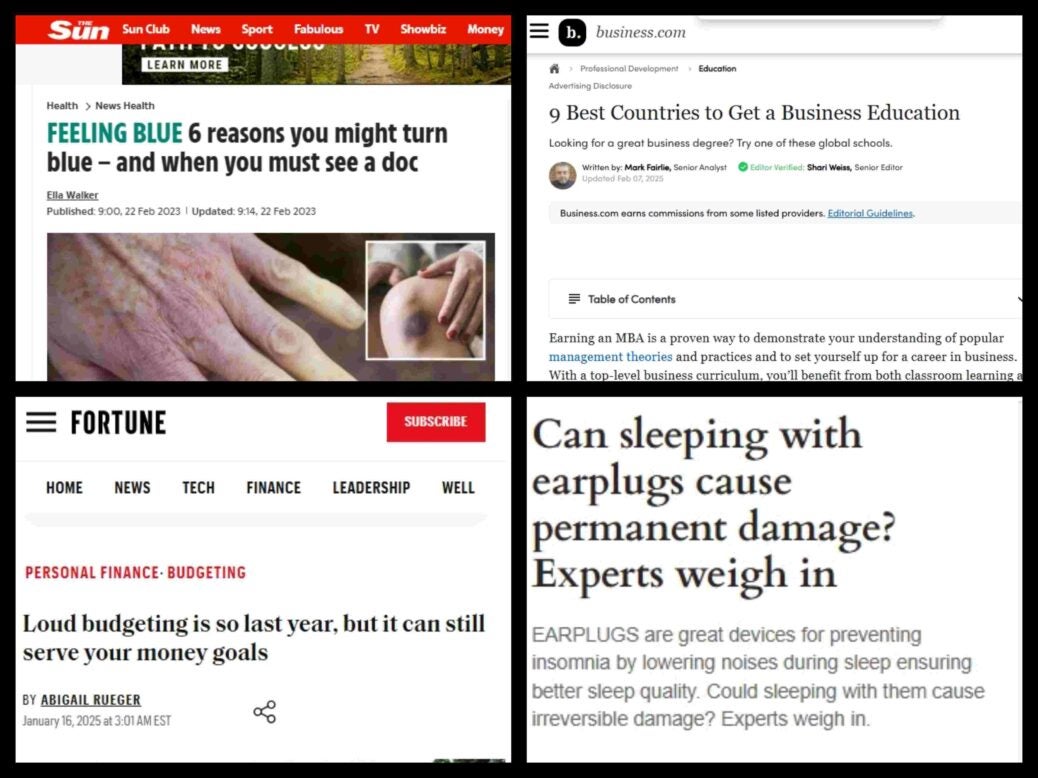
With journalists currently being bombarded by AI-written PR content, Press Gazette has gathered together tips on how to spot fake material.
This month, Press Gazette reported on an AI tool, ‘Olivia Brown’, which automates every part of the PR process, from suggesting topics to writing press releases to emailing journalists.
Digital PR companies, which aim to get secure website backlinks for their clients, openly boast of sending millions of emails to journalists.
Digital PR (a sister company to Search Intelligence which makes Olivia Brown), boasts: “Our enterprise-level custom software is an alien machine that allows our team to operate at a scale like no other agency on Earth. Our team sends out tens of millions of emails every month to the press worldwide, on behalf of our clients.”
While best practice is for journalists to verify the accreditations of any source (preferably with a phone call), Press Gazette has also gathered tips to help reporters and editors quickly tell whether a press release is an AI fabrication.
Times contributing editor Matt Rudd said he has blocked large numbers of email addresses to stop spammy, seemingly AI-written releases arriving – but the senders simply create new ones.
He said the hallmarks of spammy and AI-written releases are having no contact number in the release and email addresses that are not monitored and which sometimes bounce back.
He said he has also noticed an increasing number sent from agencies named after a single female name: “Posh girl’s first name, posh girl’s surname but not from a posh girl who has ever sent you a press release before.”
Rudd said: “There’s always some kind of AI-created stunt to grab attention – the simple plumbing mistake that could cost you £1m; if you ignore this road rule, you could end up in prison forever; this £10 gadget that makes you £100 sexier etc etc.”
Rosie Taylor, freelance journalist and author of the media pitching advice newsletter Get Featured, described the ‘tells’ of AI-written press releases.
She said: “Every letter in the headline is capped up… And then there are some catchy but empty bullet points, followed by a press release with lots of nice little bold headings and more bullet points.
“Weirdly short sentences. Sentences which list three things. Commas in the wrong place around ‘and’, ‘or’ and ‘but’. Too many direct verbs (‘Swap your X for Y’).”
Another news editor on a national newspaper said that the formatting is a giveaway, using ChatGPT-esque fonts, and frequently bolding copy.

Other signs include tables, generic email names and a complete lack of phone contacts.
The tips tally with some of the low-quality press releases sent by PR agencies Relay the Update and Signal the News.
The two agencies were linked to stories involving fake case studies, such as lottery winners who are extremely hard to track down online, and the former royal cleaner who acted as a brand spokesperson for a number of companies and did not appear to exist.
Dominic Dawes, former editor of What Hi-Fi? and communications professional, said spammy press release titles seen in recent months, such as “The mortgage hack banks don’t want you to know” and “The 33p secret recipe McDonald’s doesn’t want you to know about…”, show how social media and AI are distorting the media landscape.
He said: “What’s most concerning about the slew of mediocre, AI-authored copy we’re all seeing is not what it says about the next wave of tech revolution, but what it teaches us about how damaged we are by the tech we’re already using (i.e. social media).
“The prevailing tone – paranoid and divisive – is repetitively peppered by the promise to reveal ‘…what THEY don’t want you to know’.
“The problem is not with AI per se: the technology is just feeding us more of what we respond to and engage with online. Like irritating opening sentences with a clunky long dash two thirds of the way through, AI will continue to blindly feed us this stuff until the day comes when we stop being so responsive to it.”
A spokesperson for the Independent Press Standards Organisation (IPSO) said: “Press Gazette’s valuable reporting on the emerging phenomenon of AI-generated press releases is a useful reminder to editors and journalists of risks posed by large language models.
“Those regulated by IPSO are accountable for their content and must take care to satisfy themselves that their sources are accurate.
“The standards they have agreed to meet set them apart from non-regulated titles and help to maintain trust and credibility with readers.”
Ten ways to tell a press release might be AI-generated
- Capitalised headlines
- Short sentences
- ‘GPT formatting’ with lots of bolded phrases
- Catchy but empty bullet points
- No contact number
- Email addresses which bounce
- Sentences which list three things
- Paranoid and fear-inducing headlines: ‘The plumbing mistake that could cost you £1m’
- Extremely short sentences
- Tables and bullet points within the release.
Email pged@pressgazette.co.uk to point out mistakes, provide story tips or send in a letter for publication on our "Letters Page" blog
