

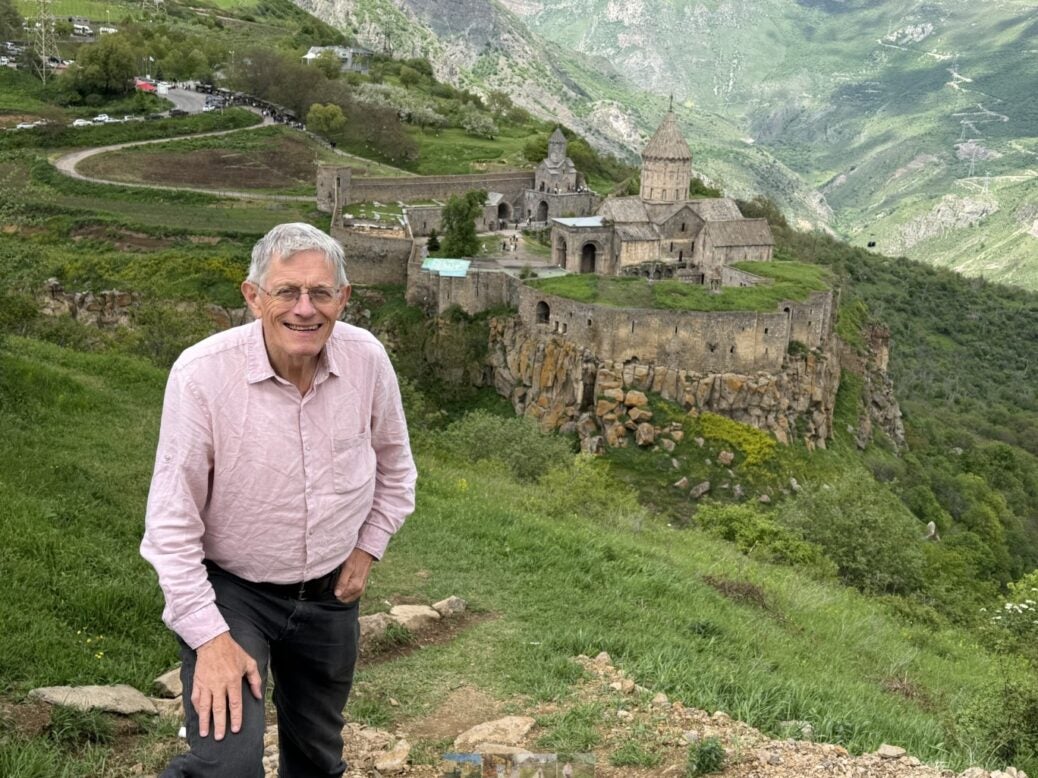
The Telegraph’s new travel correspondent is known in my house as “Simon Available” because you can count on him popping up on radio and TV at the first sign of breaking news in his field. So when I emailed Simon Calder to request an interview it was no surprise that he readily agreed.
He arrives wearing a summer-weight navy suit and carry-on rucksack, his features are set in a familiar rictus of amiability. It’s the expression we’ve seen so many times on our TV screens as he brings us reassuring updates on baggage-handlers’ go-slows and Eurostar walkouts. He is probably one of the most trusted journalists in the country but we know little about him apart from his willing manner and the glint of his spectacles in strong foreign sunshine.
Now an improbable 70-year-old, Calder was born in Crawley, Sussex, practically on the tarmac of Gatwick Airport, and absorbed aviation fuel with his mother’s milk. “We used to go up to the airport for an outing, knowing we would never be able to afford to fly,” he says. “Now I skip out of bed unable to believe my good fortune that I spend my life travelling the world and writing and talking about it.”
He said he was sorry to leave The Independent after 32 years with the title, but he’s followed a former colleague to his new paper where he will lead the travel newsletter, present videos for social media and host a podcast: “The Travel Expert” (as well as contributing written articles).
How has Calder flourished when so many journalists are of work? Come to that, how has he seen off so many editors? “I think travel was always in their peripheral vision,” he says modestly.
When The Independent first appeared in 1986, it made a point of declining freebies, but surely that didn’t mean the journos were expected to pick up the tab for their flights and hotels?
Calder bills himself as “the man who pays his way” which means he can claim he’s not beholden to the trade he covers. “I worked out that I spend about £7000 a year on travel but it’s so much cheaper now. I used to pay about the same when I started in 1994, but the money was worth a lot more in those days.”
Calder doesn’t even claim expenses on his travel costs: “I get a retainer and that’s it. I am therefore hyper-incentivised to seek out the lowest-cost journeys and the best-value places to stay.”
Before he was a journalist, Calder was a BBC sound engineer and held the Radio 4 mic for presenter Jim Naughtie on College Green, Westminster, on the day Margaret Thatcher resigned as prime minister in 1990. “When I first started in travel journalism, I had a Tandy, one of the early personal computers. But I’d also send my copy by fax. Or put it on a floppy disk and post it to the office. Now you can do your job from wherever. And you have to expect to be on the whole time.”
He has been known to speak to a broadcaster live from 38,000 feet. He cycled to the Tate Britain art gallery in London to meet Press Gazette after talking to CNN about alcohol on planes. “I’m very much in favour of a beer or a glass of wine,” he adds. Some of his appearances are “pro bono”, to bolster his brand and his employer’s. On other occasions a modest fee is involved but Calder says he’s not on a retainer to any outlet.
Despite impressions, Calders says he does not agree to every media request.
“If it’s a subject I don’t know much about, like motoring, I tend to avoid it,” he points out. But producers have his number.
He was fast asleep in a budget hotel in Glasgow in March last year when his phone began ringing at 3am. It was Good Morning Britain, wanting his take on a fire at an electrical substation near Heathrow which closed the airport. “Because I’ve been doing this for so long, I immediately knew that a quarter of a million people wouldn’t be flying that day,” he says. Calder got out of bed and prepared for a long day of broadcasting in his hotel room. He turned on the pair of laptops that accompany him everywhere: one to write and broadcast with, the other to consult for updates.
For a moment, the café at the Tate resembles an airport security checkpoint as Calder unpacks his rucksack to show me the rest of his going-away kit. “There’s passport, toothbrush, underpants.“
“Do you have just the one shirt, like Jack Reacher?” I wonder. The solitary law-enforcer, created by author Lee Child and played on screen by Tom Cruise, washes his shirt by hand every evening.
“I am Jack Reacher!” exclaims Calder happily. “I wash my shirt in the hotel sink at night. Much better than paying for laundry or taking a load of clothes around with you.”
He is married with two grown-up daughters and lives at Waterloo in central London. He’s never totted up how many miles he’s flown but he says he’s away from home for about a quarter of the time. He defends travel as “the industry of human happiness” and claims that it redistributes wealth from richer countries to poorer ones. Budget airlines are the least impactful on the environment, he claims, because they operate modern fleets “and they load them to the gunwales”. He says he’s conscious of his carbon footprint and has his own method of making reparations. “Every time I fly, I hitchhike at least once. It’s the lowest impact form of motorised transport.”
Calder has been thumbing lifts since he was a teenager, to take himself off to Brighton. It was also a way to get around the continent when he couldn’t afford an Interrail pass. Doing Europe on a shoestring seems to have inoculated him against the vagaries and hardships of modern air travel. “I find myself in the middle seat on a lot of five- or six-hour flights. But one virtue of age is that you can remember how terrible things were in the old days when you were hitching.”
He has never left his passport at home but he once went to Luton for a flight to Switzerland when he should have been checking in at Gatwick instead. He witnessed a terrifying incident of air rage on a flight to Budapest and he’s been on flights which were diverted, not just to an unscheduled airport but to an unscheduled country. He hasn’t called in sick since 1984 (he fell off his bike).“If you come from Crawley, the rest of the world just looks incredibly interesting,” he explains, which may cost him the freedom of his hometown.
In his own unassuming way, Calder’s one of a vanishing breed, the unflappable Brit in a crisis, the last boy scout who’s taken to heart the old motto: “be prepared”. The glamour has gone out of flying, to be replaced by Simon Calder, who will fly anywhere for a bargain or a story, and has brought his own sandwiches.
We spend a moment reflecting on the life of Judith Chalmers, doyenne of travel presenters, who died in May at the age of 90. “She was great, a pioneer,” says Calder. I tell him that he is her successor. “Well, that would be an absolute honour, but I’m the Judith Chalmers of Insta, Tiktok, podcasts and more.”
And with that he’s off, to catch a train and test the strength of its wifi signal live on Jeremy Vine’s show on Radio 2.
Email pged@pressgazette.co.uk to point out mistakes, provide story tips or send in a letter for publication on our "Letters Page" blog
