


Publishers looking to succeed in live blogs need to focus on “intensely newsy” topics and write with personality, according to The Guardian’s Andrew Sparrow.
The reporter has written a live blog on politics for the publisher since 2008, which he was recognised for when he won Press Gazette’s Political journalist of the year award in 2011.
He told Press Gazette why live blogs aren’t for every story, and how former editor-in-chief Alan Rusbridger’s early investment in tech helped lead to The Guardian seeing around 15% of its total page views come from live blogs.
How did you start out in live blogging?
Sparrow started live blogging for The Guardian “when website news was just taking off”, with the role advertised as being to “constantly update the politics news”.
Sparrow added that having to continually rewrite a conventional news article for breaking news “didn’t make very much sense”.
“In 2008, it felt like digital news was being written according to rules that were created for print, and it hadn’t evolved a better way of telling the story for a technology where you could update very quickly and readers were coming back to you more than once a day and you had unlimited space.”
The Guardian had already established live blogs for sport and showbiz events, such as Big Brother live episodes, before Sparrow started his politics blog.
What are the benefits of live blogs?
When Sparrow started out in live blogs, “it was pre-Twitter and pre-Bluesky, so blogs served that opportunity”, he said.
He found that news blogs were useful for changing headlines quickly, putting “the most interesting stuff at the top” and avoiding repetition of text.
“So, it made news much easier to write, much faster, particularly when editors realised they could trust journalists to self-publish, and everything didn’t have to go through editors.”
He added that this sped the whole process up, but the “tone” of a live blog is also what readers responded well to.
“I remember my print days and realising at some point that often the conversation in the newsroom was more interesting than the news that would get printed in the paper, because people would gossip and… why politicians were doing certain things,” he said, adding “there was never really any space for that in newsprint journalism”.
“But suddenly on a blog, you could open up to all of that, and it was clear that readers responded quite well to personality. That was one of the reasons why our showbiz live blogs were doing very well.”
Sparrow added that live blogs are particularly effective for major news events: “People don’t just want to read a 1,000-word summary at the end of the day. They’re quite happy to read every cough and spit and tail of development.”
What evidence is there of The Guardian’s live blogs’ success?
“We’ve got Politics Live blogs in Australia and America now,” said Sparrow, adding a business blog has been going “almost as long as” his own, the sports section has multiple live blogs and “whenever there’s a war going, we’ve had a Europe live blog now done by Jakub Krupa”.
The Guardian also launches live blogs for specific news events, such as the forest fires in France.
“The tech people say on an average day, 15% of our total page views come from the Guardian live blogs,” Sparrow said.
“This year they’ve attracted half a billion page views and readers have spent a total of 14 million hours on them.”
Sparrow added that his live politics blog tends to get between 100,000 and 300,000 page views per day. His live blog on the day of Keir Starmer’s resignation received 2.5 million page views.
What has been key to The Guardian’s success with live blogs?
“In the noughties, The Guardian had an editor who was a decade or more ahead of most of his rival editors in being interested in digital journalism. He was not just intellectually interested, but also prepared to invest in it. So The Guardian had a better online operation then,” said Sparrow.
Alan Rusbridger was editor-in-chief of The Guardian between 1995 to 2015.
This included the development of an in-house live blogging tool which enabled reporters to write directly for the web without previous copy and pasting.
He added that The Guardian “has a culture of trusting its reporters”, allowing live blogs to take off because editors would let writers “try things out”.
How has the technology behind The Guardian’s live blogs changed?
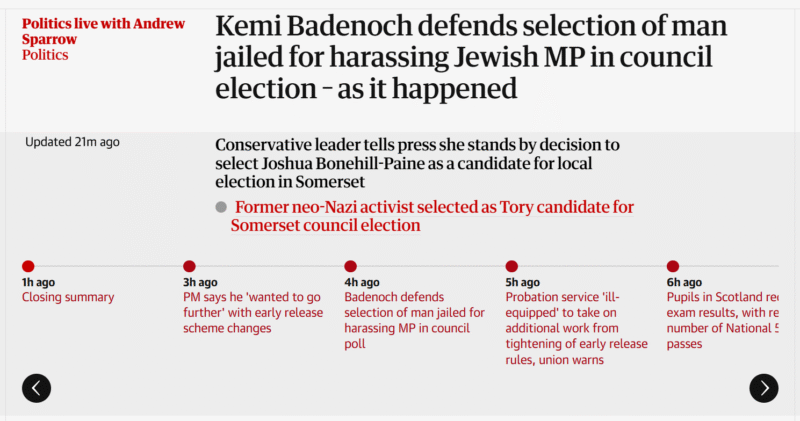
The Guardian’s CMS-based live blogging tool has evolved over time to make it easier to import photos and social media posts, have multiple authors within one page and to update headlines easily.
It has also reduced time spent on writing summaries of news so far: “We have a tool at the top of the blog that will allow you to scroll around through the individual headlines within posts, there’s actually no real point in doing a summary.”
What type of stories do well on live blogs?
“It needs to be now news,” Sparrow said, referencing content that readers wouldn’t wait a day to read.
“Andy Burnham might give a speech about green energy policy, and you think, ‘well, I’m moderately interested in that, but I’m quite happy to read that tomorrow in the paper or read that on the bus home’, but if… Andy Burnham resigns… you’re going to want to find out what’s happening now.”
The best stories for live blogs are “intensely newsy”, he said.
“Sport and politics are two very obvious ones, where the live blogs get read by heavy-duty, obsessive people who are really passionate about the topic and want updates all the time.”
A story where “the top line keeps changing” also works, he said. He pointed to parliamentary reshuffles as an example, “because every 20 minutes you get a new surprise and a new name and a new addition to the cast list”.
He added the Iraq War Inquiry in 2009 was a good example of strong news reporting via live blogging, with it ticking the boxes of being news people were interested in, the hook of whether “we’d gone to war on the basis of a lie” and inclusion of live committee hearings.
“The inquiry was also publishing documents as they were mentioned in hearings, and so the scope to be able to link to online documents was really important,” said Sparrow.
How should publishers best approach starting a live blog?
“Once you launch a live blog, you have to know that the story’s going to move on,” said Sparrow, warning against setting up blogs around announcements which may not materialise.
He added: “Within a live blog, you can be exposed very quickly if you make judgments that turn out wrong. And the solution to that is not so much to avoid trying to say anything interesting at all, but just to be careful and make sure you don’t get too carried away in the moment.”
When Sparrow started at The Guardian, editors worried readers would not engage with lengthy live blogs. After covering by-elections, he realised there were “people interested enough to read about it”.
“If you’ve got the right audience for your journalism, then people will happily read more than 400 words on a subject they care about and they’re engaged in.”
What are the biggest mistakes to watch out for?
“I have seen people trying to do live blogs in areas where the audience isn’t there, or maybe the audience is there, but the audience isn’t reading their publication or isn’t reading their publication at that particular time,” said Sparrow, adding “it’s not just what you write, it’s when you write it”.
Sparrow also advised against live blogging drier topics: “Policy is harder to do than personality,” he said, adding that “people are interested in the drama”.
“I can think of times when the blog has been too frivolous, and readers don’t like that. But equally, they like the fact that it’s a bit more unbuttoned than conventional newsprint journalism. There’s more space for personality and elbow room, but to get the balance right has probably taken me a while to find.”
Should small publishers consider live blogs?
“If they’ve got an audience who they think will want to come back during the day for updates, then yes, definitely,” said Sparrow.
“I see the local newspapers using them quite a lot now, and but sometimes they use them on stories where the story doesn’t really move on,” he added, pointing to incidents such as road accidents, which don’t generate enough “fresh information to keep it going”.
“If you are a specialist publication covering a conference where all the people in the industry are, and they’re all giving lots of different speeches, and there’s a handful of people reacting to it, I would have thought live blogs would work for that.”
He added it is possible to staff them with one person: “You need to find someone who enjoys doing it… let them do it and see if they get an audience.”
Are live blog authors under threat from AI?
“AI will never take the prime minister’s private secretary out for lunch and get them to reveal what’s going to be in the budget,” said Sparrow. “There are areas of journalism that are really AI proof.”
He added that live blogs are “an area where the personal voice matters, and I think people will probably be able to spot blogs written by AI versus blogs written by humans”.
Email pged@pressgazette.co.uk to point out mistakes, provide story tips or send in a letter for publication on our "Letters Page" blog
