

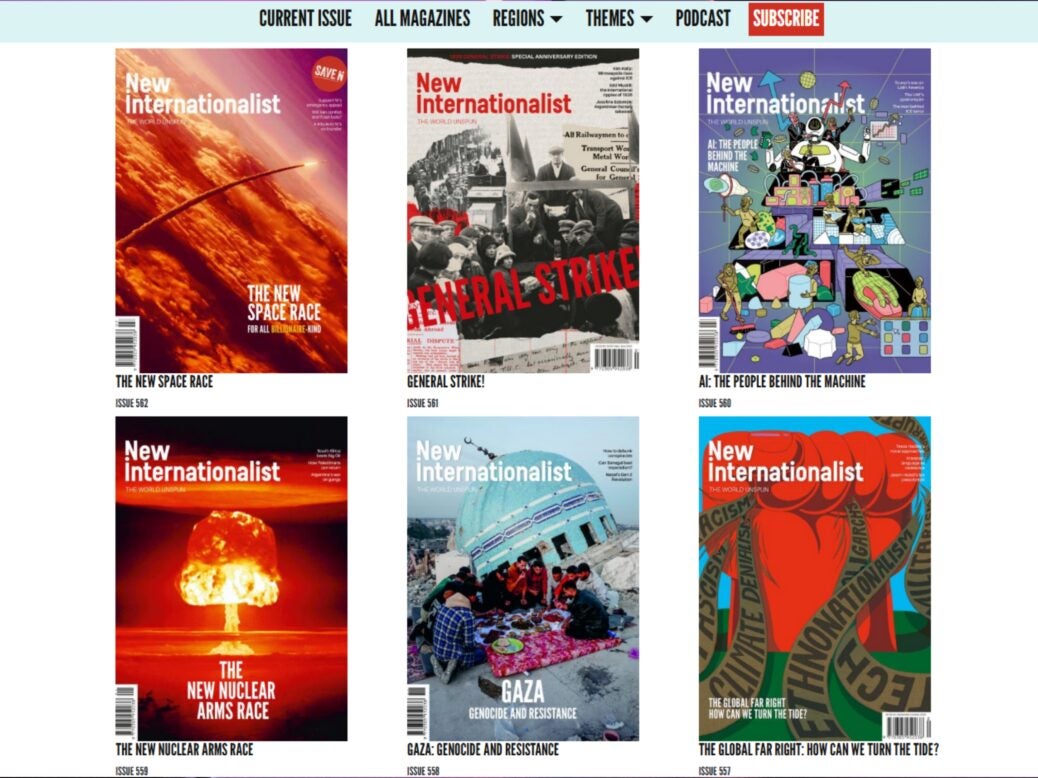
Global affairs magazine New Internationalist has brought its magazine back from “the edge” after crowdfunding more than £160,000 following challenges with costs, marketing and loss of traffic linked to AI-generated summaries.
The left-leaning title, founded in 1973, publishes stories on global, social and environmental justice in print every two months alongside a website, fortnightly podcast and merchandise business.
In June, New Internationalist launched its “More than a magazine” campaign with a goal of raising £150,000 within six weeks to “steer us out of the danger zone” and help the magazine implement changes that will “build a more secure and sustainable future”.
It surpassed its goal with donations from more than 1,600 people.
“We got pretty close to the edge,” said the magazine’s co-editor Amy Hall.
New Internationalist is a multi-stakeholder co-operative owned by around 4,600 people. A group of co-owners and a solidarity fund that helps worker co-ops put in extra cash to ensure the team of 13 part-time staff were paid.
However payment of some bills was delayed and 16 pages of the now 68-page July/August edition were cut.
Hall added: “We don’t have a billionaire backer or a big corporation behind us… that makes us quite vulnerable.”
What went wrong?
Hall said “unexpected price rises” were a big factor in New Internationalist getting to crisis levels financially.
“Our print costs went up by 10% and there were some other price rises that were quite sudden.”
She added that a main source of marketing to acquire magazine subscribers used to be university stalls and other face-to-face opportunities, but this dropped off during Covid and never returned to previous levels.
“Losing that has been quite a big blow for us… while we’ve been trying to do other forms of marketing, we’ve not yet really replaced anything with the level that we were getting from that.”
Hall also blamed AI search summaries for reducing traffic and revenue.
The title has recorded 17.7 million search impressions in 2026 so far – but only around 101,000 Google clickthroughs, amounting to an overall rate of 0.57%.
[Read more: Google search traffic to leading UK publishers set to halve by Q3 2027]
The magazine was not profitable in its 2024/25 financial year, according to its annual report, or in 2025/26, per unfinalised figures shared with Press Gazette.
It generated revenue of £989,474 in the year to March 2025, but costs came in at £1.1m, leading to a “higher than expected” net loss of more than £100,683.
In the year to March 2026, revenue of £756,372 and costs of more than £906,000 meant it recorded a higher overall loss of £149,791.
The revenue drop of almost a quarter between 2024/25 and 2025/26 is mostly due to a drop in income at New Internationalist’s Ethical Shop, accounting for around £175,000 of the £233,102 difference. This was a result of reducing product lines, staff and marketing costs.
The magazine makes most of its revenue (53.1% last year) from its 10,000 paying subscribers and newsstand sales – but this income was down 20.7% in 2025/26 to £401,770.
Other products and editions accounted for roughly 28% of revenue (£211,000) and fundraising and contracts contributed 15.5% (£117,668). Other income including advertising made up the remaining 3.4%.
Ad revenue came to £21,576 for 2025/26, representing 2.2% of total revenue. Advertising is print (including inserts) and direct-sold, with the magazine keen to avoid programmatic for “ethical” reasons to avoid gambling and diet-related spots.
Print advertising accounts for 45% of ad revenue, loose inserts for 40%, and digital ads – including website and podcast – for 15%.
Digital subscriptions cost £2.74 a month, print and digital costs £4.99 and print-only subscriptions cost £4.58. The website is not paywalled, but the print and digital issue of the magazine contain exclusive content that only subscribers can access.
However Hall said New Internationalist is now experimenting with a metered paywall, which means users can view a limited portion of an article a certain number of times before being asked to subscribe.
In its 2024/25 results, New Internationalist said the launch of its The World Unspun podcast in November 2024 “directly resulted in new subscriptions”.
But that financial year, the brand also noted “less favourable changes in the grant fundraising landscape”.
Hall said this means grants are “harder to come by” as donor priorities shift.
Crowdfunding history
The publisher has launched five crowdfunding campaigns since 2015, all of which have exceeded their targets.
Last year it raised around £60,000 aimed at funding an issue “exposing the far right” and providing general support for the title.
One fundraising campaign in 2017 raised more than £700,000, enabling the magazine to secure its future and become a multistakeholder co-operative.
The magazine gets occasional backing from big names: actress Emma Thompson and musicians Jarvis Cocker and Billy Bragg donated in 2017, while folk singer Peggy Seeger and Hollywood director Judd Apatow contributed this year.
Avoiding emergency appeals in future
Hall said the magazine will continue to turn to readers for donations and is aiming to build its base of regular donors, it will try to avoid launching another emergency crowdfunder to save the magazine.
“Like most publications in some form these days, we are going to need to turn to our readers for donations, and I don’t think that’s going to change,” she said.
Hall also said the magazine is assessing “internal processes” to ensure it does not “get to that point of emergency so quickly.
“We are reviewing the magazine and our journalism more broadly to try and refresh it and potentially change some of the ways that we produce the journalism.”
Hall added the magazine’s survival reflects its “people-powered nature”, which is what has got it “this far” and “what has brought us back from the brink of financial disaster in the past as well.
“And this campaign has shown just how strong the support is out there for what we do and for internationalist and independent media more broadly…
“People are often looking for independent sources that aren’t funded by billionaires, that don’t have massive corporations behind them… that feeling just feels like it’s only getting stronger.”
Email pged@pressgazette.co.uk to point out mistakes, provide story tips or send in a letter for publication on our "Letters Page" blog
