

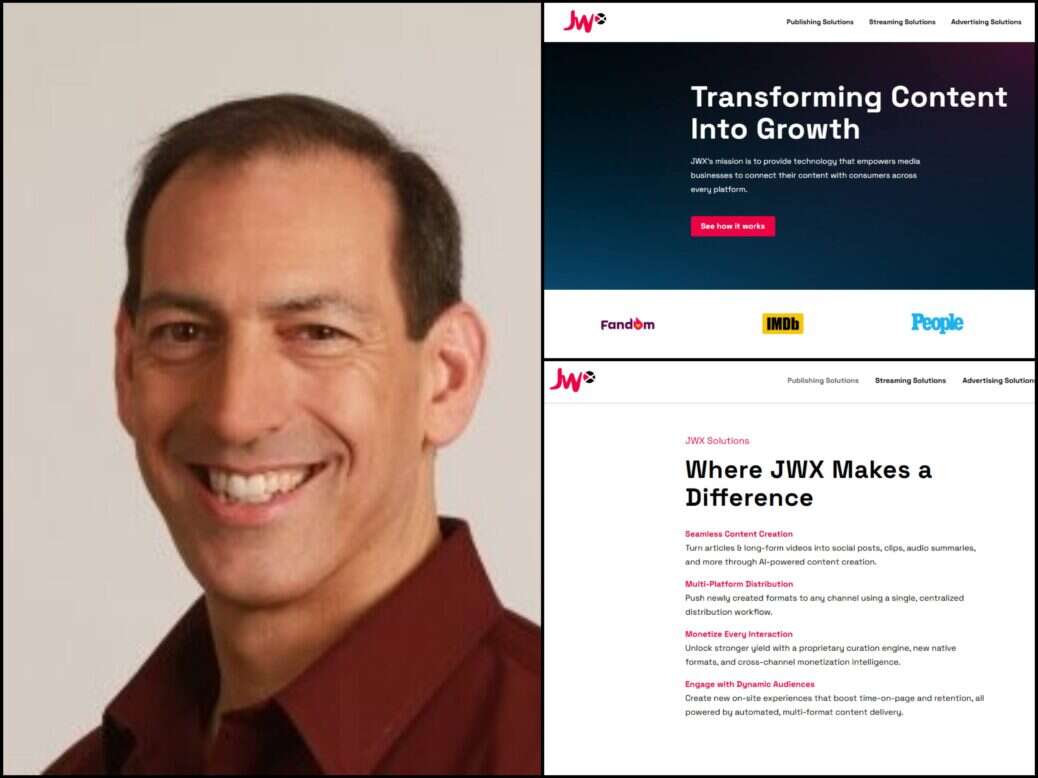
Press Gazette asked the CEO of leading video delivery and monetisation platform JWX John Nardone to share his insights on how publishers can optimise their video output.
Formerly known as JW Player and Connatix, claims to be used by most leading US publishers and helps provide contextual video advertising.
JWX clients include French daily newspaper Le Figaro, Business Insider, Politico and Axel Springer.
What advice do you have for publishers starting out in video?
Publishers must have the right content before starting out in video, said Nardone.
“You have more opportunity for high-value placements if you have high-quality video content. And if you don’t, you’re forced to extract the monetisation through the outstream or the banner, which are less desirable from the advertiser standpoint.”
Nardone added that across JWX’s publishing clients, video makes up around 30% of the ad revenue mix with general website display advertising still the “lion’s share” of monetisation for most publishers.
“We’re seeing those customers that are putting dedicated focus on Youtube, for example, or taking advantage of the Facebook monetisation programme starting to get that up to 32%, 34%. So there’s still a lot of growth to be had for a lot of publishers,” he added.
JWX’s initial discussions with a publisher involve strategising outstream ad placements as well as how this will impact the consumer experience.
“You don’t want your website to feel like it’s a bazaar, with things flashing and things popping up all over,” he said. “No user says they want more ads, but how much ad load will your audience sustain before they don’t want to come back anymore?
“That does take some time to figure out, and some trial and error sometimes, in terms of where to put the video placements.”
Initial tests of variables like the size of the video player, where it is placed on pages, traffic and repeat user behaviour is important, he added.
“And then you begin to test your way into how much can I scale this video ad content.”
Which video ads make the most revenue?
Video ads that play before the main video content is shown – also known as pre-roll ads – are “certainly the most valuable”, said Nardone.
These have “the highest CPM [clicks per thousand ad impressions], and they’re the most desired by advertisers”.
Mid-roll ads – playing in a break in the middle of the video content – are also valuable.
“And then you have outstream as opposed to instream, and that’s where a video player can pop up on the page and just play the ad, and that is considered less valuable by the advertiser because you don’t have the signal that the consumer is necessarily paying attention to it at that moment, so those will get lower CPMs,” Nardone added.
He said for outstream, there is the “opportunity” of placing the ads in multiple spots on the website “so you’ll have higher volume of that with lower CPMs”.
In-banner video ads, which play a video inside of a display format, are “the least desirable of the video formats, but some publishers do well with it”.
What type of video content is most valuable for news publishers?
For news publishers, “timeliness is really critical”, said Nardone, adding that “the window for monetising a piece of content” can be as little as 36 to 48 hours with the speed of the news cycle.
“And so what a lot of publishers do – Figaro is doing a really good job with this – is figuring out which topics and articles are trending, and quickly creating a video to accompany that article, where the video is legitimately journalism.”
In Figaro’s case this is largely what Nardone termed “professional videos”, typically combining B-roll (or stock) footage with reporter narration.
Publishers can also be timely with “natively social videos”, such as a “person just talking to the phone walking down the street”.
He added videos must be adapted for different platforms where “user expectations are different”.
In contrast, evergreen lifestyle content “doesn’t have the same monetisation window”.
“So there’s a question of how do you recycle and reuse the content in the social environment,” Nardone said. “You don’t want to overexpose it, but if something is working, you want to keep using it. You don’t have that same phenomenon in news, because when that news cycle is moved on, that content is no longer desirable.”
Nardone said one way of tracking the recyclability of a video is using tools like True Anthem that predict the “viral value” of a video using traffic and performance-based statistics.
[Read more: Wall Street Journal video team recentres around ‘journalism that’s worth paying for’]
How should social media be used for video monetisation?
Publishers can monetise video using social media in two ways, said Nardone: teasing content to drive traffic back to a website, or encouraging engagement on social platforms to make money there.
He described Youtube’s monetisation programme as “very good”, Facebook as “decent”, and added publishers are only seeing “some success” with Tiktok.
“So [Tiktok] becomes more about how do I use Tiktok to drive people back to my website, where I can create a monetisation opportunity.”
How should smaller publishers approach video monetisation differently to bigger newsbrands?
Smaller publishers should find a partner who can help them explore the opportunity of video, said Nardone, adding many titles “just don’t have people who know this stuff”.
He added publishers both big and small are facing a “squeeze” on staff at the moment and making decisions on what should be outsourced.
“Don’t try to do it all yourself… Even the biggest publishers that we talk to are telling us that they know there’s more opportunity in Youtube, for example, than they’re able to access.”
What level of investment is needed from publishers to see returns in video?
Nardone said a dedicated video team is important for making money, but publishers cannot keep expanding headcount.
“So how do we do more with less, especially as now we have to support all these social channels on Youtube? And that’s where you tend to lean to the newest technology.”
He added that while publishers don’t want to produce “AI slop”, the “sweet spot” is allowing the humans to create the “foundational content” and allowing AI to support the process.
These videos tend to include a script, voiceover and footage created by a human, with graphics, logo and music managed by an AI service.
“As long as the foundational video that you built is of high quality, we can have the AI do the transfer… to your standard, so we create a template that has essentially the prompt built into.
“Publishers are much more comfortable with that, especially for social, than the idea that the AI is going to create their foundational editorial [content],” Nardone added. “The line I think is still very sharply drawn in most organisations.”
How can publishers sustain video revenue once they’ve started?
Nardone said it is important to “keep track of the lineage” of video content to understand what drives revenue across different platforms.
He added growth is mostly seen through “indirect monetisation”, such as social media videos directing users to ad-supported websites.
“That’s a lot harder to keep track of, and certainly where we’ve put a lot of effort in trying to make sure that we can close that that loop on the traffic-driving component of these things.”
He also urged publishers to stay on top of “new and emerging social platforms”, which may not generate “massive dollars” but can still be valuable because consumers are spending time there.
What is the biggest mistake a publisher can make in video?
Nardone warned against “overloading that customer experience”.
“If you haven’t had video monetisation and you start to get video monetisation, for a lot of publishers… it’s ‘wow, money – let’s do more of that’.
“If you start degrading the consumer experience to the point that that consumer doesn’t want to return… you’re going to maybe make more money in the short term, but lose long term, and we see that tension with a lot of publishers,” he said.
“You’ve really got to be careful not to overplay that because you will piss off your users. The damage in the long term can be really quite substantial.”
Email pged@pressgazette.co.uk to point out mistakes, provide story tips or send in a letter for publication on our "Letters Page" blog
