

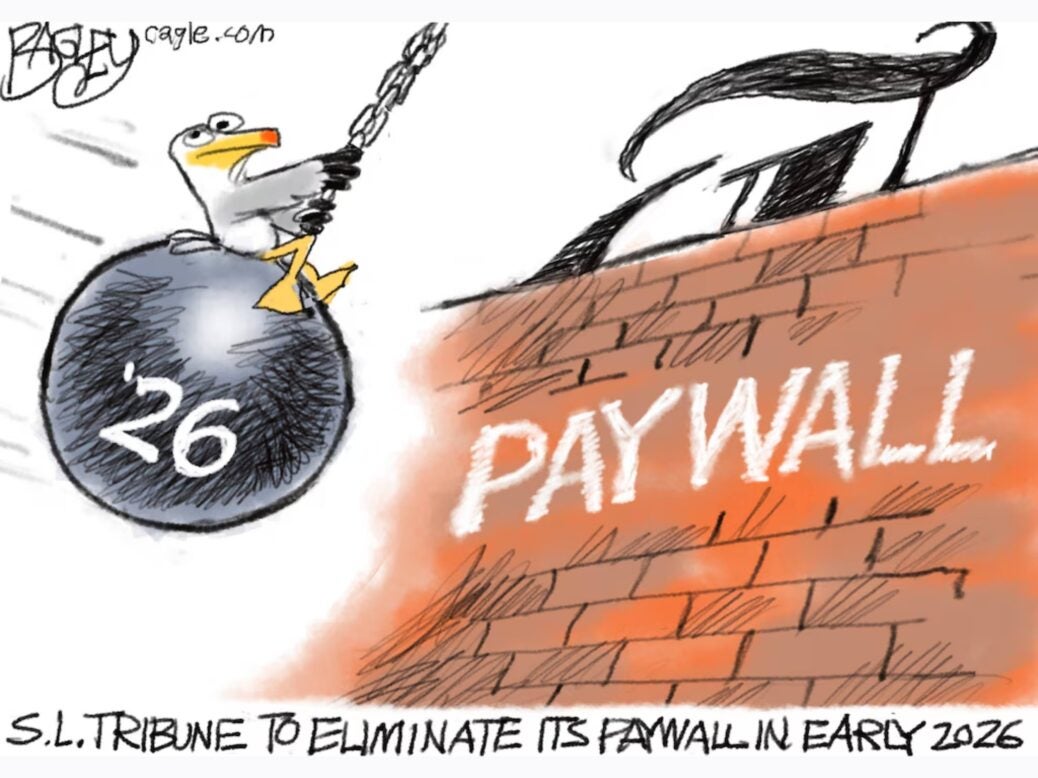
Utah-based newspaper The Salt Lake Tribune has gambled a third of its revenue by ditching its paywall and instead offering paying readers membership tiers which keep its online journalism free to all.
The 150-year-old US title moved into community-led nonprofit ownership in 2019 after successive rounds of cost cuts and financial difficulties. It switched from daily publication in 2020.
CEO and executive editor Lauren Gustus told Press Gazette: “We talked about the paywall and the idea that some people can’t afford to access quality or trusted news, and some people will never pay for The Salt Lake Tribune,” adding the paper “had to change our value proposition and what we were offering people”.
The Tribune has a website, twice-weekly newspaper, an app-based e-edition, 16 newsletters and a weekly podcast.
The title started working with technology company Flip-Pay on changing its paywall to a membership model in late 2025.
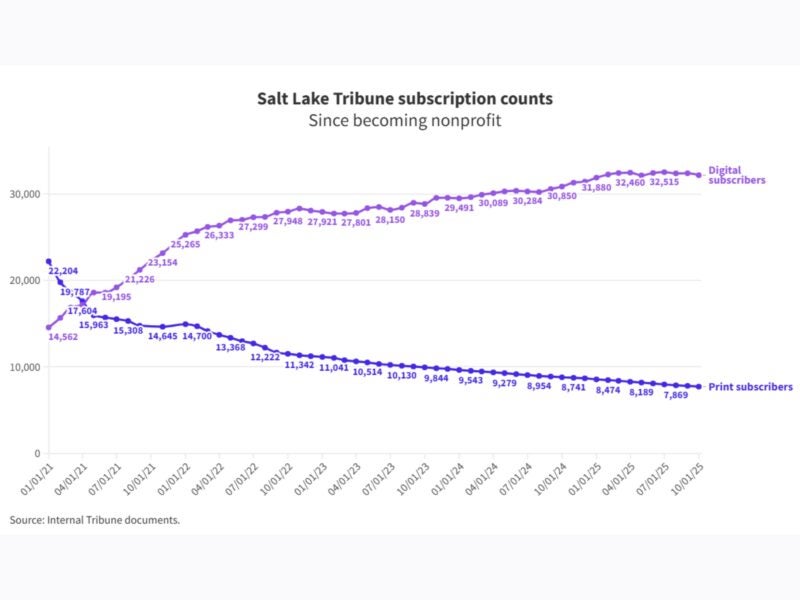
The Tribune had more than 32,000 digital subscribers and around 7,700 print subscribers towards the end of 2025.
Existing subscriptions have been converted to memberships, with subscribers receiving the chance to opt out on email, and prices were kept the same with different membership perks.
A $60 annual subscription provides full archive access, merchandise, access to members-only events and a quarterly behind-the-scenes newsletter. The $120 tier adds e-edition access and article commenting (with supporters able to pay more if they wish).
For $312 supporters get all the digital perks plus home delivery of the print edition.
As with The Guardian in the UK, articles are free to read for all – but come with a pop up urging people to become paying supporters. The messaging states: “We’ve made sltrib.com free to read — because access to trustworthy news matters. As reliable information becomes harder to find, our newsroom is focused on facts that serve Utah communities. Reporting like this takes resources. As a nonprofit newsroom, we rely on reader support to fund this work. Make a donation today to power more local news for more people.”
Gustus said: “Folks we’ve heard from are enthusiastic, and so many have said, ‘I’m going to continue my ‘subscription’. I want to support this’.” The paywall lifted on 15 May and Gustus said it was too soon to understand how many subscribers will stay on as members.
Currently some 33% of the title’s revenue comes from subscriptions, 35% came from philanthropic grants and other donations and 25% from print and digital advertising. Other revenues include royalties and money from platforms like Youtube.
Because the Tribune has nonprofit status donors benefit from tax deductions under US law.
In 2024 the Tribune moved away from working with third-party platforms to deliver targeted advertising campaigns because, Gustus said, the operational costs were too high. At this time the chief revenue officer and several advertising staff departed.
This led to a “a dip in our top line revenue, but our margins were better”, said Gustus.
Gustus said the organisation plans to prioritise more direct ad sales while still going down the programmatic route.
“We are a local and statewide nonprofit news organisation, we’re going to focus on building relationships with whomever it is that may be paying us – advertisers, subscribers – and we’re not going to invest in that high-cost business.”
The Tribune’s annual profit has remained above $1m since 2021, except for a dip in 2023 to $69,130.
Donations from individuals and companies increased from $1.8m in 2021 to $4.1m in 2025 (including $1m from a couple in the biotech industry). Revenue from advertising and subscriptions peaked in 2023 at $11.4m before falling to $8.4m in 2025.
“Why make the move if we’re doing, I would say, okay financially?” said Gustus. “We so often in journalism are reactive, we make decisions from a defensive position, and we saw an opportunity to do it differently.”
To prepare for the paywall lift, The Tribune fundraised $2.6m, matching its average annual digital subscription revenue, allowing it to run membership tests with subscribers, make election reporting free in the run up to lifting the paywall altogether and giving it a “degree of a runway based on what may or may not happen”.
“We don’t yet know how the transition will go, so 2026 brings a degree of uncertainty, but we have fundraised such that we feel optimistic,” said Gustus.
She added it is likely they will lose subscribers in the short-term, but “the goal is to grow members because there is more access and more availability and more exposure for The Trib, and then also to look at how we can steward our current members more effectively.”
Paywall down, ad revenue up
The Tribune is also hoping the removal of the paywall will increase digital advertising revenue, having accounted for around 9.6% of total revenue in 2025.
The paper projects page views will grow by 10% this year and is focusing on broad audience growth rather than dependence on one-off viral stories.
The Tribune is also looking to grow “on platforms that aren’t necessarily monetisable” but have significant audiences. It recently hired its second employee to produce videos for Youtube and social media even though its video revenue stream is “very small”.
“We want to look at the places where Utahns are and try to meet them there, even as we recognise some of those places are not going to yield a return,” Gustus said.
The Tribune employs around 90 people including about 60 journalists. Multiple recent new jobs have been in philanthropy development.
The Tribune is also rethinking its editorial output and publishing strategy.
“At the end of 2025 we started talking with our teams about how the journalism needed to change and what it meant to offer people stories of value,” Gustus said.
“I believe that as we made this transition, the journalism also needed to evolve and change as we moved into membership.”
Inspiration from The Guardian
The Tribune took inspiration from The Guardian, which had 1.3 million recurring paying supporters last year, for the new model.
This includes using newsletters to reach potential supporters and the placement of requests for donation in pop-ups and at the bottom of articles.
The title has also been collecting data on user behaviour on its site to ask for donations with personalised messages.
“Our goal is to articulate messages to anonymised individuals that are more effective than just spray and pray,” said Gustus. “Instead of everybody receiving the same message, we want to articulate something that’s meaningful on an individual level.”
The title will also experiment with a registration wall for anyone coming to the site.
US trend of becoming nonprofit and donation-based
The Tribune was the first major US newspaper to become a nonprofit. The Institute for Nonprofit News says it supports 500 such news organisations in the US.
[Read more: How paywall plus philanthropy saved The Philadelphia Inquirer]
Paul McCarthy-Brain, chief executive at Flip-Pay, said: “Local news is dying. And if you go and have a look at the American Journalism Project’s website, you will see that a nonprofit donation model is a way to protect themselves from acquisition.”
He said readers then choose to donate “to keep funding journalism as a way of protecting the brands from being swallowed up by the large conglomerates”.
Sarabeth Berman, chief executive of the American Journalism Project, said the “market failure of local news” has led to a new generation of news organisations treating it as a public good.
“The nonprofit local news organisations across the American Journalism Project’s portfolio have shown that sustainability doesn’t require a paywall,” she said.
“Readers shift from paying for access to supporting something they believe in – and that relationship is durable. The Salt Lake Tribune was the first legacy newspaper to convert to nonprofit status, and we believe it will continue to be a leader in the field.”
[Read more: The US regional dailies proving news can pay despite Washington Post challenges]
Note: Flip-pay is also the technology behind Press Gazette’s paywall.
Email pged@pressgazette.co.uk to point out mistakes, provide story tips or send in a letter for publication on our "Letters Page" blog
