

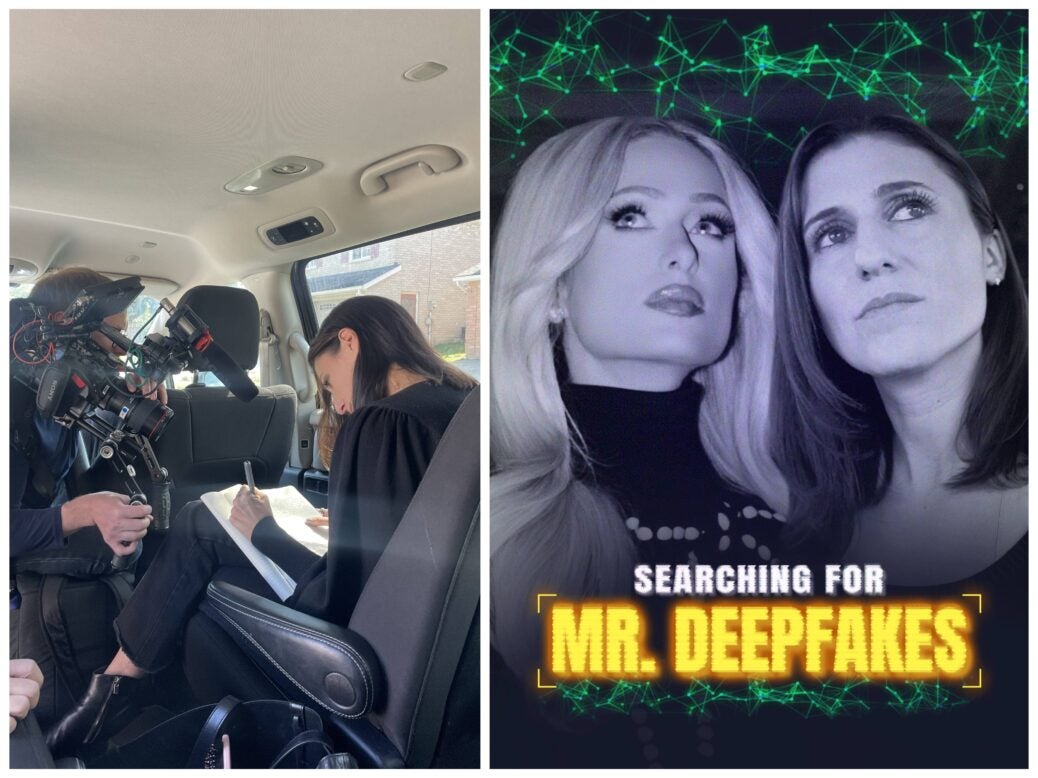
Former CNN editor-at-large and technology correspondent Laurie Segall said she chose to launch her investigative docuseries on Tiktok because it “lends itself to the format” of “rabbit hole” storytelling.
The 14-part series, launched with socialite and businesswoman Paris Hilton, explores the personal impact of explicit deepfakes on Tiktok and details the journey of unmasking an anonymous operator of one of the web’s largest deepfake abuse platforms.
Deepfake abuse involves taking real images of victims and using AI to make it appear that the person is acting out situations they never have – in this case, sexually explicit scenes.
“Searching for Mr Deepfakes” is a series of one to five minute videos – totalling around 40 minutes of content and was created by Segall’s company Mostly Human Media and Hilton’s 11:11 Media and premiered on 27 May after three years of reporting on the case.
The series sees Segall and a team of hackers, investigators and victims of deepfake abuse share information behind the website “Mr Deepfakes” eventually triggering the shutdown of the website.
“AI digital abuse was like a train wreck coming, and just given my background of covering the human side of technology for the last 15 years, I could see it happening,” Segall told Press Gazette.
She added Mr Deepfakes is “one of the most dystopian websites I’d ever seen”, with 17 million people using the site at its peak.
“I think the people I want to see this are folks who could be victims of deepfakes, teenagers, young girls, but also your mum, your wife, your sister, and also like not just women, right?”
Tiktok ‘blueprint for the future of journalism’
Segall believes Mostly Human Media is “one of the first to try” launching a vertical investigative series on Tiktok.
“The traditional world would tell me, ‘oh, this should be on CNN’, or, ‘oh, this should be on a streamer’, and it very well could and should be on places, but I really think [we should push] ourselves to do real reporting in a way that people are consuming,” she said, adding that the content also works on Tiktok as it feels “a little true crime” and this was purposeful.
[Read more: How crime content is powering Daily Mail’s podcast expansion]
“I felt that this particular story had a certain type of urgency, and the people who needed to see it are on social media, like the people who are victims of deepfakes… [and] the internet played such a huge role in this investigation,” Segall added.
“I, for better or for worse, go down Tiktok rabbit holes all the time, but it almost feels like you’re watching your friend tell you a story, right? And I think this story really lends itself to the format.”
Segall said it “took a lot” for her, with a long-form journalism background, to approach a “quick-hit format” with the emotion of the story.
“How do we not lose like real nuance and heart while trying to kind of get these into like two and a half minutes or 30 seconds or five minutes [clips]?”
The team approached this by releasing all the episodes at once so users could access all elements of the story and “binge” the series from start to end.
“We believe this project is a blueprint for the future of journalism. You don’t have to sacrifice rigor, humanity, or impact to meet audiences where they are,” she said. The series makes money through revenue share from Tiktok, and will be giving all funds to an organisation that helps victims of digital abuse.
Tiktok was a preferred platform over other streamers, such as Youtube, because it is more accepting of “alternative narratives” that may not appeal to other platforms’ algorithms, Segall added.
“I think pushing this out there on Tiktok, where people can join the conversation, and you can have a two-way conversation with people – I’m excited to comment back, I’m excited to collaborate… I think that Tiktok, in particular, is a really great platform for that.”
One challenge the team faced was writing a Tiktok script for the series was “knowing that you have about a couple seconds at the top to get people into it”, Segall said, as well as using words that could be censored on the platform.
“In writing it, we were trying to figure out what words were bleeping. We’re trying to think, ‘do we come up with code names for things?’…we did bleep out the word porn, and we don’t know if we’ll be dinged because of certain words and whatnot, but we’re gonna try it,” she said.
‘We’re viewing Paris Hilton as our streamer’
Segall said she recommends newsrooms collaborating with influential voices and capitalising on their engaged audience. She made the decision to partner with Hilton after seeing her testify in Washington supporting the Defiance Act, which addresses the issue of non-consensual deepfake pornography.
“It was really hard to get people to speak out on this. And so we ended up connecting with her team… she’s such an influential voice, especially when it comes to culture and the internet, and Paris was one of the earliest victims of non-consensual pornography,” Segall said.
“We’re viewing Paris Hilton as our streamer, like I am thinking Paris has something like 12 million followers on Tiktok, 26 million followers on Instagram.
“She’s a modern-day streamer who happens to also be incredibly deeply connected to this issue, and so that’s really exciting. So maybe we don’t have to go this traditional route to be able to have the biggest impact.”
The series will be run on Hilton’s Tiktok account as well as Mostly Human Media’s.
Email pged@pressgazette.co.uk to point out mistakes, provide story tips or send in a letter for publication on our "Letters Page" blog
