

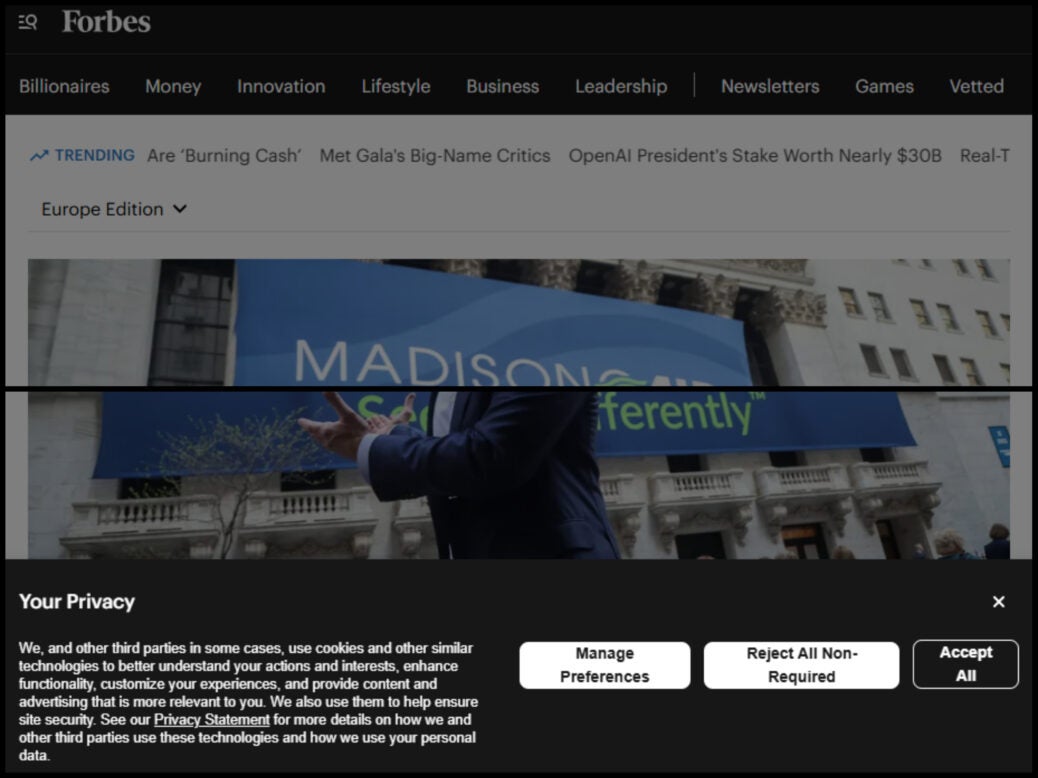
Forbes has agreed to settle a class action lawsuit in California relating to its use of third-party website trackers.
The trackers on Forbes.com collected IP addresses and other unique identifiers from visitors, which those bringing the lawsuit argued constituted unauthorised use of “pen registers” and “trap and trace devices” under the California Invasion of Privacy Act.
A “pen register” is a “device or process that records or decodes dialing, routing, addressing, or signaling information” while a “trap and trace device” is one that captures incoming information that can “identify the originating number or other dialing, routing, addressing, or signaling information reasonably likely to identify the source of a wire or electronic communication, but not the contents of a communication”.
The two plaintiffs, who brought the case on their behalf and others who may have been similarly affected, accused Forbes of installing trackers on its website including the Linkedin Insight Tag, the Bing Universal Event Tracking Tag and the Adnx Tracker, all ultimately owned by Microsoft.
They alleged that Forbes used trackers to collect and send IP addresses and other unique identifiers, without obtaining consent, to Linkedin, Microsoft and other undisclosed third parties.
Those third parties then “feed this data into large databases to compile and use information about specific users’ browsing and shopping habits across the internet”.
The plaintiffs claimed this “allows Forbes and others to optimise targeted advertising campaigns and provide website and advertising analytics at the cost of depriving ordinary internet users of control over their private internet activity”.
After “fruitful” settlement discussions, Forbes has agreed to create a $10m fund from which people can make a claim, expected to be worth $32 to $189 per person.
Forbes also agreed to implement “meaningful reforms” to its business practices to give visitors in California “enhanced notice” of the presence of third-party trackers and more control via a banner/pop-up over how their data is collected and shared with third parties.
The proposed settlement must now be approved by a court next month.
The plaintiffs believe there have been around 3.9 million unique California visitors to Forbes.com since 20 December 2023 who may be eligible for the settlement.
Registered users are included, as are those who used any web browser, because at least some third-party trackers collected information from all visitors regardless of their registration status or which browser they used.
Under the settlement an ad campaign would be rolled out so Forbes website users can potentially find out if they may have a claim, including targeted advertising on Facebook, Instagram, Threads, Youtube and display ad networks towards users in California interested in business and financial news.
Last month USA Today Co defeated a lawsuit relating to its own alleged use of third-party trackers without consent, capturing IP addresses and other information.
The plaintiffs in that case failed to allege concrete harm by this “invasion of their privacy”, judges said as they ruled in favour of USA Today Co’s motion to dismiss.
A report published last month found many major websites continue to track users despite receiving a signal from a California IP address that a website user does not wish for their personal information to be shared.
Email pged@pressgazette.co.uk to point out mistakes, provide story tips or send in a letter for publication on our "Letters Page" blog
