

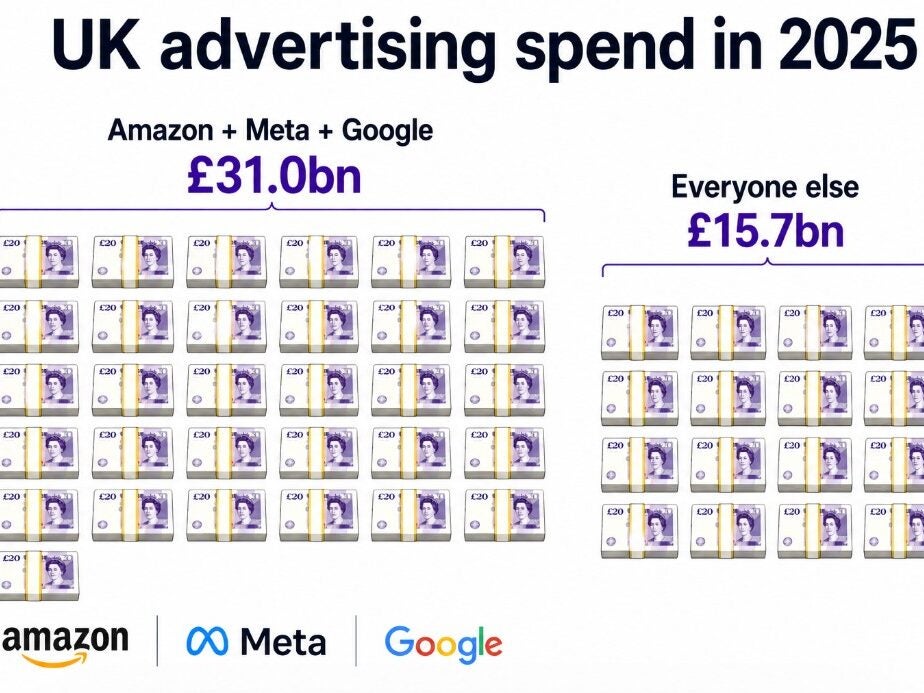
Three US tech giants accounted for two thirds of every pound spent on advertising in the UK last year.
New estimates from the Advertising Association and WARC show total UK adspend grew 6.4% in 2025 to a record £46.7bn.
But nearly all the new money went to Google, Meta and Amazon which together accounted for some £31bn of the total according to Press Gazette’s analysis.
Google took the lion’s share of UK advertising via its dominant position in search (with additional revenue from Youtube and adtech services).
Press Gazette estimates Google’s total UK advertising income at £21.5bn for 2025.
Meta came second with estimated adspend on its platforms of £6.5bn.
And Amazon came third with estimated adspend of £3bn.
Scroll down to see the methodology Press Gazette used to arrive at these estimates.
Meanwhile, adspend with the entire magazine and news industry fell 5.1% year on year to £1.6bn. Both print and online revenue fell last year in every publishing segment: national newsbrands, regional newsbrands and magazines.
The data underlines why publishers are working so hard to grow subscriptions, video and events revenue.
It also illustrates why many publishers are so keen to see stronger regulation in place that could help rebalance the online ecosystem to better encourage journalism.
They are accused by many of abusing their monopolistic positions in search and social media to grow ever more dominant whilst failing to fairly reward professional content creators.
Social media adspend (which includes Youtube) was the fastest-growing category measured by AA/WARC, up 21% to £11.5bn in 2025.
Retail media (advertising directly with online retailers) was the second fastest-growing UK advertising segment in 2025, according to AA/WARC, growing 17.5% to £3.8bn. This area is dominated by Amazon.
Search advertising also grew, by 5.8% to £17.9bn.
UK publisher adspend in 2025
Looking at published media:
— Magazines fell 5.1% to £445m (of which online fell 0.2% to £258m)
— National newsbrands fell 4.6% to £695m (of which online fell 0.9% to £345m)
— And regional newsbrand fell 6% to £412m (of which online fell 2.2% to £243m)
In 2007 the UK advertising market was worth £17bn (around £29bn in today’s money) of which £7.1bn was spent with newspapers and magazines (£12.2bn today).
The AA/WARC does not include separate figures for podcasts, but online radio advertising grew strongly – up 14.9% to £89.5m.
How did Press Gazette arrive at this data?
AA/WARC data is based on a survey of media owners and the industry bodies which represent them.
Press Gazette’s estimate of Google’s £16.3bn search revenue is based on its 91% UK market share of search and the £17.9bn AA/WARC estimate for total UK search advertising.
Google’s £3bn (gross) Youtube revenue assumes that UK Youtube advertising revenue has the same proportion to search revenue in the UK as it does globally (as stated in parent company Alphabet’s published results).
Similarly, Press Gazette has assumed that Google Network revenue of £2.2bn in the UK (for its adtech services) is in the same proportion compared to search revenue as seen globally in 2025.
To arrive at Meta’s £6.5bn UK adspend estimate, Press Gazette subtracted Youtube’s £3bn from the £11.5bn AA/WARC total for UK social media adspend. We then allocated a proportion of that £8.5bn to Meta based on the proportion of minutes spent with its properties versus Reddit, X and Tiktok (Ipsos iris data).
Amazon’s £3bn is based on its estimated 73% share of retail media rounded up to include revenue from its wider online advertising tech stack.
Press Gazette would love to hear from anyone who can see a flaw in this methodology or suggest a better way of doing this. Email: dominicp@pressgazette.co.uk.
Press Gazette used the same methodology to provide estimates for Google and Meta UK ad revenue a year ago (albeit with AA/WARC data in a different format) and those figures remain unchallenged.
Comment: Better regulation of Google and Meta is desparately needed
As we approach the 250th anniversary of America declaring its independence from Britain, we have come full circle – writes Dominic Ponsford.
In commercial media terms at least, the UK is now a colony of America.
The answer is astonishing. My best estimate is that two thirds of everything spent on advertising in the UK – £31bn – goes to Google, Meta and Amazon (in that order).
Meanwhile, news publishing (the thing that underpins democracy) is being squeezed further and further out of the picture.
All advertising on magazines and newspapers (in print and online) was worth £1.5bn in 2025. Back in 2007 (before the financial crash) advertising that supported professional journalism was worth £7bn a year.
To some extent Google and Meta simply offer a better service to advertisers. But they also have monopolies over search and social that would not be tolerated in any other aspect of the UK economy (let alone one as vital to society as information).
These figures underline the desperate need for better regulation of these tech giants under the Digital Markets Competition and Consumers Act, and the urgent need for publishers to find alternative revenue streams in the meantime.
At Meta around 10% of the £6.5bn a year spent with it on advertising in the UK is fraudulent.
So it makes at least £650m a year in the UK alone from criminals who steal people’s identities to con trusting consumers out of their savings.
The most hijacked person for use in these scam ads is Martin Lewis, who is also probably the UK’s most trusted journalist.
Press Gazette asked him yesterday whether Meta has raised its game since he sued them for defamation in 2018. No, he said, the issue is worse than ever.
And this underlines the competitive disadvantage that has enabled Google and Meta to grow to monstrous proportions in the UK – undermining democracy and providing a helping hand to criminals on the way.
Publishers have to check everything they present and are liable for it (ads and content). Google, Meta and others are protected by the Electronic Commerce Regulations 2002 in the UK and Section 230 of the Communications Decency Act in the US.
This means they are no more liable for most illegal content than, say, the companies that maintain the telecoms cables.
The Online Safety Act makes tech platforms responsible for curbing the most dangerous content. But enforcement by Ofcom is clearly not working.
Email pged@pressgazette.co.uk to point out mistakes, provide story tips or send in a letter for publication on our "Letters Page" blog
