

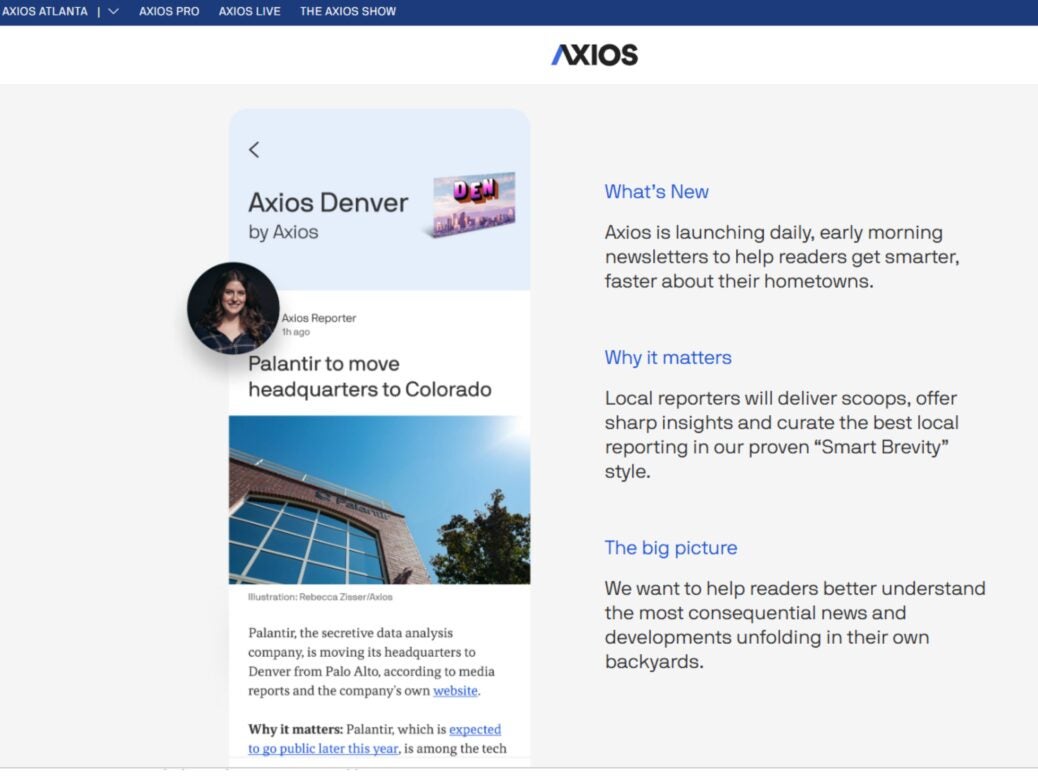
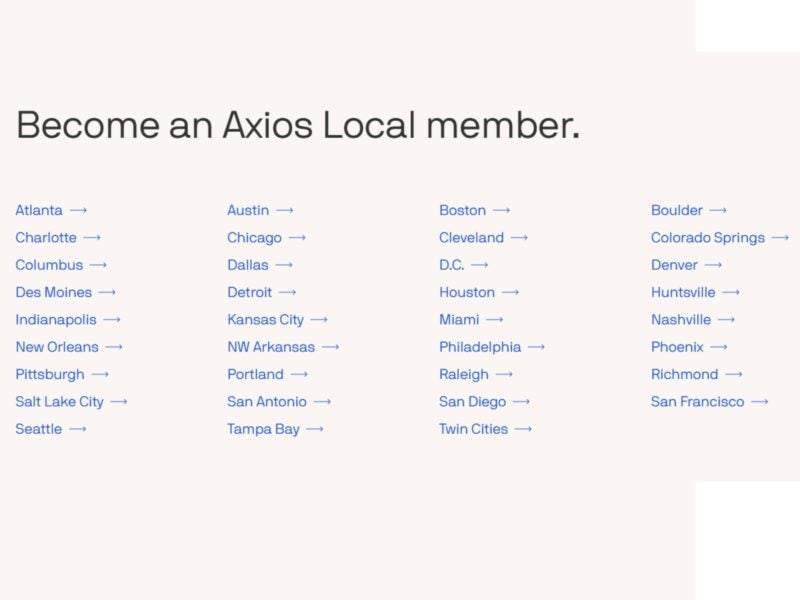
Axios will have a local newsletter in 43 US cities by the end of 2026 as it continues to expand.
Axios Local has not yet hit profitability but investment has seen paying members more than double to 15,000 since the end of 2025. Since launch in 2022, Asxios Local now has more than two million free subscribers across 35 cities, with more than 100 local reporters.
“Our endgame is to be everywhere in all of the US,” said Holly Moore, executive editor at Axios Local.
“News organisations are closing rapidly across the US, and so we do think that there is a need for high-quality journalism in a lot of places.”
Axios has previously said it believes it can launch in at least 100 US cities.
Moore said: “Local is definitely a hot topic in Axios. It’s something that especially our founders are super interested in, ‘how do we get into more places?’”
So far this year Axios Local has launched a newsletter for Colorado Springs, Scottsdale and Mesa in Arizona, Hollywood and Fort Lauderdale in Florida and Cincinnati in Ohio.
Its 36th and 37th newsletters will launch in Arapahoe County and Douglas County, both in Colorado, this month.
The newsletters are mostly daily, typically run by two full-time reporters per area, delivering three to five pieces of original reporting and lifestyle stories per edition, plus stories “that are being told by the community” and links to relevant news covered by other titles. Axios Local editions also have their own websites.
Axios does not share financial figures but has said the local business is not profitable. The more mature Axios Local markets are now helping to fund new launches, Moore said.
Axios Local general manager Liz Alesse said in a statement to Press Gazette that expansion is the “path” to profitability, rather than the obstacle to it: “The technology and operating model we’re building now is designed to compress the time and capital required to achieve profitability,” she said.
A key part of the expansion strategy is launching in markets “near existing anchor cities”.
“So we’re doing what we’re calling connector communities, and that’s like this Colorado expansion,” said Moore, adding that the launch in Boulder in 2025 was due to the brand already having visibility in Denver.
Axios also targets areas that have a “huge need for local news” and “areas that are growing already in terms of population, and the suburbs are a huge opportunity,” said Moore.
Local News Initiative research helps Axios identify news deserts to launch in.
“These suburban areas are growing at a rapid clip, and the news isn’t there to support it in that same way,” Moore added.
News decline isn’t the sole motivation for launch, but newspaper activity does drive strategy.
“We’ve seen what’s happened at The Washington Post, where they have changed their Metro section quite a bit. And we do think there might be a need there. And then also, we’re already in Pittsburgh, where the Post-Gazette [has seen] some changes around there [with it being] repurchased,” said Moore.
She added: “We absolutely are paying very close attention to how the news landscape is shifting and making strategic news decisions around that.”
[Read more: US newspaper circulations 2025: Washington Post print declines 21% in a year]
Changing expansion strategy
The company paused expansion in 2023, after launching in 30 major US cities, to “make sure that we were doing it in the smartest way possible”, said Moore.
The pause followed the business reportedly missing its revenue, hitting $8.6m in 2022, short of its $10m forecast. At this point, Axios Local was still not profitable, but had 1.55 million subscribers across all markets.
Moore said: “We took a break to say, ‘okay, does this model that we are doing in these largest cities work in these smaller cities and these smaller communities?… Where are the most people to read us? Where are the most advertisers? It was also intentionally how can we learn something from this city?”
Expansion resumed in 2025 with a more experimental approach, testing the model in “news impoverished” areas like Huntsville, Alabama.
Moore said: “One of the things that we found harder is to aggregate stories when there’s less news on the ground. I don’t know [if] by many definitions Huntsville would be considered a news desert, because there are some outlets there, but there’s no daily paper there anymore, and so that was the first place that we went that didn’t have that competition.”
Moore added that it took “longer to hire than we expected” in Huntsville as a result.
“We are really focused on making sure that we have the right talent… if you’re going to go into a small city with one reporter, that better be the best reporter,” she said.
Paying members doubled in four months
Axios Local mainly makes money from advertising but also holds events and sells paid memberships.
Its paid membership programme, launched in 2021, asks for donations ranging between $25 to $500 per year and has grown from 7,000 paying supports at the end of 2025 to 15,000.
While most content remains free to all, members receive birthday shoutouts, exclusive newsletters, engagement and networking opportunities with reporters and merchandise like tote bags.
Local advertisers paying for direct-sold premium sponsorship ads on the newsletters are steadily making up more of the revenue (the business doubled its local advertising in 2024).
Partnership with OpenAI
A three-year partnership with OpenAI in January 2025 has also supported the ability to expand.
Axios Local uses OpenAI technology to streamline workflows, surface local trends and reduce time spent on admin tasks so journalists can do more original reporting. Local journalists also take part in OpenAI Academy training and education schemes. In return, OpenAI can train on Axios Local content.
Moore predicts that “there will be headwinds with newsletters” in the future, “whether that’s an Axios thing or any newsletter”.
“Because as AI is able to summarise what’s in inboxes, we’re going to have to think of new ways and new metrics to help us get people to click into the newsletter,” she said.
Standing out from local competition
The company is now preparing to launch its local newsletter brands on Instagram this year, followed by Linkedin, X and Facebook. Moore said it was important people consume the brands “on all the platforms”.
Axios Local stands out from its competitors by offering “what is important to the people that are living there on that day”, said Moore, adding that getting “inside the room” is key plus being “cognizant of the audience and their time”.
“Are we writing it in a way that you could tell your friend at a bar and they would understand it?… It’s about giving complex information in easily understandable ways,” she said.
Axios Local also aims to stand out through its community connections.
For example, a reporter for the Des Moines newsletter is growing a pumpkin for the Iowa State Fair – “Is she a farmer? No, she isn’t,” said Moore. “But she told her readers that she was doing this, people reached out to her and gave her seeds to grow this pumpkin with… there is this element of how much engaging with the community is super important to what we do.”
Email pged@pressgazette.co.uk to point out mistakes, provide story tips or send in a letter for publication on our "Letters Page" blog
