

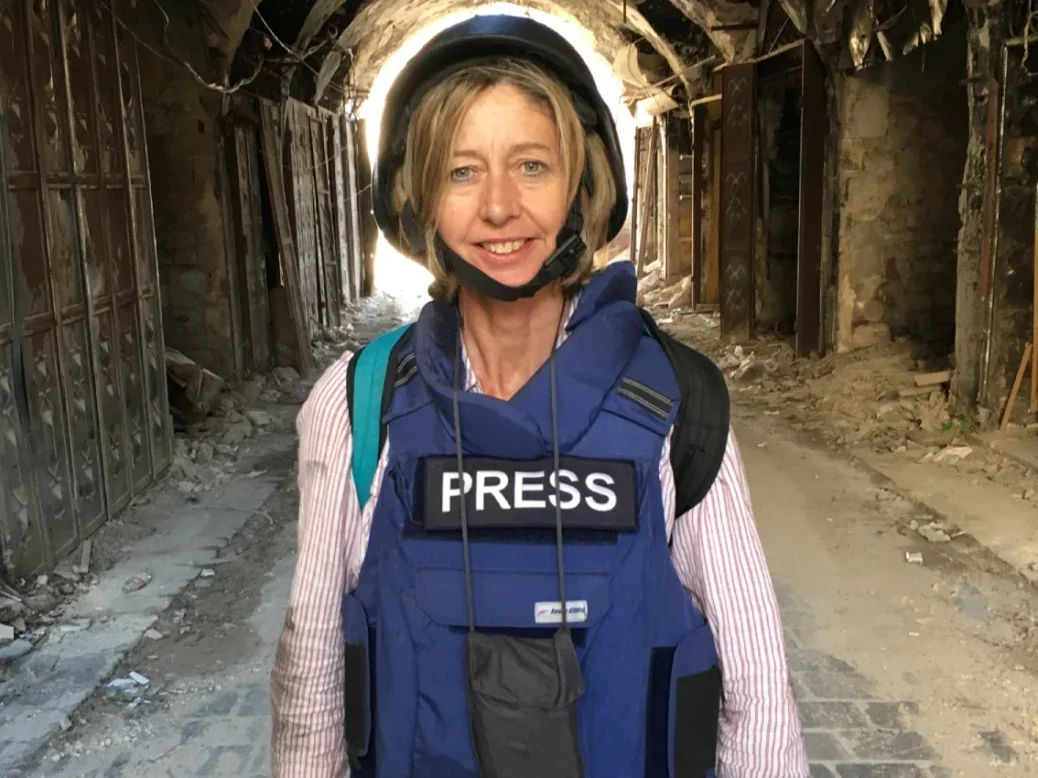
Sunday Times chief foreign correspondent Christina Lamb has called for the creation of an independent international task force to investigate crimes against journalists.
Lamb warned journalists are now being deliberately targeted in war zones and are being put at risk by wearing the flak jackets emblazoned with the word “press” which are meant to protect them.
She said she is “convinced that press freedom and journalism are under threat more than at any time in my almost four decades of reporting”.
Lamb was speaking at the annual meeting of the Network for Investigation and Prosecution of Genocide, Crimes against Humanity and War Crimes attended by war crimes prosecutors and police investigators in The Hague.
Her words came days after Lebanese newspaper journalist Amal Khalil was killed in an Israeli airstrike while sheltering after a previous attack.
Khalil’s killing, and the wounding of another journalist, has been labelled as a “deliberate and targeted” act perpetrated by Israel, which denied it targeted journalists but said the incident was under review.
Lamb noted Khalil was “clearly identifiable as a journalist in her blue press jacket” and compared her death to the 86 journalists killed by Israeli forces in Gaza last year.
Khalil previously claimed she had received a message in 2024 from an Israeli number threatening her and warning her to leave southern Lebanon. The message reportedly said: “We know where you are and we will reach you when the time comes… I suggest you flee to Qatar or somewhere else if you want to keep your head connected to your shoulders.”
Lamb said: “It shouldn’t need saying but let me say it: Journalists are civilians. Deliberately targeting them is a war crime.
“And yet, just as with sexual violence in conflict which I write about a lot, accountability is the exception not the rule.
“We take risks to shine a light on injustice and bring back stories of those who can’t. We are not saying we should be special, just treated as the civilians we are and left to do our job.”
Lamb noted that the design has just been unveiled for the UK’s first memorial to British journalists killed in conflict.
But she said “perhaps a better memorial for those lost” would be a “standing, independent international task force investigating crimes against journalists”.
The call for an independent body was also made by Committee to Protect Journalists chief executive Jodie Ginsberg in a lecture in London last month.
Ginsberg said: “Killing journalists is the ultimate form of censorship. And no discussion of journalist safety in the current moment can avoid what has been the deadliest assault on journalists since CPJ began [in 1981].
“Of the 129 journalists and media workers killed last year, 86 were killed by Israel. The majority of them were Palestinians.”
Lamb said she always knew that her work could be dangerous: “I was after all going to places where people were shooting at each other so was a clear risk I could be killed or injured. But I didn’t think anyone was trying to kill me.
“If anything happened to me it was either bad luck or I’d done something stupid. As a journalist and civilian I was, I thought, protected by Geneva convention.
“What has changed is now we journalists have become targets.”
Lamb described this shift as “part of a general pattern of increasing authoritarianism and declining media freedom around the world… Attacks on journalists are a warning sign that attacks on our rights will follow.”
She suggested journalists today may be “better off” wearing camouflage than their traditional “press” flak jackets: “If people are targeting us, we shouldn’t make ourselves more obvious.
“During the war in Iraq we taped TV to our vehicles to mark ourselves out as press – something I very much doubt we would do today.”
Lamb referenced the killing of her Sunday Times colleague Marie Colvin in shelling by Syrian government forces in 2012.
“Killing journalists is the ultimate form of censorship and happening so much that a new word has been coined to cover what has been happening: ‘journacide’…
“Nor is it just in war zones. I never imagined that a journalist in a European Union country – Slovakia – might be killed for their investigative reporting. Or that a journalist I knew might be brutally murdered and dismembered inside a consulate building in Istanbul.” Lamb was referring to the killings of Jan Kuciak and his fiancée in a contract killing, and to the murder of Washington Post columnist Jamal Khashoggi, both in 2018.
Lamb said the “bleak climate” facing media today extends to a “unprecedented” wave of legal intimidation in the US, journalists being imprisoned “from China to the Gulf”, and restrictions on press entering some countries including Gaza.
Email pged@pressgazette.co.uk to point out mistakes, provide story tips or send in a letter for publication on our "Letters Page" blog
