

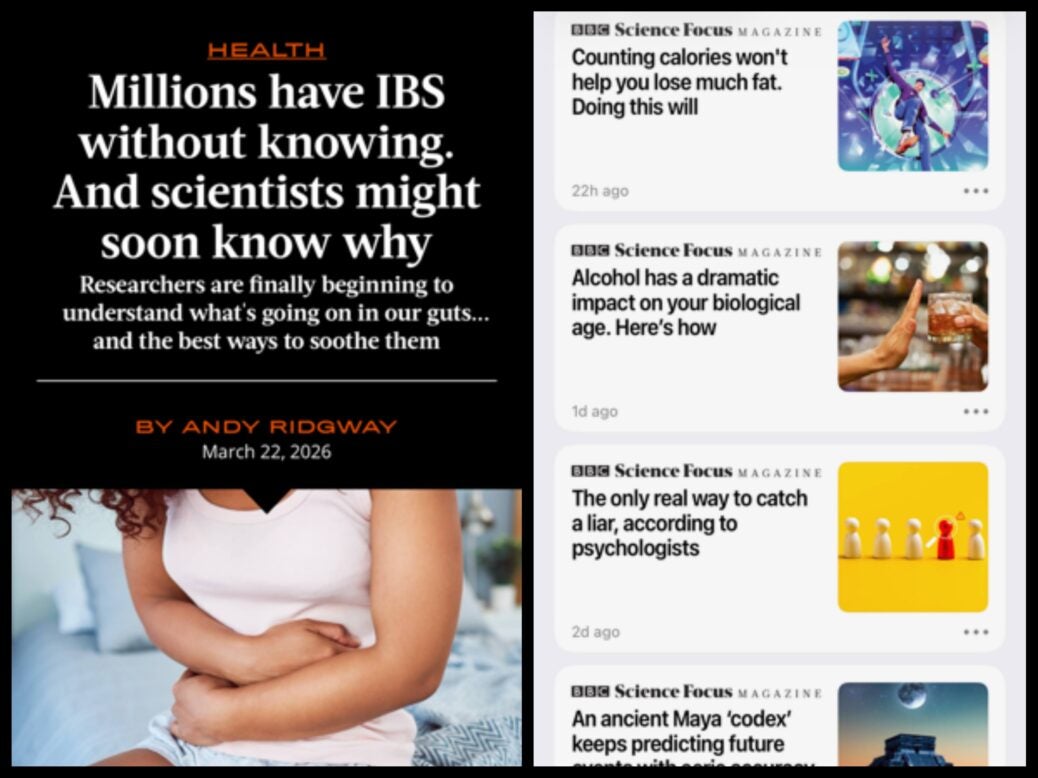
BBC Science Focus has made “embarrassing amounts” of money and almost doubled its team since finding success on all-you-can-read subscriptions app Apple News.
The title – available as a print magazine, app, website, podcast and newsletter – targets “people who had a bad science teacher”, publisher and editor Daniel Bennett told Press Gazette.
In other words, those “intelligent and curious” that have been put off science, he said, with the audience ranging from “precocious 14-year-olds” to scientists.
BBC Science Focus was originally part of the BBC’s magazine division before being sold in 2011. This was followed by Immediate taking over the title, before it became fully owned by the company’s former subsidiary Our Media this year.
It is still produced under licence from the BBC, meaning it adheres to stricter ad guidelines than most commercial titles, such as not being able to endorse products or imply political bias.
As a result, “ads have never been a massive part of our revenue makeup,” Bennett said.
Like many publishers, BBC Science Focus had a wake-up call during the pandemic. After laying off four staff in 2020 due to falling sales, Bennett assessed the title’s revenue streams and found two areas across the business that showed growth: digital advertising and Apple News.
From there, the publisher moved forward with a new strategy to focus on Apple News in 2022. Until then, content had been “hidden” from the digital world, Bennett said.
Apple News, the free pre-loaded app on Apple devices, provides a curation of top stories chosen by editors.
It pays publishers through its free platform Apple News and paid Apple News+, estimated to have 1.7 million subscribers in the UK, which provides access to full magazines and newspapers and shares half of its £12.99 per month subscription revenue with them.
The free iteration of Apple News offers publishers revenue through display, video, and native ads, giving publishers 100% of the revenue generated from ads they sell, and 70% of revenue from ads sold by Apple.
“As a group, we all agreed together that we put digital first, and we’d all kind of put the magazine second… we basically looked at every piece of content we put out and just thought, how can we make this more digital?”
The shift saw quick results: four years ago, the magazine had six full-time editorial staff and monthly page views of around 1.5 million.
Today, it has almost doubled those statistics on both fronts. Its team has grown to 11 full-time editorial staff, including its first podcast editor, plus two full-time and one part-time design staff, and it hits three million page views per month.
Bennett credits much of this growth to Apple News success. While it saw initial success on Google Discover, this has since dropped off due to platform updates.
“How long do you have a top spot on Google News? Maybe an hour,” said Bennett. “And sure, you can get hundreds of thousands of page views for that long. But when I was looking at Apple News, you could own a piece of real estate, as we call it, so you could be the top story back in 2022 and you could be there for four days.”
Apple News “looked like everything I loved about magazines, like great headlines”, said Bennett. “You didn’t have to think about SEO… And so then we started to kind of lean into that as a platform back in 2022 a time when I don’t think anyone else was.”
Apple News+ rewards engagement rather than clicks
Bennett added the platform rewarded engagement over clicks.
“It wasn’t just… how many eyeballs could you get in… but actually how long could you keep them for,” he said, adding this was part of why they shifted away from being a title purely focused on serving direct subscribers.
This also included rethinking content from being exclusively science-based to health and trending product news which perform well on Apple News.
“You’ve got a certain number of people who want to read about black holes, and they will pay for a magazine to do so, but when you’re in the world of digital the number of people who want to read about how to lose weight is far bigger,” he said.
Clear headlines rewritten for Apple News are also key after the team realised pun headlines did not translate well to the platform. This was a tactic most magazines hadn’t caught onto in 2022, said Bennett.
The digital shift is clearly seen in BBC Science Focus’ digital circulation – 99% of which comes via all you can read magazine bundles like Apple News+ (353,644 out of 355,458 average circulation per issue). The title sees most users on Apple News+, but is also active on Amazon’s Kindle, Readly, and Zinio.
“There’s no dependency on ads here, like you’re literally getting paid for the quality of your content,” Bennett said of Apple News+, adding BBC Science Focus has made “embarrassing amounts and grown our team from doing this”.
BBC Science Focus’ share of the Apple News+ subscription means it gets a portion of £6.50 per user per month dictated by dwell time, so the amount of time they spend reading a particular magazine brand.
Bennett said all-you-can-read subscriptions won’t “work for every business”, but does for a team of their size.
“No business wants to be dependent on one revenue stream,” he said.
To diversify revenue, the BBC Science Focus has a podcast and app, the latter has some 5,000 users and offers paid-for digital access to the magazine.
The current revenue split at the magazine is 25/75 between print and digital, with almost half (45%) of digital revenue from Apple News, and the remainder made up of website advertising and digital subscriptions.
The majority (80%) of the magazine’s subscription revenue has always come from subscriptions with 20% from newsstand. Print accounts for 20% of advertising revenue.
Email pged@pressgazette.co.uk to point out mistakes, provide story tips or send in a letter for publication on our "Letters Page" blog
