

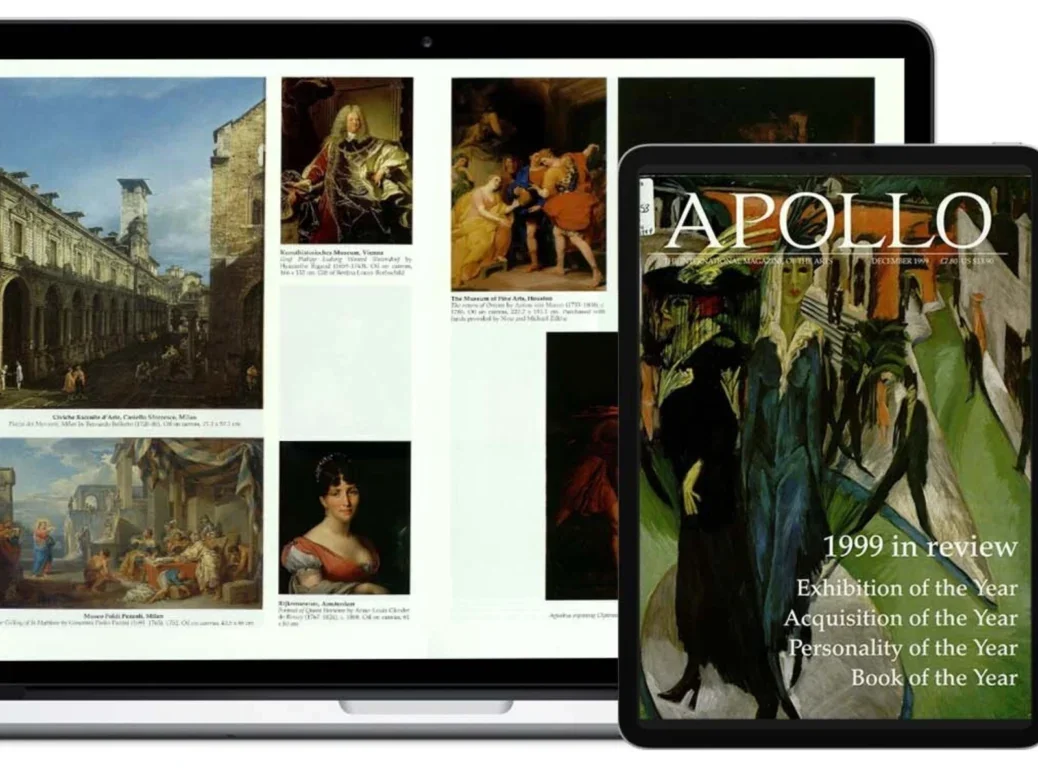
The Spectator’s sister monthly art magazine Apollo has added a premium subscription tier giving access to its full 101-year archive, as it defies Google AI summaries with “niche” and authoritative reporting.
Apollo set out to digitise its full archive for the first time last year as it marked its 100th anniversary. Subscribers can now pay £100 a year for a premium digital tier with access to more than 1,200 magazines, or £120 with the print magazine included.
A standard digital subscription (the Apollo website has a metered paywall) costs £52 per year, and print and digital costs £70.
Editor Edward Behrens told Press Gazette: “Whenever I have subscribed to various journals who have archives of good writing that has a degree of permanence about it, the archive is one of the most interesting things about the subscription. So I feel this is a model that makes sense.”
The archive is also available to institutions such as universities and libraries that are signed up to Exact Editions, the platform that digitised and hosts the Apollo archive.
“We know that a lot of people come to Apollo as students and then stick with us for the rest of their lives. And the reason that the students find us a valuable resource is because of that archive,” Behrens said.
He continued: “But we did a little bit of exploration into it and found that museums are also very interested in it, and art world insiders, and we’re taking a punt that it would also appeal to readers.
“We didn’t do endless surveys. It seemed like a useful thing to do. We think we can make a useful revenue stream from it. So let’s put it out there and see what happens.”
Behrens, who joined the title in January 2022, said the value of archive content had been proven during the Covid-19 pandemic.
The shutdown of arts events meant there was less to cover so Apollo instead shared “timely archival stories that proved incredibly popular” including via a newsletter.
Apollo’s archive spans from the start of the surrealism movement, which emerged in the interwar period. Behrens described it as an “amazing resource” that shows how different art movements were viewed contemporaneously. He also noted Apollo published some of the most famous art historians, such as John Berger and Brian Sewell, as well as more niche experts.
New ownership leads to redesigned website and reduced churn
Apollo, which is profitable, was part of the £100m deal that saw GB News co-owner Sir Paul Marshall buy The Spectator in September 2024.
The titles are now part of his business Old Queen Street Media, which also publishes news and opinion site Unherd.
After the takeover, Apollo underwent investment into a website redesign to make it “more dynamic and also a bit newsier and faster”, Behrens said, although he noted it still has a slower pace than newsbrands like The Art Newspaper.
“It is important, I think, one that we look fresh, and two that we are capable of serving our readers on their phones, which the previous website was not that adept at doing. So we were able to overhaul everything and give ourselves the new public face that I think Apollo deserves.”
Apollo also benefitted from a subscriptions platform built in-house at OQS Media that helped The Spectator to an all-time high subscriber total last year.
Behrens said the CoEditor platform, which has made the subscriber sign-up process more efficient, has reduced churn at Apollo. He declined to share a subscriber number for the art magazine but said it has a print readership of 35,000.
Apollo’s subscriber base is 40% in the UK, 40% in the US and 20% in the rest of the world. Behrens said the “majority” of subscribers get the print and digital package, although there is a “significant cohort” who are digital only.
Why Apollo magazine has survived and thrived despite Google AI changes
Google was historically Apollo’s top referrer digitally and Behrens said although there has been some hit to traffic from AI Overviews, it was “not massive”.
He said: “It’s proving more resilient than the first week or two [after AI summaries arrived] suggested it might, and numbers levelled out quite quickly.”
He shared a theory about why, explaining that “often our subjects are not a major part of the LLM training copy, so AI doesn’t have that much to add to, doesn’t have that much to sort of précis or keep people away from us. The specificity of our articles means that they are still the authority that people go to, and there’s not enough of an overview to bar people from it…
“I guess there are lots of people who will tell you that niche is where you want to be right now, and I think that’s what we’re seeing at the moment.”
Apollo has also made up for some of the search drop it has seen by trying out posting visually-led content on Pinterest. Behrens said this has directly led to traffic and subscriptions.
Apollo has an editorial team of six, including Behrens, four commercial staff, including one in New York, and one marketing person, as well as some shared marketing and events resources within OQS Media.
Apollo regularly features luxury advertisers, such as fashion brand Loewe. Many of its readers are art collectors as well as the well-informed, art-going public.
Partnerships and events are also an “increasingly big part of the business”, he said, citing gallery talks as an example. Apollo will host talks in its office during the Frieze Art Fair in London in October.
Email pged@pressgazette.co.uk to point out mistakes, provide story tips or send in a letter for publication on our "Letters Page" blog
