

If internet users accept convenient, plausible-sounding AI answers as “good enough” en masse, it harms the publishers that provide the primary sources used to generate those answers.
This second of three articles covering the AOP’s newly launched ‘Artificial Intelligence Publisher Impact Study’, looks at the behavioural impacts of AI on how users seek information online, as revealed by a nationally representative UK study conducted by Ipsos.
The first article in this series examined the 7.1% average reduction in referral traffic to premium UK publisher domains in the first half of 2025 and revealed how this reduction varied widely across various content topics and types. So why is this happening?
The decline in referral traffic to UK publishers is no surprise when we look at the rise of ‘stop here’ behaviours caused by AI. This is when the user, having retrieved their desired information, does not interact further. We found that the presence of an AI Overview on a search results page causes an 18% reduction in a user’s propensity to click through to the source.
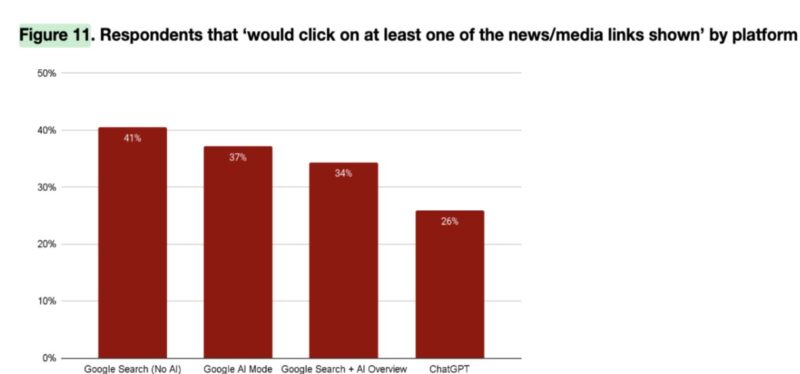
Standalone environments such as ChatGPT are even more likely to encourage “stop here” behaviours: only 26% of ChatGPT users report they would click at least one media link shown in a response, compared to 34% for a Google Search with an AI Overview. At the time of testing, AI Mode showed the most referral intent with 37% of respondents saying they would click through to at least one source.
The study found “stop here” behaviours could go in two different directions depending on interface: some users stopped because they found the answer to be sufficient, others stopped to answer follow-up queries within the platform itself. Of course, neither is beneficial to publishers, but the divergence does demonstrate how effective AI chat interfaces are at keeping users in situ.
ChatGPT is designed to emulate a conversational back and forth, keeping users locked into an ongoing dialogue that can adapt to their preferences over time in the ultimate realisation of engagement-focused algorithm design. Despite being superficially similar to Google’s AI Mode, twice as many ChatGPT users report making follow-up queries within the interface as their next action after receiving information.
Between AI Overviews and AI Mode, Google AI interfaces appear intended to drive at least some users off platform, while ChatGPT’s design encourages dependence. This may be a deliberate effort on Google’s part to preserve its value exchange with publishers or as a result of controls imposed by regulators.
However, this propensity to refer outwards may change as AI Mode becomes Google’s favoured user interface and if it follows ChatGPT’s footsteps towards a more chat-like experience optimised for user engagement and retention.
An optimistic reading of these study results is that AI Mode could work as a hybrid model that better preserves the traditional information ecosystem referral path, as Google would certainly like publishers to believe. Whether this will be the case in another matter. In its own documentation, Google has claimed that AI Mode is “driving the most significant transformation of Search in its history”, highlighting how sticky users find the interface while making no mention of sources or referrals.
Google is clearly still working out publishers’ place in this “significant transformation” and, until they know, we won’t either.
Young far more likely to use AI (but also click on links)
Our study found significant demographic divergence in AI usage. Adoption and frequency of use of standalone AI interfaces skews towards males, the degree-educated, and those aged 25 to 34. Only 11% of those aged 55 or older reported using ChatGPT more than once a week, compared to almost half of those aged 18 to 34. Google search remains ubiquitous across demographics, peaking among 45–54-year-olds.
In a small silver lining for publishers, the 25–35-year-olds who are most likely to use AI are also the most likely to feel the need to click on a link to complete their information retrieval. A fifth of this cohort stated they ‘definitely would need to click on a media/news link’, while only 8% of 55+ year-olds reported the same.
There is perhaps an element of media literacy around source retrieval at play here, as this would be the cohort most familiar with habitual internet search. Unfortunately, this may not be a skill that gets passed through the generations, as only 15% of those aged 18 to 24 in the study felt the need to click through.
We also found evidence that habitual AI use causes an increase in “stop here” behaviours. Around a quarter of participants who used Google’s AI mode about once a month complete their journeys within the interface, rising to almost 40% for daily users, significantly more than even ChatGPT.
Though we found there is broad public understanding of AI’s likelihood to generate falsehoods, it seems familiarity breeds complacency rather than contempt. As usage of AI interfaces becomes habitual, publisher referrals face further decline.
Another factor significantly affects users’ willingness to stay in-platform: trust. Around a third of users do not feel the need to click through if they completely distrust the source. Unfortunately, the same proportion won’t click through if they completely trust the source, because the presence of a trusted publisher brand means they are satisfied with the generated answer.
This trust U-curve exposes the Catch 22 at the heart of premium media brands’ relationship with AI platforms: our hard-earned trust is being used to make AI outputs valuable enough that the reader feels no need to visit our sites.
As frustrating as this may be, it does provide publishers a potential opportunity, because even convenience won’t be enough for AI platforms to retain users if they cannot trust the information they receive. In our third and final article, we will explore the trust paradox in detail, and what it means for publishers when AI companies ultimately depend on our reputations.
Email pged@pressgazette.co.uk to point out mistakes, provide story tips or send in a letter for publication on our "Letters Page" blog
