

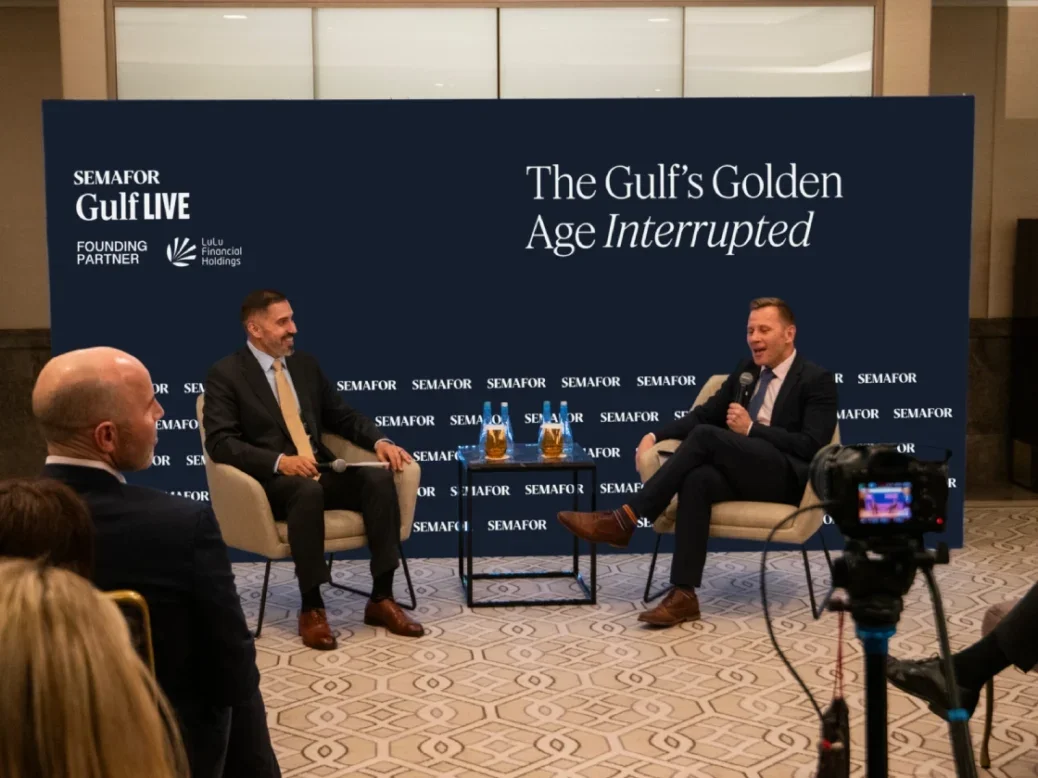
Despite the ongoing US-Iran war, Semafor is expanding its coverage of the Persian Gulf and seeing growing commercial benefits from doing so.
Co-founder and editor-in-chief Ben Smith told Press Gazette they are aiming to be “the business outlet of record in the Gulf”.
The audience, he said, includes business leaders, investors and “everybody who’s following one of the world’s central geo-economic stories” both from the Middle East region and power centres like Washington DC, New York and London.
He said it is “meant to be a first read for people who are obsessed with and need to be obsessed with the Gulf – and we’re very sophisticated about it, not the occasional kind of colourful dispatch from Arabia”.
Semafor launched its Gulf edition in 2024 as its third region after the US and sub-Saharan Africa. In 2025 the three-year-old newsbrand moved into profit with $40m of turnover.
It is led by editor Mohammed Sergie, who previously covered energy and commodities in the Middle East for Bloomberg and opened The Wall Street Journal’s Riyadh bureau in 2009, alongside Saudi Arabia bureau chief and global sovereign wealth fund correspondent Matthew Martin, who previously led Middle East money and power coverage at Bloomberg.
Semafor has five staff journalists across the region and the same number of columnists.
The newsletter has now stepped up from three days to five days a week. Smith also said there would be more events, both large and small, in the region.
Smith said Semafor Gulf has already been breaking news as well as providing “strong analytical coverage of the post-war challenges”.
He highlighted exclusive stories such as the $16bn cancellation cost of contracts for building parts of Saudi Arabia’s futuristic region Neom.
And he claimed other publications had “pulled back” from the Middle East because of the US and Israel’s war with Iran while “we’re certainly doubling down, and we’re seeing interest both editorially and commercially really just accelerate”.
Semafor’s global vision and expanding in video
Semafor’s journalism is funded by brands who want to reach political and business leaders by sponsoring its email briefings, podcasts, website content and events. Smith said there has been “tons of commercial interest” in the Gulf products.
Smith said the Gulf was “just a huge opportunity and it is part of, I would say, our broader strategy of globalising.
“We launched in the US and in sub-Saharan Africa, and our view is that there are these very big, deeply interested communities of business leaders and political leaders and NGO leaders who are very focused on these regions and who are really unsatisfied with what they’re getting from, in particular, big global publications that are filtering the news through London, through New York…
“People in the Gulf aren’t looking to global media just to learn how London sees them. They want a sophisticated point of view that’s as good as you can get anywhere else but is fundamentally a point of view from the region and from great journalists and their sources in the region, so that’s how we’re building – with very strong coverage obviously in the US in Washington, very strong coverage in Africa, and now very strong coverage in the Gulf that we’re really doubling down on, and then looking to expand that model to European and Asian editions in the coming, I’d say, couple of years.”
Smith added that the aim is to start with “full-fledged regional coverage” of Asia “within the next year”.
In February Semafor launched a weekly China newsletter promising a “weekly guide for leaders who need to understand China’s economy, its role in global markets, and its ambitions in technology, finance, and energy to make informed decisions”.
When Semafor launched in late 2022 it positioned itself as a global news company for underserved educated audiences who read in English.
Smith told Press Gazette they “faced some totally reasonable scepticism” about their claim but said now he believes “we’re the only really ambitious global start-up.
“There are lots of people in the news start-up news space doing really great work, but I don’t think anyone has the kind of conviction we do about building a global operation. And I think that we’re starting to grow into that vision that we talked about when we launched.”
Semafor is also expanding into video and has appointed head of video Adam Banicki, the former general manager of video at Fortune Media. At least five new shows are in development.
Video revenue has grown by 150% year on year and is expected to reach a “high-seven- to low-eight-figure revenue” by the end of this year, Adweek first reported.
Smith previously told Press Gazette that Semafor’s biggest early mistake was that they could “build a business around quality mini docs and things like that that were aligned to the journalism, but also to what marketers wanted”. It did not work financially and a previous head of video left in December 2023.
Now, Smith said, Semafor has “found a lot of success” with its shows (previously described as podcasts but they are also in video) which are currently: Mixed Signals he co-hosts with Max Tani about the media industry, CEO Signal, and finance Compound Interest.
They have also “found a real commercial lane” for video coming out of live events such as the headline-making World Economy Summit hosted in Washington DC in April.
“So those two separate platforms have given us a lot of confidence about being able to build a business around it and being able to grow organically and commercially,” Smith said.
Email pged@pressgazette.co.uk to point out mistakes, provide story tips or send in a letter for publication on our "Letters Page" blog
