


Search referral traffic is in decline due to increasing usage of AI. This has been common knowledge among online publishers since the proliferation of chat interfaces and generated summaries in search results, and we now have concrete data to prove it with the AOP’s newly launched “Artificial Intelligence Publisher Impact Study”.
As champions of premium online publishers, it is of paramount importance that we not only answer why this trend is occurring but provide insight on what can be done about it. To that end, we commissioned DJB Strategies to investigate where referral declines are most concentrated and where there are pockets of resilience.
The study is comprised of two components: six months of traffic analysis across eight major UK publishing groups totalling 10.8 billion pageviews (the sample accounted for about 80% of total traffic, after long-tail URLs were removed), along with a survey of consumer awareness and usage of AI tools, conducted by Ipsos. In this first of three articles examining and explaining the study’s findings, we will be covering the traffic analysis component.
We found that in Q2 2025, the same quarter in which Google said its Search revenue grew by 12% and AI Overviews significantly expanded, the very publishers funding and feeding the information ecosystem saw referral traffic from the platform plummet. Meanwhile, Google Search is being purposefully transformed from a gateway to content into a destination itself.
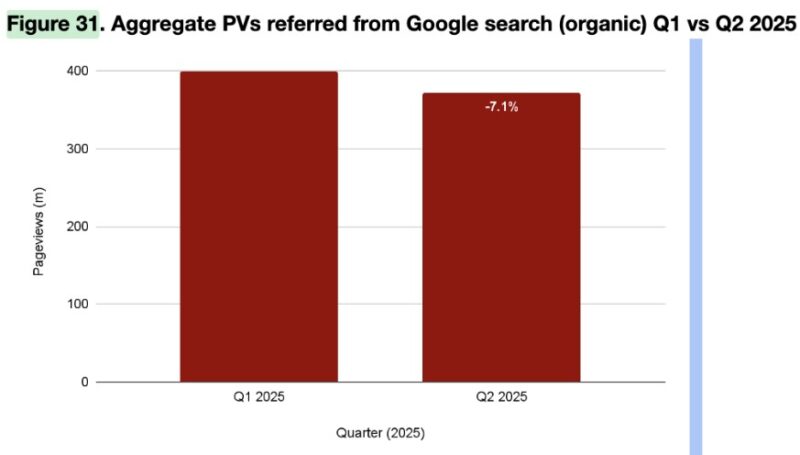
Between Q1 and Q2 2025, organic Google Search referrals fell by 7.1% across all participants in the study . If this trajectory is sustained, pageviews delivered by Google will be cut in half by Q3 2027, and this is without accounting for compounding effects that habitual AI use may have on return traffic. Given the company’s intention to make its zero-click AI Mode central to its future search experience, it’s not unreasonable to expect declines to accelerate.
However, these declines are not evenly distributed. Participant traffic was segmented by topic and content type across 147 domains, allowing precise analysis of the categories most vulnerable to AI substitution.
While all participants experienced reduced referral traffic during the study period, news publishers fared significantly better with an average quarterly decline of around 5%, compared to 18% for the consumer/B2B segment. This discrepancy is likely due to the tighter guardrails placed around news in AI Overviews compared to more easily aggregated evergreen content.
The relative insulation enjoyed by news content is also apparent when splitting sessions by topic, where news saw a modest increase of 2%. Sports, travel, and health & wellness fared best with 37%, 22%, and 7% traffic increases respectively. All other topics saw declines, with politics, finance and & business, and technology rounding out the worst affected with falls of 7%, 23%, and 28%.
How content is presented matters just as much as what it is about. It’s here that we see the types of queries that a user might turn to AI to answer reflected clearly in the data. Google referral traffic declines exceeded 20% for guide/how-to content, where users are likely to favour the speed and convenience of an AI answer over editorial expertise.
Conversely, content with an explicit point of view is naturally most resistant to AI substitution. Opinion/commentary referral traffic increased by 4% and interviews by 1%, while product reviews remained relatively flat with a 1% decline.
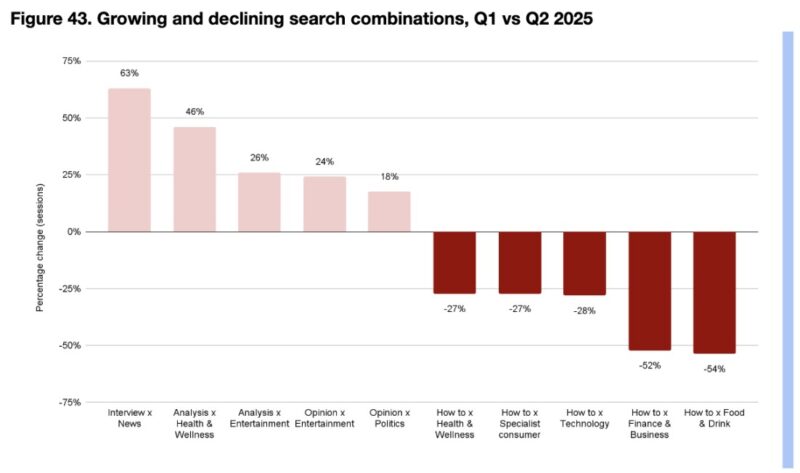
By overlaying content type with topic, we could identify the most acute areas of referral growth and decline. News interviews and health & wellness analysis returned quarterly increases of 63% and 46% in sessions prompted by Google search referrals, while finance & business and food & drink how-tos declined by 52% and 54%.
Of course, it’s not at all trivial for publishers to pivot their output to satisfy the algorithm. The vast majority of sessions (which accounted for more traffic than all others combined) were reportage content, which saw a 4% reduction in referral traffic. However, it would be worth considering how reportage can be injected with more of a human touch to make it more resilient to AI substitution.
The impacts of referral declines on publisher revenues are also not evenly distributed. Properties primarily funded through high-volume programmatic advertising are most reliant on transient search traffic, while those with more reader-funded revenue models will be more resilient.
As this study’s participants were from the premium end of the industry, it isn’t representative of the long tail of smaller publishers who are more likely to be reliant on programmatic advertising, and thus less capable of absorbing shocks through other revenue streams.
Regardless of size, publishers must avoid the trap of expanding URL output in affected areas to defend their traffic levels, resulting in weakening views-per-page. Doubling down on declining content only accelerates losses, and publishers can no longer rely on traffic volume driven by audiences seeking basic information retrieval.
Email pged@pressgazette.co.uk to point out mistakes, provide story tips or send in a letter for publication on our "Letters Page" blog
