


Social and video platforms are now a bigger source of news consumption globally than TV or news websites/apps, according the 2026 Reuters Digital News Report on publishing trends.
The report also found that the use of AI chatbots for news has not changed in the UK and US over the past year, although usage has grown from 7% globally to 10%.
Trust in news is at a record low since the Digital News Report began its surveys in 2015, while interest in news has fallen notably in five years – especially in the UK.
The Digital News Report is based on online surveys carried out in January and February based on nationally representative quotas for age, gender, totalling nearly 100,000 people across 48 markets.
Press Gazette has broken out the key findings for news publishers to know about this year.
Social and video platforms overtake publishers as go-to news source
At a global level, social media and video platforms including Facebook, Youtube, Tiktok, Instagram and X have overtaken publishers as a news source for the first time.
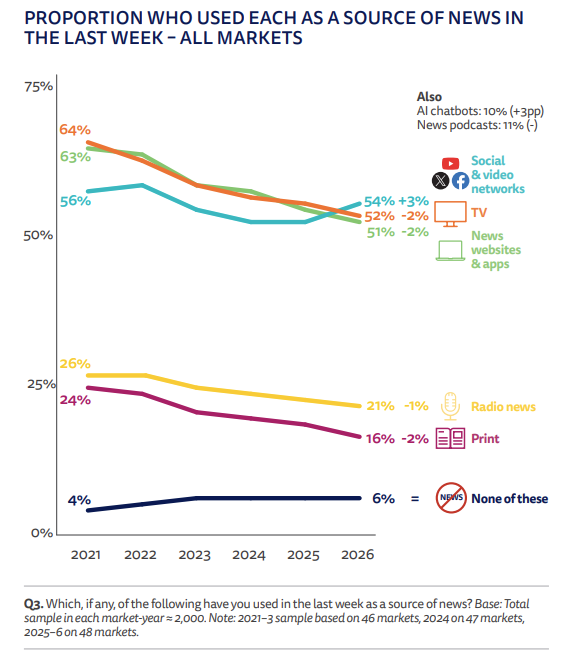
Usage of these platforms has remained stable as usage of TV and news websites/apps has fallen.
Across the 48 markets measured by the Reuters Institute, social and video platforms were used by 54% of respondents to access news (up three percentage points in a year), rising to 56% if AI chatbots are also included.
This includess content from established news organisations shared on social platforms.
Some 52% (down 2pp) of people said they now get news from TV and 51% (down 2pp) said they use news websites and apps directly. Five years ago, in 2021, these news sources were on 64% and 63% respectively with social and video networks on 56%.
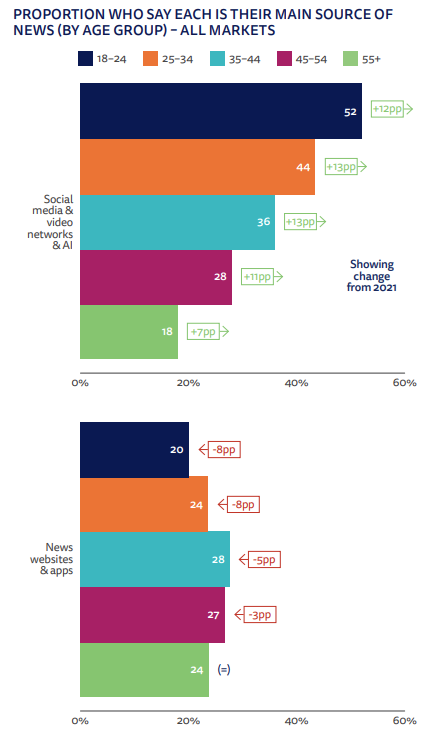
The report noted: “This shifting composition of news consumption is happening among all age groups.”
Consumption of video on news publisher websites has fallen by 10 percentage points since 2021 to 23% of people, while those watching news-related videos on social media or video networks has risen to 69% (up 14pp).
Globally, 30% of people said social media and video networks are their main source of news, up from 22% five years ago. This was higher among young people – 52% of those aged 18 to 24 said the platforms or AI chatbots were their main way of getting news followed by 44% of those aged 25 to 34.
The proportion of people getting their news only from platforms has risen from 6% to 12%.
The report noted: “Looking back over the five years since the peak of the pandemic the trend is very clear. Whatever growth is left in online as a preferred way of getting news is almost all to third-party sources – social media and video networks and AI chatbots.”
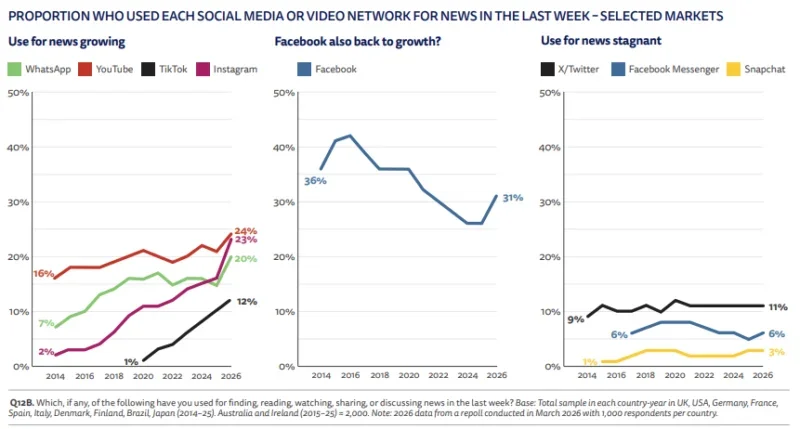
Looking at the individual platforms, Tiktok has seen the biggest growth in the past five years, up 22 percentage points to 37% of people in 47 markets saying they used it for any purpose (not just for news). Some 12% in selected major news markets said they use Tiktok for news, up from 1% in 2020. Usage by 18 to 24-year-olds for news has risen from 32% to 42% in the past year.
Instagram saw the second-biggest rise (up 11pp to 53% using it for any purpose) and it is used by 23% of people for news.
X/Twitter saw the biggest fall in overall use (down 7pp to 17%) while its use for news has remained steady on 11%.
Youtube is now the most-used social/video platform overall (69%) and the second-biggest for news (24%).
Facebook was the second-biggest for overall use (67%) and remains the biggest social media platform for news having returned to growth after an algorithm change last year made publisher content more prominent.
Use of AI chatbots for news not rising in UK and US
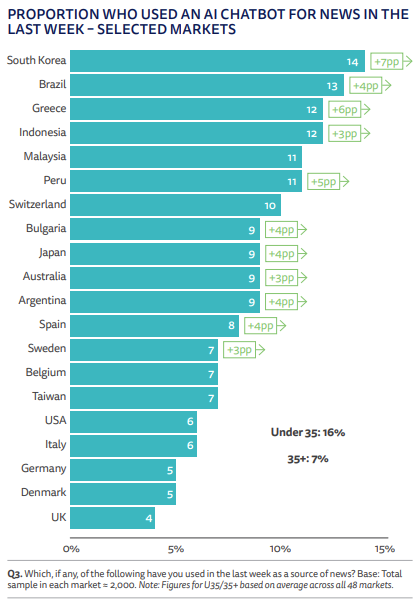
Globally, weekly use of AI chatbots like ChatGPT, Perplexity and Google Gemini for news has increased from 7% in 2025 to 10% (and 16% for under 35s versus 7% for 35 and overs).
In some countries usage for news doubled from a small base, for example in Greece rising to 12% and South Korea to 14%.
But in the UK usage of AI chatbots to access news content remained on just 4%. In the US usage stayed on 6%.
The report suggested that low usage may be at least in part due to low levels of trust.
A fifth of people globally said they trust answers from AI chatbots, compared to 37% who trust the news generally. But in the UK just 6% said they trust AI answers.
Usage also “follows the pattern of platformisation” that has been going on, the report said.
“In general, the adoption of AI chatbots for news is higher in countries where search, social, aggregator and video platform adoption is relatively high, and lower in countries where direct access remains popular.”
Some 42% of people who use AI chatbots for news claimed they always or often click through from the answers to the original sources. This is highest in South Korea (56%) and much lower in Denmark (26%).
Using AI answers for news is most popular among 18 to 24-year-olds (17% globally) followed by 15% of 25 to 34-year-olds.
Engaging in this new habit for getting news was highest among the most intensive news consumers (18%) versus those who access news just once a day (7%).
The most popular way of using AI for news was asking a follow-up question about a news story (42% of users) followed by asking it to give the latest news (35%), asking it to summarise a news story (34%), and asking it to find or evaluate a news source (33%).
Interest in news in UK plummets in five years
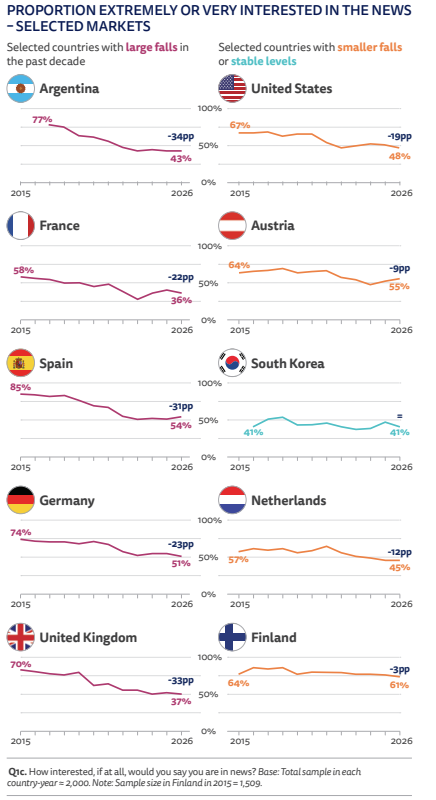
The proportion of people who say they are extremely or very interested in the news has dropped by 13 percentage points globally in the past five years, from 59% to just under 46%.
The UK saw one of the highest rates of interest falling off, down by 33 percentage points from 70% in 2015 to 37% today.
The US had a smaller but still notable drop from 67% to 48%.
These declines could partly explain the drift from TV and online news websites/apps towards third-party sources, the report noted.
Reuters Institute segments people into “news lovers”, “daily briefers” and “casual users” based on their news habits. Since 2021 the proportion of “news lovers” has fallen from 29% to 22% while “casual users” have increased from 16% to 25% of survey respondents.
Alongside falling interest in news is rising news avoidance. In 2017, 29% of people globally said they often or sometimes avoid the news and this has now risen to 42% – although this was flat year on year.
The proportion who sometimes or often avoid the news was up 4pp in the UK to 50% while in the US it rose by 3pp to 45%.
Trust in news continues to fall
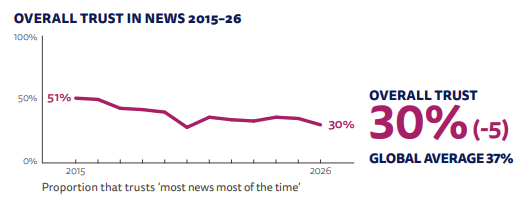
Meanwhile, trust in news was at a global record low since the Digital News Report began its surveys in 2015.
Trust in news was at 37% globally (people saying they trust ‘most of the news most of the time’), down from 40% where it had sat for three years.
Trust dropped by 5 percentage points in both the UK (to 30%) and US (to 25%) this year.
The two highest drops out of the 48 markets surveyed were the Philippines (down 10pp) and Ireland (down 9pp).
In several European countries, including the UK, immigration was seen as the worst-covered major story. In the UK immigration had a net satisfaction score of -37 (the percentage point difference between the proportion who think the news media is doing a good job versus a bad job) while climate was on -19, the Middle East was on -17, inflation was on -4 and Trump was on -6.
Brits think the UK news media is doing a good job at covering Ukraine, however, with a net satisfaction score of +8.
News creators ‘not cannibalising publisher attention’
Globally, 27% of people said they had encountered news content from news influencers or creators in the past week.
This varies hugely by country, with the UK comparatively low (18%) compared to the US (32%) or Thailand (47%).
But the Reuters Institute said the data it compiled did not appear to show that news creators were taking attention away from legacy newsbrands.
“Most people who are getting news from creators are doing so in a way that is complementary to their existing news habits,” it said.
Just 3% of people globally say they have all their news needs met by news-focused creators. In the UK that figure is 6% (the US is higher at 15%). The report added that “in practice these individuals might still be consuming other news sources”.
Paying for online news stagnates but growth in Ireland
The proportion of people paying for any online news across 20 richer countries has stagnated: last year it was on 18% and it is now 17%.
The report said there appears to be a ceiling of 10% to 20% in most markets (although Norway on 40% and Sweden on 32% are outliers.
The UK remained level with 10% of people paying for online news while the US dropped by four percentage points in a year to 16%.
“This stagnation of reader revenue growth in part will reflect the long-term decline in the use of owned news sites and apps, which have lost 12pp of reach since 2021, shrinking the top of the subscription funnel,” the report noted.
“With fewer new visitors coming to sites, publishers are increasingly focused on retaining existing subscribers and ARPU (average revenue per user) optimisation in exploring innovative new ways – such as bundling – of attracting new subscribers.”
Ireland, where all four major quality newspapers have adopted paywalls over the past decade, is one of just two countries outside the Nordics where more than 20% of people are paying for online news. Ireland is on 22% following growth of 10pp since 2020, while Australia is on 23% (up 9pp).
Access the full Reuters Institute Digital News Report for 2026.
Email pged@pressgazette.co.uk to point out mistakes, provide story tips or send in a letter for publication on our "Letters Page" blog
