

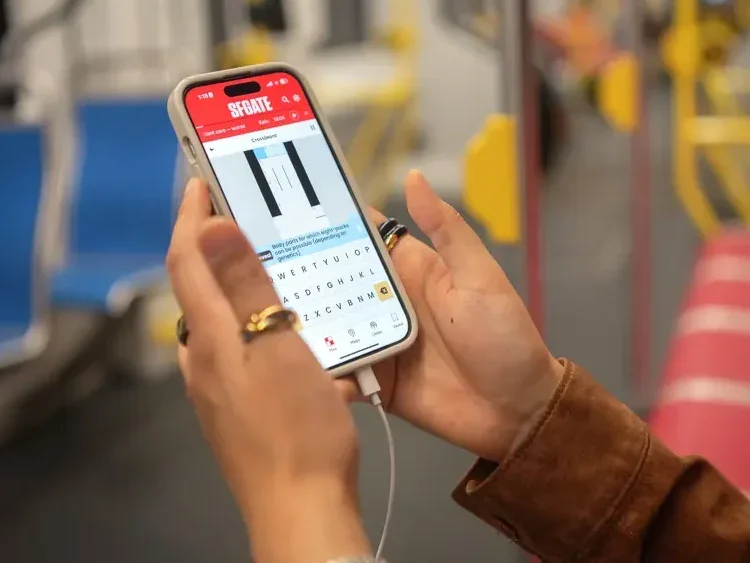
Hearst’s California news website SFGate has introduced a paid reader model for the first time with the launch of a paywalled ad-free app.
Headline website traffic has fallen sharply in recent years in the face of Google changes, but the site is said to have a particularly strong audience of returning visitors.
The San Francisco-based website will remain completely free to read but the app, which launched on 16 July, costs $4.99 per month (with a seven-day free trial) under “Friends of SFGate” branding.
As well as access to ad-free articles, other perks of the app include interactive maps, story bookmarking, the ability to listen to the day’s top stories, and streaks and leaderboards for the title’s California mini crossword.
Editor-in-chief Grant Marek told Press Gazette: “The early returns on it are sort of what we expected they would be: that people who are visiting the app are reading six stories every time they visit, which is crazy… so it’s really our deepest, most loyal readers.”
SFGate is the most profitable paywalled or free news title run by Hearst and, Marek said, has the largest number of readers who return at least six times a month.
This meant there was an opportunity to give those loyal return visitors a “cleaner experience” with a paid app, he said.
“I think a lot of the journalism industry is really shifting right now away from maybe bulk visits and toward deeper relationships with readers. I think everyone probably wants someone to visit more often than to get everyone to visit once. So this is really trying to encourage that behaviour.”
But he said SFGate wants to continue making its work widely available via its website: “For us, we find free journalism to be hugely important in this moment. An informed electorate is something that we badly need.”
SFGate has 60 journalists across 23 cities and five states, of whom 30 are in San Francisco itself.
The brand is the first of Hearst’s free news websites to launch a paid offering.
It launched in 1994 and was originally the online home of the San Francisco Chronicle until the latter brand launched its own paywalled website in 2013.
SFGate remained free, initially as part of the same newsroom before separating completely in 2019. It has expanded to cover all of California and a large part of the American West, while the Chronicle remains intensely focused on San Francisco and the Bay Area.
The same split model of a free and a paid newsroom can be seen elsewhere within Hearst Newspapers, for example at the San Antonio Express-News and MySA, or the Houston Chronicle and the Chron.
SFGate had 18.5 million visits in the US in July, down 29% compared to the same month last year.
Marek said the growth of Google’s AI Overviews and other AI answer engines “definitely has had an impact”.
As a result, he said, SFGate has “leaned away from certain story types that we think are easily summarisable, and it has pushed us to do deeper, harder journalism”.
He said they decided “not to bend over backwards” to try and please the tech giants, noting that the likes of Google, Facebook and Instagram want to keep people on their own properties.
Instead, he said the solution is to “just deepen your relationship with your readers. Get them to come more often. Have the goods on stories that they’re like ‘man, this was great. I want to keep coming back and reading more of this stuff.'”
Last year most of SFGate’s search traffic was coming from Google Discover, the aggregation app that has changed its algorithm to promote Youtube, X posts and AI-written summaries of the news.
Marek said he remains “cautiously optimistic” despite the “hostile” approach from tech platforms.
“I’m very excited about it. I feel like a lot of the changes that are happening are bad and suck, but in another sense, they’re really wonderful because they’re pushing us to find new ways to tell our stories, which I think is great.
“Every day, we’re sitting down in a room and saying ‘is this going to get someone to want to come back, or is this just the same thing they can find anywhere on the internet?’ So, it’s fun.”
Making the app ad-free is “about giving readers more options,” he added. “We’re not telling everyone ‘you have to pay this to read our journalism’. We’re saying ‘if you come a lot and you are annoyed by the ads, we’re giving you an opportunity to get rid of them’.”
Games and puzzles are also important to encouraging people to come back, Marek said, explaining there is a “really active” userbase spending time with the California mini crossword, which requires knowledge of the state for some of its clues, every day.
“An app allows us to add streaks, and we’re doing a leaderboard, so you’ll be able to see where you finish compared to people on our staff, which I think will be really fun. Again, it’s trying to keep building those deeper relationships with readers.”
The next part of the strategy will be new events like the first SFGate pop-up newsroom event, which is planned for 18 September on the JFK Promenade in San Francisco’s Golden Gate Park.
Marek said about ten to 12 SFGate journalists will be there to “give more people an opportunity to talk to a journalist, and build those connections with actual humans”.
He cited a recent Pew Research Center survey that found less than a quarter (23%) of US adults have ever spoken to or been interviewed by a journalist, saying that figure “should be far more”.
SFGate is also planning to start a series of live events in some of its markets beyond the Bay Area, such as Lake Tahoe and the Central Coast.
Marek said they will partner with other local outlets to host events where audiences can “listen to someone tell a story very dynamically” and hear “behind the scenes of what it’s like to be a journalist”. Friends of SFGate will get early access to the planned events.
Email pged@pressgazette.co.uk to point out mistakes, provide story tips or send in a letter for publication on our "Letters Page" blog
