

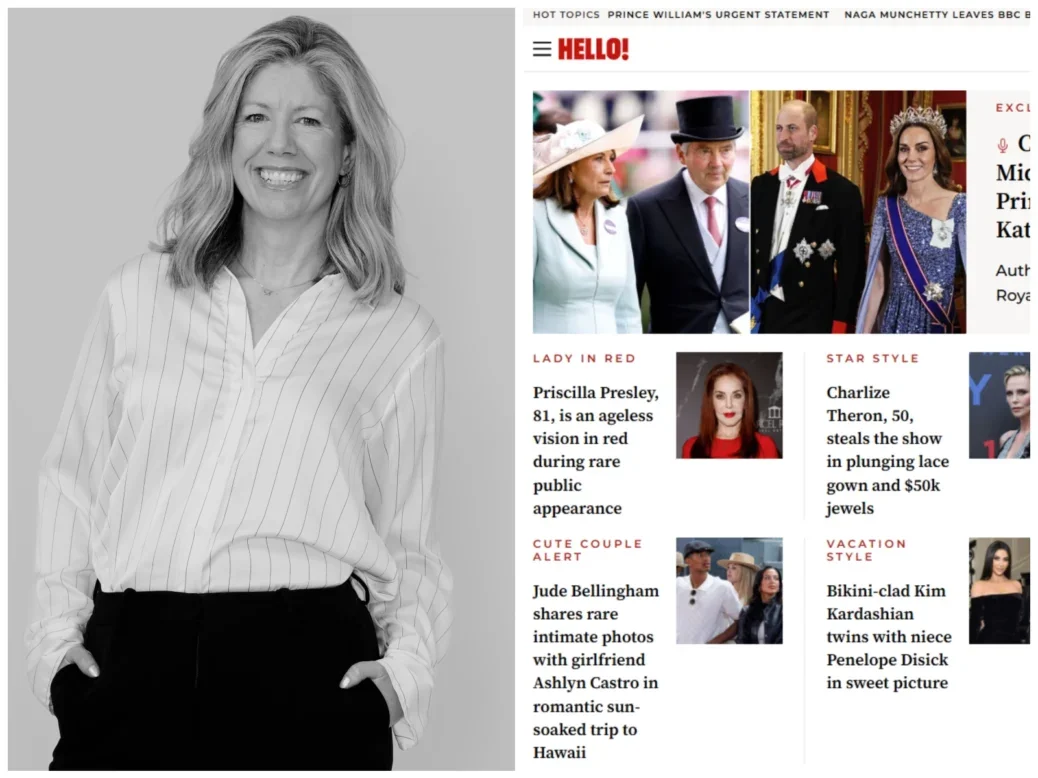
Celebrity and royal magazine brand Hello! has “plugged the gap” from lost advertising revenue from Google Discover page views by boosting content syndication.
Advertising revenue share from platforms like Apple News, MSN, Yahoo and Newsbreak is seen as a bridge while Hello! builds up its first digital paid membership offering, chief content officer Sophie Vokes-Dudgeon told the Press Gazette podcast.
She described a “year of transformation” for Hello! following a massive hit to its Google Discover traffic that began in August 2025 and saw website audience fall 24% (to 4.7 million) compared to the month before.
Vokes-Dudgeon said Hello! had been “riding a Google wave” and that Discover in particular had helped it reach a peak audience of about 40 million unique visitors globally per month.
She said Hello! had seen Google fluctuations in the past, notably following a major website relaunch in 2023, but that it was the Discover algorithm change towards promoting social media posts, Youtube videos and “locally-relevant” content last year that proved the “biggest requirement for a pivot”.
Hello! did maintain Google search traffic despite the hit to clickthroughs from AI Overviews because, Vokes-Dudgeon said, its content is “predominantly news, less evergreen”.
The Hello! editorial staff of about 35 people is now “streamlining” what they write about to ensure stories fit their brand identity rather than chase clicks.
For example, Vokes-Dudgeon said, they once started writing lots of gardening stories because they were doing well on Google Discover “but that doesn’t make sense for Hello!”.
She said: “Previously, page views was the king and that is not what we’re focused on these days. We do have targets for each of these different platforms, but because the future of our business is community and is building Hello!’s community, we are really now very, very specific about a story idea. Does that feel like a story that someone who was coming to Hello! would want? Does it make sense for our audience?”
‘Google was profitable, but building community took second place’
Vokes-Dudgeon, who has been at Hello! for ten years and in her current role since 2023, added that they “don’t regret having lent in, as they say, so heavily to Google because it was very profitable for us. It was a good result. But it did mean that things like building up our own communities, building up our own newsletters, had taken a bit of a second place to traffic.
“So this is without doubt where we want to move to as a brand, having control of our own community, having a community that comes to us on a daily basis, that comes to events when we throw them, that sort of thing. But the reality is that takes time to build.”
Hello! was a launch partner for the paid subscription service Apple News+ in the UK in 2019 and said it was a “very strong revenue stream”.
Hello! magazine is available behind the Apple News paywall, while its daily feed of stories goes onto the free version.
She said Hello! had syndicated content to MSN and Yahoo for around a decade but they “just hadn’t paid any real attention – they were getting our content, but we weren’t packaging it in any particular way”.
MSN and Yahoo share advertising revenue with publishers and sell programmatic ads at a premium because of their huge signed-in audiences.
In the past year Hello! started using a data dashboard from data analytics company Maro that combines page view reports from all the various platforms and the website itself.
“It sounds very simple, but was very clever and actually proving difficult for us to do internally with the limited data resources,” Vokes-Dudgeon said.
She added that this means Hello! can now much more easily see if a piece of content works on one or more platforms, or was not worth doing because it did not meet the target on any of them.
They set their own targets for what constitutes success or failure for a story and this is translated into a traffic-light system to show the data.
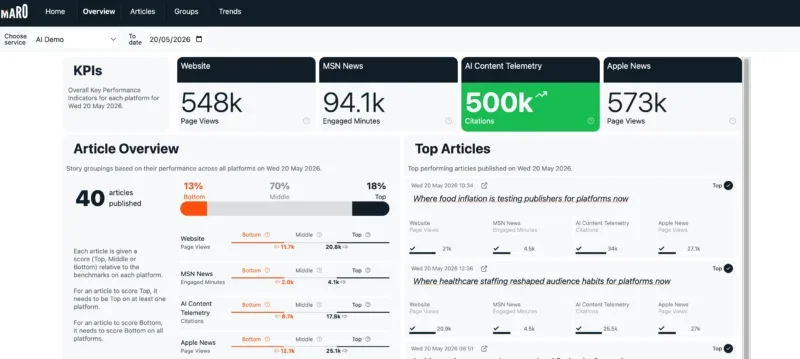
Seeing this data, Vokes-Dudgeon said, means Hello! could stop doing the stories that did not meet the mark.
Producing more of what works, and less of what doesn’t
“As a small business without masses of opportunity for external funding or anything like that, if we want to pivot how we do things, we need to do that with the resource that we’ve got.”
Hello! is owned by Spanish publisher Groupo Hola, where Hola! was first created in 1944 before its UK version was created in 1988.
“So that means we have to write fewer of the stories we were writing in order to free people up to produce the content that’s hopefully going to lead to building a community, and allow people time to do social media and do some more marketing and that sort of thing. So identifying what we could stop was key, but it was very hard to see what that was.”
Hello! has now increased the proportion of its content scored in the top-performance bracket by 12% and reduced its worst-performing stories by 11%.
This data dashboard, Vokes-Dudgeon said, was combined with Hello!’s own calculations relating to the “hugely varied” return on investment per page view for the various platforms.
“I know that, for example, the ROI on a page view from Apple is about 15 times less than we would get on our own website.
“So that makes sense as to why we’ve never really used it as a focus for what drives the stories that we’re writing or whether or not, let’s say Apple loves royal stories, but our homepage didn’t, we weren’t using it like that.
“But then actually the truth is that the audiences that are available on some of these platforms are so vast that even though an individual page view is worth very much less, the quantity that they can serve you can be very much higher.”
Headlines and pictures optimised for each syndication platform
For Hello!, Vokes-Dudgeon said, Apple, MSN, Yahoo and Newsbreak are the best syndication partners in terms of bringing in revenue.
She noted: “The ROI from a page view on Newsbreak is substantially higher than that of a page view on Apple, but then the volume of page views on Apple is much higher.”
The changes have resulted in a growth in page views of between 33% and 102% across the aggregators.
Hello! is now optimising more specifically for headlines and pictures on each platform.
It is also adapting certain content types that do well if they also match the Hello! brand. For example, Vokes-Dudgeon cited retro content that “really hit” on one platform which led them to decide it was worth doing more of it in a way that fitted in with their usual coverage areas.
Conversely, at one stage the title was writing up the “best buys on Amazon for Google, because that worked very well, but that doesn’t feel really like a Hello! piece of content”.
Vokes-Dudgeon said that the original aim was to increase syndication revenues by 10-15% but that they have “seen significantly bigger revenue increases” than that, meaning they have “pretty much plugged that gap” from the Google decline.
Hello! also now has a bigger total audience reach with its content than it did when it was mostly reliant on Google.
“It’s not all on our own platform, but it is appearing in front of more people’s eyeballs than it was before. You don’t earn as much money with syndication as you do with your own owned and operated, but it is pretty much making up that gap that we saw.”
The syndication success has enabled Hello! to move resources into starting to create content that will help it build a direct paying audience.
As a result minutes spent with Hello! content on its website in the UK were up by 46% in June compared to August last year when the Google Discover hit happened.
Online subscriptions
Hello! VIP soft-launched several months ago and currently offers digital access to the weekly magazine, the magazine archive, special editions and on-demand video access to live events for £4.25 per month.
Vokes-Dudgeon said access to the magazine was especially popular in the US where readers would not otherwise be able to get it.
But she said the main goal initially has been to get people signed up to the free community. Sharing an email address gets them newsletters, full commenting access, Q&As, a Whatsapp community, and a free daily puzzle.
Hello! now has about one million people registered for free.
Now it will be a process, Vokes-Dudgeon said, of “just practicing and trying and seeing what people will pay for”.
She said they have found opinion content “really strong. I read that a lot about political opinions, political journalists. But I didn’t know whether that would work for us, but it really does.
“And that is quite a pivot for us because I think previously we’ve always had this opinion that our audience is intelligent enough to draw their own conclusions. We just present the stories and we don’t comment in that way, and so the writers were not used to doing it either. But actually we have discovered that that is very popular. And perhaps because of our unique tone of voice, people know they’re not going to be reading anything that’s super negative.”
Vokes-Dudgeon said the VIP offering has “gone better than I hoped that it would” so far. In particular conversion to paid once people have signed up for free is “very strong… that’s good news for the future”.
Hello! was unsure if people would pay to attend events like live podcast recordings, Vokes-Dudgeon said, but then 70 people paid £75 each to watch The Right Royal Podcast live in London.
“So then bit by bit, we are going to figure out how to scale and how to make these meaningful revenue lines.”
Vokes-Dudgeon added: “We call it our year of transformation because it is, and pivoting and transformation is never easy. I don’t want to make out like I’m pretending that it is, because it’s not easy to make these changes and we have to keep one side going while we build the other. But we are really encouraged by the green shoots that we see of the community building that’s happening.
“And it is also really fun. Holding live events and meeting people that consume your content is much more fun than just churning out 40 stories on Prince Harry’s Spare book. So we’re feeling positive about it and just trying to stick to the plan and hoping that in years to come, we will continue going in that direction that we’re seeing at the moment.”
Email pged@pressgazette.co.uk to point out mistakes, provide story tips or send in a letter for publication on our "Letters Page" blog
