

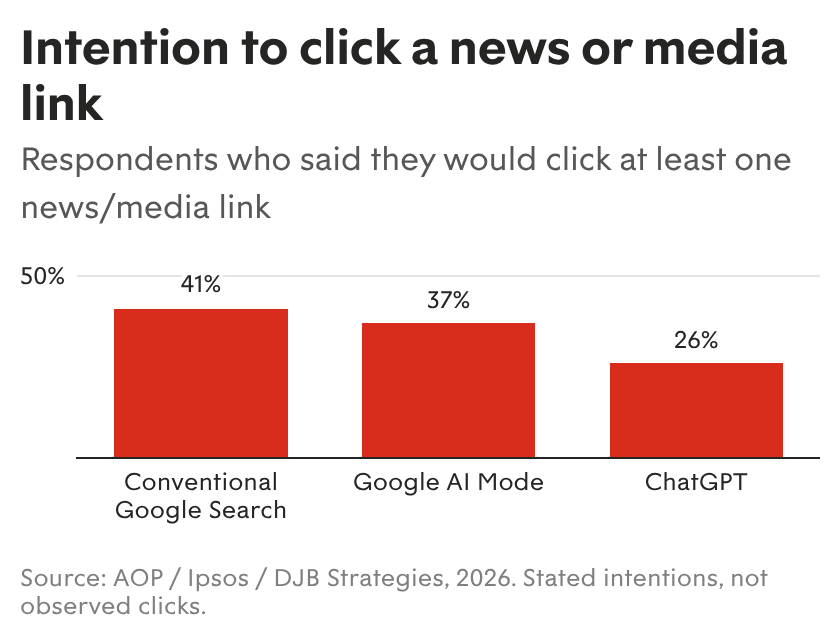
People remain far more likely to click on at least one news link from Google’s AI Mode experience than they are from ChatGPT, according to a new study.
While AI Mode continues to send a meaningful proportion of traffic to publishers, they must use this time to lessen their reliance on Google.
A new report from DJB Strategies, From Search Risk to Agentic Risk, looks at how the disruption from AI to journalism businesses will play out over the next three years.
Central to this is the contest between two distinct models of search. Google’s AI search products retain a (substantially degraded) version of the historic value exchange in which publishers provide content and receive traffic.
Conversely, competitors such as ChatGPT are optimised solely around satisfying users’ needs within their own applications, with very little traffic returned to publishers. Google’s model may buy publishers more time to adapt.
The task for publishers is to use it to build businesses less dependent on the search giant – or indeed, its competitors.
Working with Ipsos, earlier this year DJB Strategies conducted a study into AI search behaviours for the AOP.
It found that for the most important search intents for UK publishers, when presented with Google’s AI Mode, 37% of consumers said they would click on at least one news or media link.
For ChatGPT, the figure was 26%. These compare with 41% for conventional Google search without an AI summary at the top. These results show what is at stake for journalism in the contest between two models of online information retrieval.
Whilst Google increasingly uses publisher content to answer queries within the need for users to leave its own products, even AI Mode continues to send a meaningful proportion of users on to publishers’ websites.
The AOP findings suggest that people’s willingness to click through varies considerably by what they are looking for, with people from ChatGPT most likely to want to dig deeper into image galleries and those on Google’s AI Mode wanting more about politics and celebrity news direct from publishers.
This referral traffic is not an act of goodwill; Google has little choice. The search giant has built its core business on a model in which publishers allow it to crawl their websites, without payment, in return for traffic.
This free-but-permissioned approach means maintaining a value exchange of sorts is critical. The alternative is publishers withdrawing their content or moving to widespread paid licensing for AI search – a precedent Google has always been determined to resist.
ChatGPT, on the other hand, is closer to a fully intermediated model in which discovery and consumption take place almost exclusively within the application. It does not generally secure publisher consent prior to using content and therefore does not need to deliver traffic back to secure ongoing access.
Its primary concern is instead creating a consumer product that satisfies as many users, in situ within the application as possible. Its need is to compete with Google on user experience, not to maintain a traffic-based value exchange with publishers.
In the short term, publishers therefore have reason to prefer Google’s model. More information retrieval taking place through an interface that still sends users to source websites preserves more opportunities to sell advertising, acquire subscribers and build direct relationships. The AOP findings suggest the difference could be significant.
The way Google maintains this exchange can itself work against publishers, though. Earlier this year the UK’s Competition and Markets Authority (CMA) imposed new rules on Google, requiring effective controls over AI use without penalising publishers in conventional search.
Google’s response has been to bundle AI Overviews, AI Mode and Google Discover’s generative features into a single AI opt-out, whilst expanding summaries aggressively across Discover.
The commercial logic is to route as many Discover clicks as possible through AI, bolstering the traffic return attached to those features and making it more costly for publishers to withhold content from AI search.
This is, in effect, Google using Discover to protect Search. Discover is commercially insignificant to Google, but its traffic matters enormously to publishers: Chartbeat’s latest figures show Google Discover delivering more than twice as much traffic to its publisher network as conventional Google Search.
That imbalance gives Google room to degrade the feed if doing so helps preserve the unpaid content access it needs to compete with OpenAI.
The longer-term danger is that Google wins this fight and then steadily reduces what it returns to publishers. It would have a commercial incentive to keep more engagement and monetisation within its own products, offering only enough traffic to maintain access to content. The greater its dominance, the more scope it would have to act in this way.
This is the direction Search has already taken, through richer results, snippets and now AI answers. If publishers become similarly dependent on Google for AI distribution, they will have fewer alternatives and less power to resist the same gradual deterioration.
Google’s need to keep sending traffic to publishers may buy the industry time to adapt. As the report sets out, AI’s impact varies considerably across content types and audience needs. That should inform where publishers put their editorial resources: destination content that audiences deliberately seek out, distinctive reporting and analysis, and audio and video built around personalities, expertise and experiences that an AI summary cannot readily replace.
The aim is to give people more reasons to come directly, return regularly and pay where the proposition supports it. Newsletters, apps and other direct channels can strengthen those habits, whilst the content itself gives audiences a reason to use them.
Google will likely remain an important source of traffic for years. Publishers should use the time it buys to build businesses that need less of it.
Download the full report From Search Risk to Agentic Risk.
Email pged@pressgazette.co.uk to point out mistakes, provide story tips or send in a letter for publication on our "Letters Page" blog
